What Alabama Just Made Possible
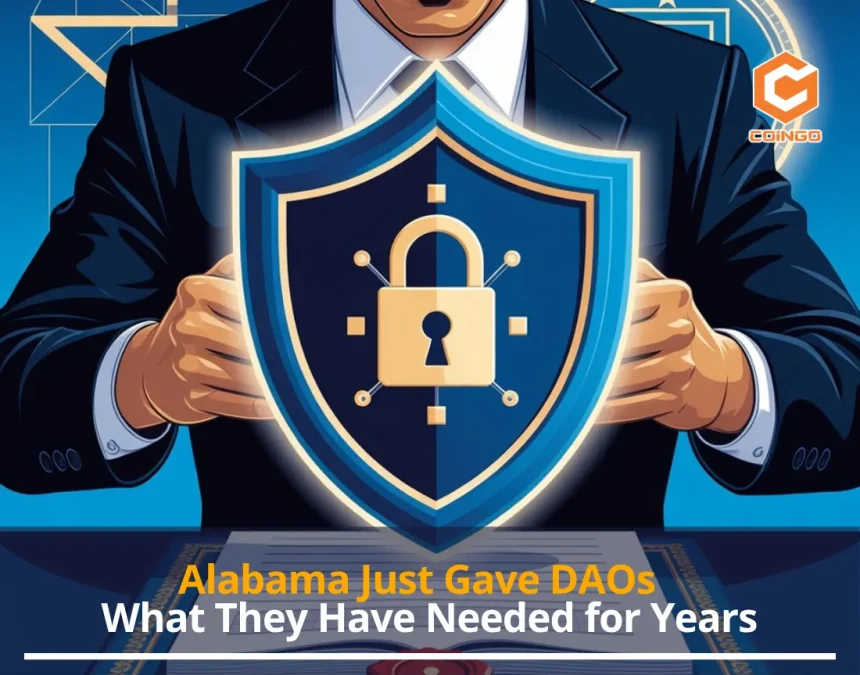
For most of the crypto industry’s existence, decentralized autonomous organizations have occupied an uncomfortable legal gap: real entities with real assets and real participants, but no recognized standing in any court, no ability to enter contracts under their own name, and no shield protecting contributors from personal liability for organizational decisions. Alabama closed a portion of that gap on April 1, 2026, when Governor Kay Ivey signed Senate Bill 277 — the Decentralized Unincorporated Nonprofit Association (DUNA) Act — into law.
The state becomes the second in the United States to grant DAOs legal status, following Wyoming’s 2024 DUNA legislation. The bill passed the Alabama House 82-7 with 16 abstentions on March 17, a margin that reflects broader bipartisan appetite for clearer legal frameworks around decentralized governance — and signals growing momentum as the CLARITY Act works through the U.S. Senate.
Under the new law, a qualifying DAO obtains full legal entity status: it can own property, sue and be sued, and enter into contracts, while individual members and administrators are shielded from personal liability for the organization’s activities. Governance can operate entirely on-chain through smart contracts and token-based voting — a formal legal acknowledgment that blockchain-native decision-making constitutes valid organizational governance.
The Requirements and the Constraints
Not every DAO qualifies. To operate under the DUNA framework, an organization must have at least 100 members joined for a common nonprofit purpose — governing a blockchain protocol or smart contract system being the most direct example. The key constraint is that DUNAs cannot distribute profits to their members. DAOs structured primarily to generate token-holder returns will not find this wrapper useful and will continue to need traditional corporate structures or offshore arrangements.
That restriction makes the Alabama DUNA Act most relevant to protocol governance DAOs, infrastructure communities, and open-source blockchain ecosystems — entities whose primary function is coordination and governance rather than profit extraction. Major protocols like Lido, Uniswap, and Aave, whose DAOs collectively manage billions in treasury assets, fit this profile closely. The law takes effect on October 1, 2026.
Table 2 — Alabama DUNA Act: Key Requirements
| Requirement | Detail |
|---|---|
| Minimum members | 100 members with a shared nonprofit purpose |
| Governance | Fully on-chain via smart contracts and token-based voting |
| Legal powers | Own property, enter contracts, sue and be sued |
| Liability | Individual members and admins shielded from personal liability |
| Profit distribution | Prohibited — DUNA is a nonprofit structure |
| Effective date | October 1, 2026 |
| Passage vote | 82-7 in Alabama House, 16 abstentions (March 17, 2026) |
The Broader State-Level Picture
Wyoming pioneered legal DAO recognition with its DAO LLC law in July 2021 and later passed its own DUNA Act in March 2024. Wyoming’s framework goes further, offering both a DAO LLC (for profit-capable entities) and a DUNA structure (for nonprofit governance), giving builders two distinct legal pathways depending on their organizational design.
West Virginia is close behind: its DUNA Bill (HB 5060), introduced in February, cleared the state House on March 4 and awaits Governor Patrick Morrisey’s signature. Vermont and Tennessee have created pathways for DAOs to register as specialized LLCs, while California recognizes unincorporated nonprofit associations that can provide limited liability without formal state registration.
Table 3 — U.S. State DAO Legal Frameworks (April 2026)
| State | DAO Framework | Year | Structure |
|---|---|---|---|
| Wyoming | DAO LLC + DUNA Act | 2021 / 2024 | For-profit LLC + nonprofit DUNA |
| Alabama | DUNA Act (SB 277) | 2026 | Nonprofit DUNA only |
| West Virginia | DUNA Bill HB 5060 | Pending (2026) | Nonprofit DUNA — awaiting governor signature |
| Vermont & Tennessee | DAO LLC registration | Varies | Profit-capable LLC pathways |
| California | Unincorporated nonprofit association | Varies | Light-touch, no formal DUNA label |
Why This Matters Beyond Alabama
As of 2025, more than 13,000 DAOs operate globally, with collective treasury assets exceeding $24.5 billion according to CoinLaw. The average DAO treasury sits around $1.2 million. Ethereum and its layer-2 networks host over 85% of DAOs by count. Yet most of that capital has moved without formal legal standing — creating liability exposure for contributors, complicating institutional partnerships, and closing off banking relationships that require a recognized legal entity.
Miles Jennings, head of policy and general counsel at a16z Crypto, described the Alabama law as “forward-looking policymaking at its best,” saying it gives decentralized communities “the certainty to build, govern, contract, and scale in the real world.” Jennings noted that decentralized governance is “one of the core constructs in market structure legislation” — pointing to the CLARITY Act as the federal framework that Alabama’s law helps support.
The structural risk that remains: a DAO operating as a DUNA under Alabama law still faces SEC scrutiny if its governance tokens qualify as securities under the Howey Test. State recognition does not resolve federal classification. With the CLARITY Act still pending Senate passage and DAO token classification unresolved, the Alabama legislation provides legal infrastructure — but the federal picture remains the harder constraint for most protocols.
Observers are watching for potential DUNA registrations by major protocols in Q2 2026, and for copycat legislation in Tennessee and New Hampshire. If West Virginia’s governor signs its DUNA bill as expected, three states will have recognized DAOs within a matter of weeks — a pace that suggests the state-level movement is accelerating faster than federal crypto legislation can keep up.