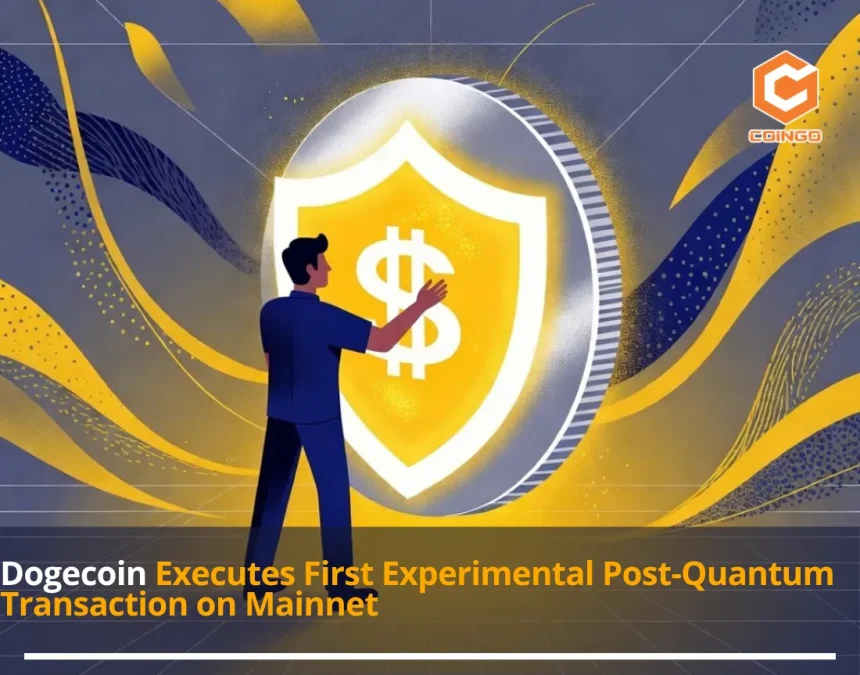
First PQC Transaction on Dogecoin Mainnet, Confirmed
Dogecoin Foundation director Timothy Stebbing announced on April 10, 2026 that Dogecoin Core developer Michin Lumin and the Foundation team have successfully executed an experimental post-quantum secure transaction on the Dogecoin mainnet. Stebbing described it as ongoing experimentation, indicating the milestone is a proof-of-concept rather than a production deployment.
Dogecoin software engineer Ed Tubbs responded publicly to the announcement with a confirmation, describing the achievement in brief but unambiguous terms. The transaction marks a concrete technical step in Dogecoin’s quantum resilience work, moving it beyond the proposal and discussion phase into executed experimentation on a live network.
Why Quantum Resistance Matters for Dogecoin Specifically
The urgency around quantum resilience across the crypto industry accelerated following Google’s quantum computing research update in late March 2026. Google researchers warned that future quantum computers may be capable of breaking some of the cryptographic protections underlying digital assets — including Dogecoin — with fewer computational resources than previously estimated.
In its research, Google categorized major blockchain protocols by their quantum vulnerability profile. Dogecoin falls into a category that includes UTXO-based ledgers — a group where individual users have meaningful ability to reduce their quantum exposure. These protocols allow users to protect their assets using ephemeral public keys hidden behind a cryptographic hash, which shields funds against at-rest attacks where a quantum computer reads and exploits exposed public keys without waiting for a transaction.
The residual vulnerability for UTXO-based chains like Dogecoin is the on-spend attack — a scenario where a quantum attacker intercepts a transaction at the moment a public key is briefly exposed during signing. This attack vector is more technically demanding than at-rest attacks, but not theoretical. The primary behavioral risk that amplifies exposure is address reuse, which leaves public keys permanently visible on-chain even between transactions.
RE-EN and the Longer Roadmap
The mainnet experiment builds on a formal proposal that dates to January 2025, when Dogecoin developers proposed integrating RE-EN (Revolutionary Encryption Network) — a next-generation quantum-resistant encryption system — into Dogecoin’s security infrastructure. RE-EN is designed to protect private keys, secure transaction signing, and future-proof the network against quantum threats while maintaining backward compatibility with the existing blockchain architecture.
The January 2025 discussion on the Dogecoin GitHub repository outlined the motivation clearly: existing cryptographic standards like secp256k1 — the elliptic curve algorithm used by Dogecoin, Bitcoin, and most major UTXO chains — are in principle vulnerable to a sufficiently powerful quantum computer running Shor’s algorithm. Post-quantum cryptography replaces these algorithms with mathematical problems that remain computationally hard even for quantum machines.
What the April 10 mainnet experiment demonstrates is that the Dogecoin development team has moved past theoretical discussion and successfully executed a transaction using a post-quantum cryptographic scheme in a live environment. The word “experimentation” from Stebbing is precise — this is not a network-wide upgrade announcement, and full integration would require a coordinated protocol change with broad community and miner support. But the technical groundwork is now demonstrably in place.