
The 440% Growth: What Actually Happened
Solana entered 2024 with approximately $100,000 in tokenized real-world assets on its network. As of early January 2026, that figure had reached $873.3 million — a record high at the time. By April 2026, it had crossed $1.7 billion. The year-over-year growth in the number of distinct RWA holders reached 440%, driven primarily by the mid-2025 launch of tokenized equity products on the network.
The holder count growth tells the story of a specific product finding a specific audience. In June 2025, Solana launched xStock tokenized equities — fractional shares of publicly traded companies including Tesla and Nvidia, tradeable on-chain with sub-cent fees and near-instant settlement. Retail traders who already understood Solana’s wallet infrastructure found a new way to use it: accessing familiar stocks without a brokerage account, with composability across DeFi protocols.
By January 2026, Solana had 126,236 distinct RWA holders, up 18.4% in a single month. The 30-day growth rate reflected a sustained acceleration, not a spike. By March 7, 2026, the count reached 154,942 — narrowly surpassing Ethereum’s 153,592 for the first time. Solana’s official X account announced the milestone. The news spread widely across crypto social media.
The lead did not hold. Within hours, the counts had reversed. By the week of April 6, 2026, Solana had grown to approximately 179,000 RWA holders against Ethereum’s figure in the same range — with Solana consistently ahead on this metric, though the margin fluctuates with data updates and periodic cleanups across platforms.

Table 1 — Solana vs. Ethereum RWA Market: Key Metrics (April 2026)
| Metric | Solana | Ethereum |
|---|---|---|
| Total RWA value | ~$1.7 billion | ~$15.4 billion |
| RWA holders (Apr 2026) | ~179,000 | ~153,000–175,000 |
| Number of distinct RWA assets | 300+ | 675+ |
| Market share (excl. stablecoins) | ~6% | ~55%+ |
| YoY holder growth (2025–2026) | 440% | Moderate / institutional pace |
| Dominant product type | Tokenized equities, yield-bearing treasuries | Institutional money market funds, treasuries |
| DEX liquidity-to-volume ratio | 0.4 (thin, retail-driven) | 4.57 (deep, institutional) |
| Key institutional anchors | BlackRock BUIDL, Ondo, Western Union | BlackRock, Fidelity, JPMorgan, Franklin Templeton |
What Are Real World Assets (RWA)?
Two Markets, Not One
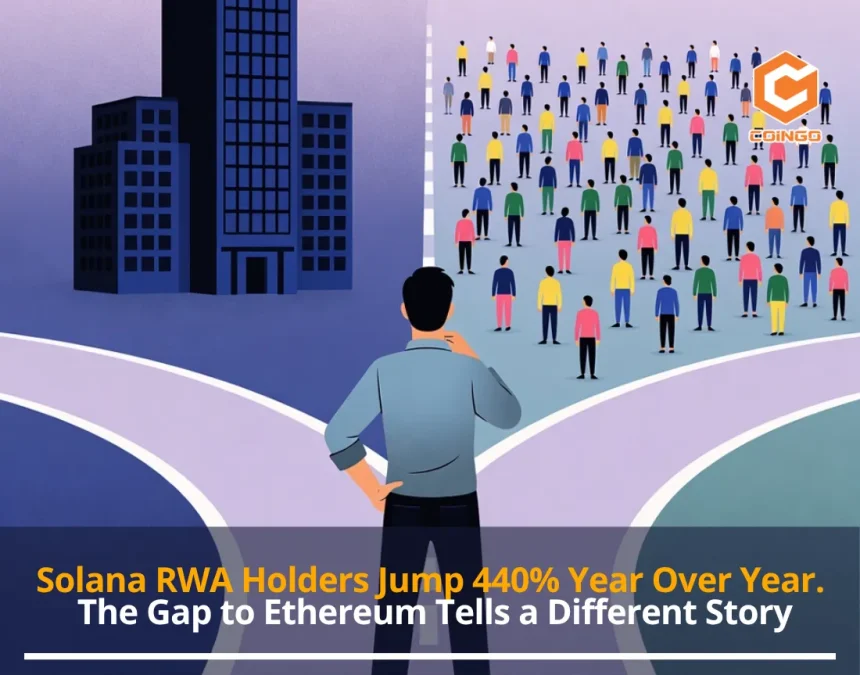
The data from RWA.xyz and the broader market makes a structural argument that is easy to miss in headline comparisons: Solana and Ethereum are not competing for the same RWA market. They are serving two distinct segments of it, and both are growing.
Ethereum’s $15.4 billion in tokenized RWAs is concentrated in a relatively small number of large products built for institutional use. BlackRock’s USD Institutional Digital Liquidity Fund holds $255.4 million on Solana but commands billions more on Ethereum. Franklin Templeton, Fidelity, and JPMorgan have all deployed tokenized products primarily on Ethereum, where regulatory familiarity, institutional-grade tooling, and deep liquidity pools already exist. Ethereum’s 675+ distinct RWA assets versus Solana’s 300+ reflects years of institutional product development on a network that traditional finance already understands.
Solana’s $1.7 billion — growing fast but still less than a seventh of Ethereum’s total — is concentrated in a different product archetype. Tokenized equities like Tesla xStock and NVIDIA xStock are designed to spread across many wallets: they are fractional, accessible with sub-cent fees, and composable with DeFi protocols. A single institutional fund on Ethereum might hold more capital than all of Solana’s tokenized equity products combined while touching only a handful of wallets.
AMBCrypto’s analysis of the data put it directly: “Ethereum hosts fewer holders but significantly larger positions. Solana shows broader participation with smaller average holdings.”
The liquidity depth metric is the clearest expression of this gap. DeFiLlama data shows Solana with a 0.4 liquidity-to-volume ratio — meaning $6.53 billion in TVL supporting $14.96 billion in weekly DEX volume. Ethereum’s equivalent ratio is 4.57. Ethereum has more liquidity relative to the trades being executed. On Solana, smaller transactions execute efficiently, but larger institutional orders encounter thin depth where price impact rises quickly.
What Drove the 440% Growth
Three catalysts explain the pace of Solana’s RWA holder growth in 2025 and into 2026, and they are worth separating because they reflect different types of adoption.
Tokenized equities: The June 2025 launch of xStock products on Solana opened a category that Ethereum had not captured at retail scale. Fractional shares of Tesla, Nvidia, and other high-profile companies are a product type that travel naturally across many wallets because they attract individual traders rather than institutional allocators. In January 2026, Ondo Global Markets expanded to Solana with access to over 200 tokenized U.S. stocks and ETFs, becoming the largest RWA issuer on the chain by asset count at that point. xStocks subsequently launched xChange, an RFQ engine connecting tokenized stock trading to equity market liquidity, and announced institutional access through Talos.
Institutional ETF validation: The SEC approved six spot Solana ETFs in October 2025, attracting approximately $765 million in inflows. ETF approvals brought Solana into the same regulatory conversation as Bitcoin and Ethereum ETFs and provided a familiar on-ramp for traditional finance participants. Bitwise (BSOL) and Fidelity (FSOL) were among the issuers. Morgan Stanley subsequently filed for its own Solana Trust. By early 2026, total Solana ETF assets had surpassed $1 billion.
Western Union’s network effect: Western Union selected Solana to build a stablecoin-based remittance platform for its 150 million customers across more than 200 countries, with 360,000 cash access points. The platform launched in early 2026 under the USDPT stablecoin brand. A remittance platform at that scale represents a structural demand floor for Solana-based financial activity that is fundamentally different from speculative trading volume.
The Institutional Infrastructure Question
The gap in total value — Ethereum’s $15.4 billion versus Solana’s $1.7 billion — ultimately reflects a difference in which institutional actors have built what, and how long they have been building it.
Ethereum’s dominance in institutional RWA is not primarily technical. Solana’s throughput (theoretically 65,000 transactions per second, and with the Firedancer client launched in December 2025 reportedly reaching 600,000 TPS) already exceeds any current institutional demand. The Alpenglow consensus upgrade planned for 2026 is expected to reduce finality to 100–150 milliseconds. The technical case for Solana in high-frequency settlement is strong.
The gap is structural. Ethereum has years of regulatory precedent as the chain on which institutional token products were launched, audited, and accepted by regulators. When BlackRock chose where to deploy BUIDL, or when JPMorgan conducted on-chain commercial paper issuance, they were operating within a compliance framework that had been validated on Ethereum. Replicating that validation on a new chain is not a technical problem — it is a regulatory, legal, and reputational one that takes time.
Galaxy Research has projected Solana’s Internet Capital Markets will reach $2 billion in 2026, up from $750 million. That target was already exceeded by the time the prediction circulated. Anthony Scaramucci of SkyBridge told CNBC in early 2026 that Solana is well-positioned to become a standard for tokenized assets, citing its technical features and cost efficiency. The CLARITY Act, which would provide a federal framework for tokenized digital asset securities, carried approximately 70% odds of passage in 2026 according to Polymarket data in March — a regulatory catalyst that could benefit both chains but may particularly accelerate Solana-based products that have been built in anticipation of it.
What the 440% Means and What It Does Not
A 440% year-over-year increase in RWA holders is a real signal. It reflects genuine product-market fit for tokenized equities among retail participants who already understand Solana’s wallet infrastructure. It reflects a growing institutional footprint, anchored by BlackRock’s BUIDL deployment on the chain and Ondo Finance’s expansion. It reflects a technical and regulatory environment that is becoming increasingly favorable for RWA issuance on non-Ethereum chains.
It does not mean Solana is winning the RWA race. The global distributed RWA market reached $27.68 billion as of April 6, 2026, with 711,000 total holders across all chains. Ethereum holds more than half of that value. Closing a 9x gap in total capital requires not just faster holder growth but the migration of institutional products that are currently built, regulated, and operating on Ethereum’s infrastructure.
“Solana may have won the headcount race, but Ethereum continues to control the vast majority of value in the tokenized asset economy.” — CCN analysis, March 2026
The more useful framing is that Solana has demonstrated, in roughly 18 months, that a high-throughput, low-cost chain can capture the retail layer of the RWA market in a way that Ethereum’s fee structure and institutional orientation have not prioritized. Whether that retail base translates into institutional capital migration — or whether the two chains continue to serve genuinely separate segments of the tokenization market — is the question that the remainder of 2026 will begin to answer.