WLFI Falls 83% From Peak as Token-Backed Borrowing Goes Public
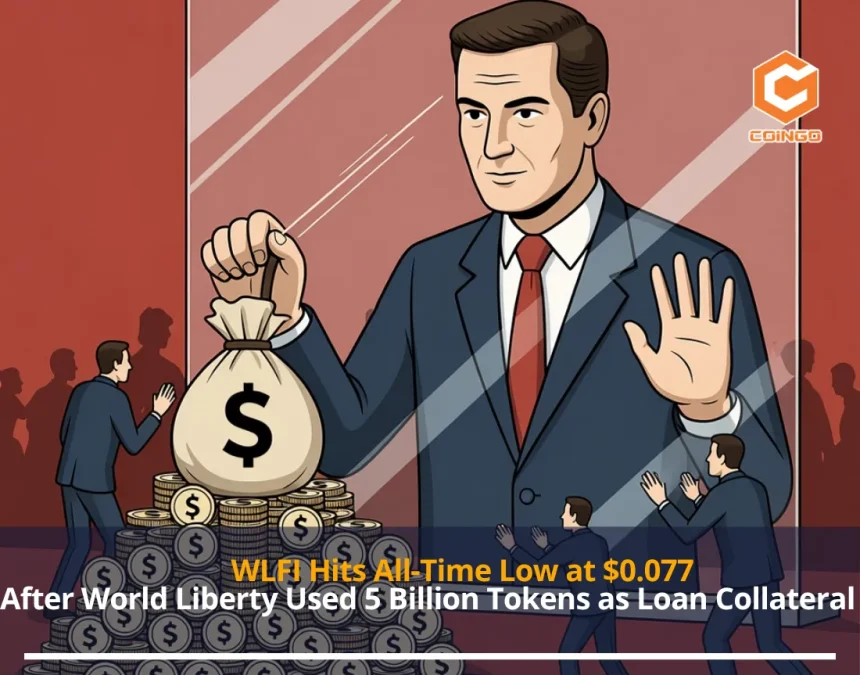
WLFI, the governance token of Donald Trump–backed World Liberty Financial, hit a new all-time low of approximately $0.07714 on Saturday, April 11, 2026. The token is now down 83% from its September 2025 peak of $0.46 and was trading at around $0.07879 at the time of reporting, down 4.66% over the prior 24 hours.
The catalyst for the latest decline was on-chain data revealing that a wallet linked to World Liberty Financial had deposited approximately 5 billion WLFI tokens on Dolomite — a decentralized lending platform co-founded by the project’s own chief technology officer, Corey Caplan — and used those tokens as collateral to borrow $75 million in USD1 and USDC stablecoins. More than $40 million of that was subsequently transferred to Coinbase Prime, according to Arkham Intelligence on-chain data.
Why the Market Reacted: Liquidation Risk and Circular Collateral
The concern among DeFi analysts is structural. WLFI has an FDV of approximately $10 billion but is not a liquid asset — the token has restricted transferability, a small float, and limited secondary market depth. Using it as collateral for a $75 million loan creates a specific risk: if WLFI’s price declines toward the liquidation threshold, Dolomite would need to sell WLFI into an illiquid market to recover the borrowed funds.
The math compounds quickly. One analyst on X framed it directly:
“WLFI has almost a $10 billion FDV, but it is not an extremely liquid asset. So imagine what would happen if 5% of WLFI’s total supply would suddenly need to be sold to liquidate the position.”
A second criticism focused on the circular nature of the arrangement. Dolomite is co-founded by WLFI’s own CTO, meaning the platform accepting WLFI as collateral has a direct interest alignment with the borrower — an arrangement that independent DeFi protocols typically avoid. Another commenter described the setup as:
“The financial equivalent of printing casino chips, borrowing cash against them, and telling everyone else not to panic because the house still believes in the chips.”
Dolomite ranks 19th among DeFi lending platforms by total value locked according to DefiLlama — a relatively small platform absorbing a position of this scale.
World Liberty’s Defense: Yield Generation and No Liquidation Risk
World Liberty Financial acknowledged the activity publicly but pushed back on the risk framing. The project stated that its collateral positions remain well above liquidation thresholds and described itself as an “anchor borrower” for the platform, arguing the strategy serves a productive purpose.
“Everyday users are earning outsized stablecoin yields right now — at a time when traditional markets are offering very little. That’s the whole point.”
The project’s argument is that by borrowing against its WLFI holdings, it is generating stablecoin liquidity that flows into yield products accessible to users. The mechanism is real — DeFi protocols routinely use governance tokens as collateral — but the combination of a project borrowing against its own token on a platform co-founded by its own executive, while retail token holders remain locked out of their holdings 18 months post-sale, has produced a credibility problem that the yield argument has not resolved.
Where This Fits in the Broader WLFI Timeline
The Dolomite loan revelation arrived one day after World Liberty announced a planned governance vote to create a phased unlock schedule for early retail WLFI buyers — the same buyers who paid into a token sale that raised at least $550 million and have been unable to access liquidity since October 2024.
The sequence is significant: the platform’s treasury is actively borrowing $75 million against token holdings while retail participants await a governance vote to determine if and when they can access their own tokens. That asymmetry — institutional flexibility versus retail lock-up — is driving the community backlash more than the mechanics of the loan itself.
WLFI’s current price of approximately $0.079 implies a circulating market cap well below the $550 million raised in the token sale, meaning early buyers are substantially underwater. The all-time low, combined with the ongoing lock-up, the loan disclosure, and the pending governance vote, positions this as the most sustained period of negative sentiment the project has faced since launch.