


Where the Numbers Actually Stand
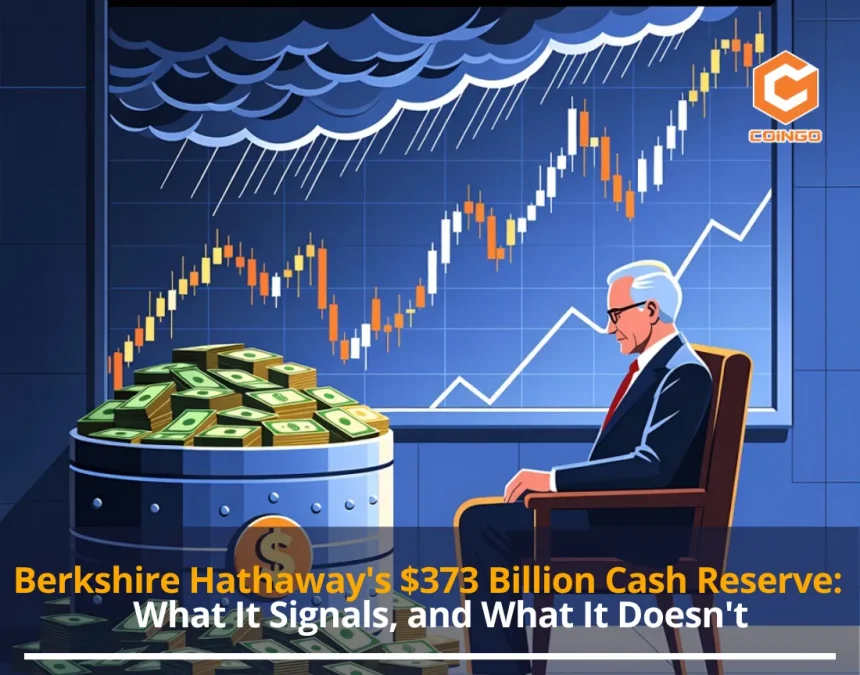
Berkshire Hathaway’s cash reserves reached $373 billion at year-end 2025, a record when excluding the value of Treasury securities purchased but not yet settled. This figure exceeds the market capitalization of 477 of the 500 companies in the S&P 500. The bulk of the position — approximately $314 billion — is held in U.S. Treasury bills, short-term government instruments chosen specifically for their liquidity over yield.
The $300 billion figure cited in recent headlines reflects an earlier filing point in the accumulation. The actual year-end 2025 balance is higher. What matters more than the headline number is the direction and pace: Berkshire was a net seller of stocks for 12 consecutive quarters through Buffett’s retirement at the end of 2025, consistently building this reserve while finding few opportunities that met its investment criteria.
Table 1 — Berkshire Hathaway Portfolio Snapshot (Year-End 2025)
| Item | Value / Detail |
|---|---|
| Total cash and equivalents | $373 billion (year-end 2025) |
| U.S. Treasury bills (within cash) | ~$314 billion |
| Marketable equity portfolio | ~$306–$308 billion |
| Apple stake (largest holding) | ~$57 billion (18.6% of portfolio, down from ~$170B in 2024) |
| Total assets | $1.15 trillion |
| Consecutive quarters as net seller | 12 quarters through end-2025 |
| CEO | Greg Abel (effective January 1, 2026); Buffett remains Chairman |
Why Buffett Sold Apple and Bank of America
The two most significant equity reductions in Berkshire’s recent history were Apple and Bank of America — historically two of its largest and most profitable positions.
On Apple: Buffett originally invested approximately $38 billion in Apple between 2016 and 2023. The stake grew to roughly $170 billion at its peak. Berkshire has since sold approximately 75% of that position, leaving a remaining stake of about $57 billion. Buffett has cited Apple’s forward P/E multiple expanding above 33x as a primary driver — well beyond the valuation metrics Berkshire typically accepts for large positions. Tax efficiency also played a role: with corporate tax rates favorable and Berkshire’s cost basis in Apple extremely low after years of appreciation, realizing gains at current rates was presented as prudent capital management.
On Bank of America: Berkshire originally acquired its stake in 2011. The position generated tens of billions in profits over 14 years. The reduction reflects similar valuation and portfolio concentration logic, not a negative view of the business itself.
The proceeds went into Treasury bills, not into other equities. Buffett described the current environment in his final shareholder letter as exhibiting “casino-like behavior” and “feverish activity” — language that suggests his caution was directed at market-wide valuations rather than any specific company or sector.
What Abel Says About the Cash
Greg Abel, who became President and CEO of Berkshire Hathaway on January 1, 2026, addressed the cash position directly in his first shareholder letter.
“Many times in Berkshire’s history, some observers have suggested that our substantial cash position signals a retreat from investing. It does not.” — Greg Abel, CEO, Berkshire Hathaway, February 2026
Abel pointed to active deal activity as evidence: Berkshire completed a $9.7 billion acquisition of the chemicals business of Occidental Petroleum and reached an agreement to acquire pest control business Bell Laboratories. He stated that share repurchases would remain an important capital allocation option, and confirmed no dividend would be paid as long as the board believed the capital could generate shareholder value internally.
Abel also signaled that Berkshire resumed buybacks under his leadership. An 8-K filed on March 5, 2026 disclosed that approximately $225 million was spent repurchasing Class A shares — the first buyback activity after a 21-month hiatus. Total buybacks since mid-2018 now stand at approximately $78 billion.
What This Means for Markets — and Crypto
Berkshire’s cash accumulation is widely read as a signal that one of the most disciplined capital allocators in modern finance could not find enough attractively priced opportunities to deploy capital at scale. That is a data point about market valuations, not a prediction of any specific outcome.
Historically, Berkshire’s large cash positions have preceded significant market dislocations — the 2008 financial crisis being the most cited example, when Buffett deployed capital aggressively into preferred shares of Goldman Sachs, Bank of America, and General Electric at distressed prices. The logic of building a cash reserve is straightforward: the ability to act quickly when others cannot.
For crypto markets specifically, the significance is indirect. Berkshire does not hold digital assets and Buffett has been consistently critical of Bitcoin. But Berkshire’s defensive positioning reflects the same macro environment that has kept the Crypto Fear and Greed Index at Extreme Fear levels through much of early 2026, compressed altcoin markets, and pushed Bitcoin dominance to near five-year highs. When the world’s largest non-sovereign cash holder is choosing Treasury bills over equities, it signals that the macro backdrop for risk assets broadly remains cautious.
Abel has inherited $373 billion in dry powder and has been explicit that it will be deployed — when the right opportunities emerge. Whether those opportunities arrive through a broader market dislocation, a single large acquisition, or continued buybacks will define the early chapters of Berkshire’s post-Buffett era.