
How to Choose the Best Prediction Market
Why the Choice of Platform Matters More Than the Trade
Selecting the right event to bet on is only half the equation in prediction markets. The other half is the platform that executes, settles, and holds your capital. Two traders who correctly predict the same outcome can walk away with very different returns depending on the fees they paid, the slippage they absorbed, the withdrawal timeline they faced, and the resolution dispute — if any — they had to navigate.
- How to Choose the Best Prediction Market
- Regulatory Standing: The First Filter
- Liquidity: The Most Overlooked Cost
- Fee Structure: The Visible Cost and the Hidden One
- Resolution Criteria and Oracle Quality
- Market Category Coverage and Depth
- Funding, Custody, and Withdrawal
- Data Access and Transparency
- The Regulatory Patchwork: What to Monitor in 2026
- No Platform Is Optimal for Every Use Case
The prediction market sector moved fast between 2024 and 2026. Total trading volume crossed $44 billion in 2025, with at least nine major financial and sports operators launching their own event contract products. That expansion brought more options — but also more variance in quality. Some platforms are easy to access but thin on liquidity. Others list hundreds of markets but struggle to define clear resolution criteria. Understanding what to evaluate before funding an account is the practical starting point.
Regulatory Standing: The First Filter
In the United States, prediction market platforms operate under the jurisdiction of the Commodity Futures Trading Commission (CFTC), which classifies event contracts as financial derivatives rather than gambling products. As of 2026, the CFTC has asserted exclusive federal jurisdiction over these instruments — a position that is still being contested by several state-level regulators, particularly around sports-related contracts.
For a participant, the practical implications of a platform’s regulatory standing are concrete:
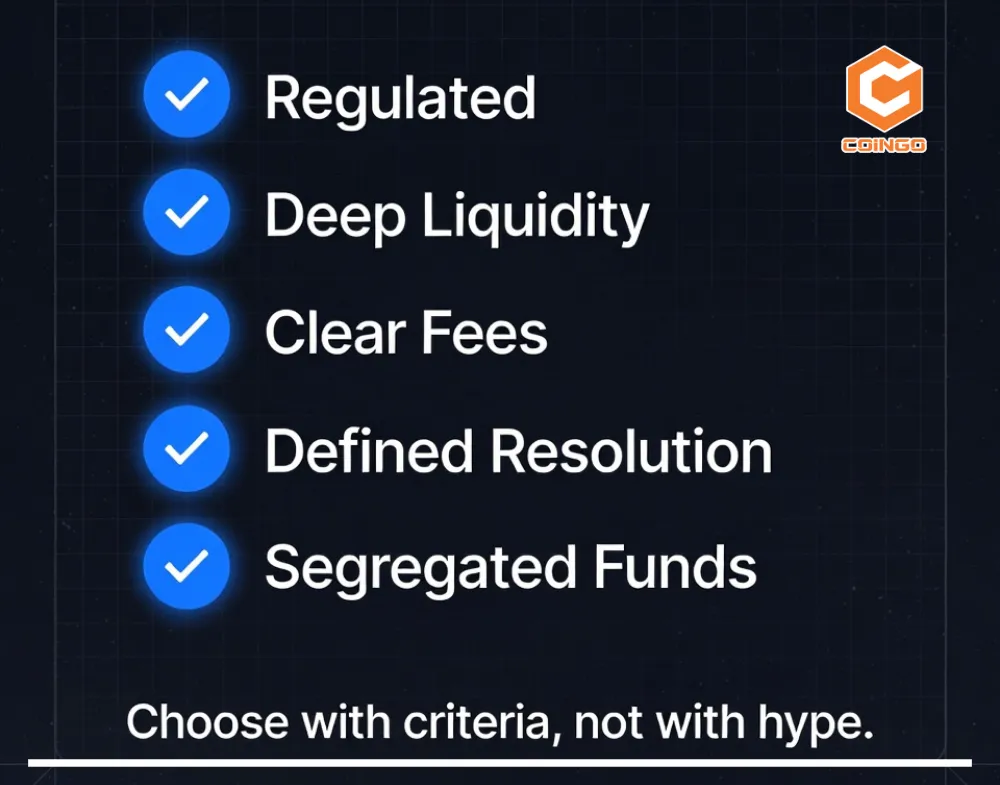
Segregated funds: CFTC-regulated exchanges are required to hold customer deposits separately from operating capital. This matters in the event of a platform insolvency or operational failure — your funds are not commingled with the platform’s own assets.
Dispute resolution: Regulated platforms are required to maintain documented resolution criteria and dispute processes. If a contract settles in a way you believe is inconsistent with the stated rules, there is a defined pathway to challenge that outcome.
Jurisdictional access: Regulation determines where a platform can legally operate. Some states have obtained restraining orders against specific platforms, and regulatory status can shift with little notice. Confirming a platform’s legal status in your jurisdiction before onboarding is not optional — it is the first check.
Decentralized, blockchain-based platforms operate differently. Settlement on these platforms is governed by smart contracts and on-chain oracles rather than a licensed clearinghouse. This reduces custody risk in some respects — funds remain in the participant’s wallet until a trade is executed — but introduces different risks, including smart contract vulnerabilities, bridge failures, and the absence of any formal consumer protection framework.
“Regulated platforms usually win on trust, cleaner banking, and clearer payout flow. Crypto-native platforms often win on speed, market freshness, and API depth — but they ask more from the user.” — CryptoSlate, March 2026
Liquidity: The Most Overlooked Cost
Liquidity is the single most important operational factor for anyone trading prediction markets beyond casual position sizes. It is also the factor most frequently underweighted when evaluating platforms.
A market with deep liquidity allows a participant to enter and exit positions at prices close to the last traded price. A market with thin liquidity forces the participant to absorb slippage — the gap between the price they expected and the price their order actually fills at. On a binary contract priced at $0.70, even a small amount of slippage can materially reduce the expected return on a correctly called outcome.
Several factors determine liquidity quality on a given platform:
Order book depth: The total volume available at each price level. A platform may show a market as “active” based on headline trading volume while the actual depth at any given price point is thin enough to move on a modest order.
Bid-ask spread: The difference between the highest price a buyer will pay and the lowest price a seller will accept. A tight spread — $0.01 or less on a major market — indicates strong liquidity. A spread of $0.05 or more on a binary contract implies meaningful friction.
Market maker presence: Established platforms deploy capital or incentivize third-party market makers to maintain two-sided liquidity. Platforms that invest in market-making infrastructure sustain tighter spreads across a wider range of contracts. Some regulated exchanges allocate substantial daily budgets specifically to liquidity incentives.
Event-driven liquidity concentration: Most platforms concentrate liquidity around headline events. A platform that shows strong depth during a major election or sports final may be significantly thinner on secondary markets, niche props, or contracts without near-term resolution. Testing a platform on a non-headline market before committing significant capital is a reasonable diligence step.
Table 1 — Liquidity Quality Indicators: What to Check Before Trading
| Indicator | Healthy Signal | Warning Signal |
|---|---|---|
| Bid-ask spread | $0.01–$0.02 on major markets | $0.05+ on binary contracts |
| Order book depth | Multiple price levels with volume | Single price level, thin fill |
| Exit before resolution | Easy at near-fair value | Wide spread or no counterparty |
| Volume outside headline events | Active secondary markets | Liquidity collapses off-peak |
| Market maker activity | Continuous two-sided quotes | Gaps in the order book |
Fee Structure: The Visible Cost and the Hidden One
Prediction market platforms typically disclose a per-contract fee, often expressed as a percentage of the potential profit or as a flat amount per contract. This headline fee is the starting point for cost comparison — but it is rarely the full picture.
The total cost of a trade includes the platform fee, the bid-ask spread absorbed at entry, the spread absorbed at exit if the position is closed before resolution, and any deposit or withdrawal fees associated with the funding method. On platforms with thin order books, slippage on entry and exit can exceed the disclosed platform fee by a significant margin — particularly on lower-priced contracts, where a small absolute price difference represents a large percentage of the contract’s value.
Two structural models dominate the market in 2026:
Maker/taker fee model: Participants who add liquidity to the order book (makers) pay a lower fee or receive a rebate. Participants who remove liquidity (takers) pay a higher fee. This model incentivizes limit order usage and tends to produce tighter spreads on active platforms.
Commission on expected earnings: Some platforms charge a fee based on the potential payout of the contract rather than the trade value. This model is harder to compare across platforms without calculating the effective fee rate for specific contract prices — a $0.70 contract and a $0.30 contract at the same gross fee schedule will carry different effective costs.
A practical approach: calculate the all-in cost of a round-trip trade (entry and full exit before resolution) on a contract similar to the one you intend to trade, using the platform’s disclosed fee and the current bid-ask spread. That number is a more accurate cost baseline than the headline fee alone.
Resolution Criteria and Oracle Quality
A prediction market is only as reliable as its resolution process. The resolution criteria define exactly what outcome triggers a $1.00 payout, what triggers a $0.00 payout, and how ambiguous situations are handled. These criteria are set at contract creation and govern the entire lifecycle of the trade.
Resolution quality varies significantly across platforms and contract categories. Several factors determine it:
Specificity of the contract definition: A well-written contract defines the exact data source, the measurement time, and the threshold. A poorly written contract leaves room for interpretation — and interpretation disputes. Geopolitical contracts are particularly prone to ambiguity, given the complexity of real-world events and the difficulty of defining “winning” conditions cleanly.
Oracle source: The oracle is the system that reads the real-world outcome and reports it to the platform for settlement. High-quality oracles reference authoritative, publicly verifiable data — official government releases, major sports league statistics, central bank announcements. Oracles that rely on media reports or aggregated sources introduce a layer of interpretive risk.
Dispute mechanism: Regulated platforms are required to have formal dispute processes. Decentralized platforms typically use token-based voting systems to resolve contested outcomes. Neither mechanism is perfect. Reviewing a platform’s historical dispute rate — and how those disputes were resolved — provides more signal than the stated process alone.
Voiding and cancellation policy: Some platforms reserve the right to void or cancel contracts under defined circumstances, including events that do not resolve within the specified window or outcomes that are determined to violate platform rules. Understanding when and how a platform exercises this right is relevant to any trade on a high-uncertainty event.
Market Category Coverage and Depth
The prediction market landscape has expanded significantly beyond its original focus on elections. As of 2026, active market categories span economics and monetary policy, geopolitics, sports, technology, digital assets, and cultural events. Platform specialization matters: a platform that leads on macroeconomic contracts may have thin or absent coverage in sports, and vice versa.
For participants who focus on a specific domain, depth within that category is more important than breadth across categories. A platform that lists 50 sports markets with genuine two-sided liquidity is more useful for a sports-focused trader than one that lists 500 markets of which 490 are effectively illiquid.
Three structural differences in market architecture are worth understanding:
Binary vs. scalar contracts: Binary contracts settle at $1.00 or $0.00. Scalar contracts pay out on a continuous scale based on where a numerical outcome lands relative to predefined levels — for example, the exact unemployment rate printed on a given date. Scalar contracts allow for more nuanced positioning but require clearer resolution criteria and are less common across platforms.
Short-dated vs. long-dated contracts: Zero-days-to-expiration (0DTE) contracts on daily economic data releases — CPI prints, Fed rate decisions, jobs reports — have emerged as one of the highest-volume categories in 2026. These contracts require a platform with fast settlement infrastructure and reliable real-time data feeds. Long-dated contracts on multi-month or multi-year outcomes attract a different type of participant and require confidence in the platform’s operational stability over time.
Combo or parlay contracts: Some platforms allow participants to bundle multiple binary contracts into a single position. All legs must resolve correctly for the full payout; the trade-off is higher potential return against lower probability of full payout. These structures add complexity to fee and resolution analysis.
Table 2 — Platform Evaluation Framework by Trader Profile
| Criterion | Casual Trader | Active Trader | Data Researcher | Institutional |
|---|---|---|---|---|
| Regulatory status | Important | Critical | Moderate | Critical |
| Liquidity depth | Moderate | Critical | Moderate | Critical |
| Fee structure | Moderate | Critical | Low | High |
| API / data access | Not needed | Useful | Critical | Critical |
| Market breadth | High | Moderate | High | Moderate |
| Resolution clarity | Moderate | High | High | Critical |
| Fiat funding rails | Important | Moderate | Low | Critical |
| Mobile UX | High | Moderate | Low | Low |
Funding, Custody, and Withdrawal
How money moves in and out of a prediction market platform is a practical concern that receives less attention than trading mechanics — until it becomes a problem. The funding architecture determines how quickly capital is available after deposit, how accessible it is during the event window, and how long withdrawal takes after settlement.
Two fundamentally different custody models exist in the current market:
Centralized custody (fiat-native platforms): Customer funds are held by the platform or a licensed custodian in segregated accounts. Deposits via bank transfer, debit card, or payment apps (ACH, PayPal, Apple Pay) are credited to a trading balance. Withdrawal timelines vary — some platforms process same-day, others take several business days. The key risk is platform operational failure; the mitigation is regulatory oversight and segregation requirements.
Non-custodial (on-chain platforms): Funds remain in the participant’s own crypto wallet until a trade is executed. The platform interacts with a smart contract to settle positions. This eliminates platform custody risk but introduces wallet management requirements, network fee costs, and smart contract risk. Participants who are not comfortable managing crypto wallets and private keys will find this model adds significant friction.
Practical questions to answer before funding any account: How long does an ACH deposit take to become tradeable? Are funds available immediately after a contract resolves, or is there a settlement delay? What is the maximum withdrawal per day, and are there fees on withdrawal? Is the platform available in your jurisdiction, and could that change?
Data Access and Transparency
For participants who use systematic approaches — historical backtesting, probability modeling, or market comparison across platforms — data access is a meaningful differentiator. Not all platforms offer equal access to historical market data, real-time order book feeds, or programmatic trading interfaces.
API access: Some regulated platforms offer documented, public-facing APIs that allow participants to retrieve real-time prices, order book data, and historical contract data programmatically. Platforms that restrict data access or do not publish API documentation limit the ability to build data-driven trading processes.
Historical resolution data: A platform’s track record of contract resolution — including disputed outcomes and how they were handled — is informative about operational quality. Platforms that make this data publicly available demonstrate a higher standard of transparency.
Cross-platform price comparison: The same event can be priced differently across platforms because they operate separate order books with different participant sets. Participants who trade across multiple platforms can identify price discrepancies — cases where one platform’s implied probability diverges from another’s — and position accordingly. This requires access to comparable real-time data from each platform.
The Regulatory Patchwork: What to Monitor in 2026
The regulatory environment for prediction markets is changing faster in 2026 than at any prior point in the sector’s history. The CFTC’s assertion of exclusive federal jurisdiction is being tested in courts across multiple states. Several state regulators — including those in Nevada, Massachusetts, New York, and Tennessee — have taken enforcement actions against specific platforms or categories of event contracts, particularly sports-related ones.
In February 2026, a U.S. federal court ruling in Tennessee classified sports event contracts as “swaps” under the Commodity Exchange Act, supporting the CFTC’s jurisdictional claim. But the same month saw active legal disputes in Nevada and New York moving in the opposite direction. A blanket legal status that applies uniformly across all U.S. states does not yet exist.
Internationally, the EU’s Markets in Crypto-Assets (MiCA) regulation takes effect in July 2026 and will apply to prediction market platforms using cryptocurrency settlement, adding a new compliance layer for decentralized platforms operating in European markets. Countries including Australia, Argentina, and New Zealand have moved to restrict access to major platforms in 2025 and early 2026.
The practical implication for participants is that access to a platform can change with limited notice. State regulators have issued orders blocking specific platforms from operating in their jurisdictions while legal challenges proceed. Monitoring the regulatory status of any platform you use is an ongoing requirement, not a one-time check.
Table 3 — Pre-Registration Checklist: Questions to Answer Before Funding
| Question | Why It Matters |
|---|---|
| Is the platform licensed in my jurisdiction? | Determines legal access and consumer protection |
| Are customer funds held in segregated accounts? | Protects capital in the event of platform failure |
| What is the disclosed fee structure — commission or maker/taker? | Affects the total cost of each trade |
| What is the typical bid-ask spread on the markets I intend to trade? | Hidden cost of entry and exit |
| How are disputes resolved, and what is the historical dispute rate? | Signals resolution quality and operational integrity |
| What data sources does the oracle use for settlement? | Determines resolution reliability |
| How long do deposits and withdrawals take? | Affects capital efficiency and access |
| Is there an API or historical data available? | Required for systematic or data-driven approaches |
| Has the platform faced regulatory action in the past 12 months? | Indicates jurisdictional risk |
| What happens to open contracts if the platform is restricted or shut down? | Worst-case scenario clarity |
No Platform Is Optimal for Every Use Case
The prediction market sector does not have a single best platform. It has platforms that are better suited to specific use cases, participant profiles, and jurisdictions. A participant focused on macroeconomic event contracts with systematic data needs will have a different optimal platform than one trading sports outcomes on a mobile app, or a researcher using market prices as forecasting signals without placing any trades.
The criteria above — regulatory standing, liquidity depth, fee structure, resolution quality, market coverage, custody model, and data access — provide a consistent framework for evaluation regardless of which platforms are available at any given point in time. In a sector where the competitive landscape is shifting on a monthly basis, a framework that survives platform turnover is more durable than any specific recommendation.
The sector processed nearly $10 billion in combined monthly volume from its two largest platforms alone in late 2025. That scale is attracting more institutional participants, more regulatory scrutiny, and more competition. For participants entering in 2026, the selection criteria matter more — not less — than they did a year ago.