
The Final Batch: 45,034 ETH in a Single Day
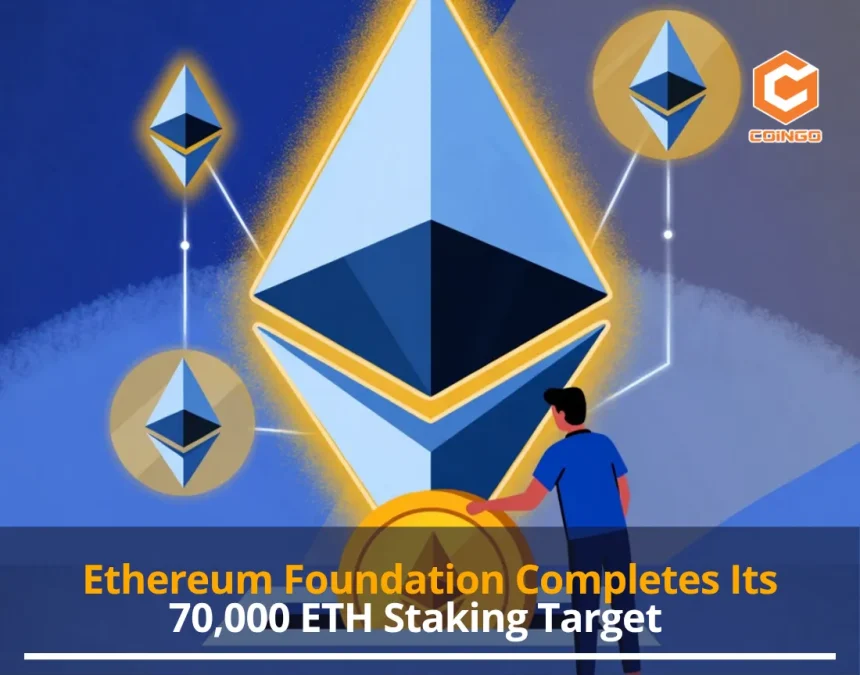
The Ethereum Foundation staked 45,034 ETH, worth approximately $93 million, on April 3, 2026, bringing its total staked position to roughly $143 million and completing the 70,000 ETH target it announced in February. The transaction was executed in several batches and recorded at 08:02 UTC, according to on-chain data from Arkham Intelligence.
This followed a deposit of 22,517 ETH ($46 million) made on April 1, which was at the time the largest single-day staking event in the foundation’s history. Together, the two operations across four days account for over $139 million in ETH moved into validators, completing a process that started with a modest 2,016 ETH deposit in late February.
Why the Foundation Changed Course
For years, the Ethereum Foundation deliberately avoided participating in staking. The reasoning was straightforward: as the organization most associated with Ethereum’s protocol development, holding validator positions would raise questions about its influence over consensus decisions, particularly during contentious network upgrades or forks.
That position shifted in mid-2025, when the foundation adopted a new Treasury Policy that prioritized generating on-chain yield over periodic ETH sales. The change was partly a response to community criticism. Regular ETH sales by the foundation had created predictable sell pressure, drawing sustained criticism in governance forums and on social media.
Under the updated model, staking rewards flow directly back into the treasury to fund the foundation’s roughly $100 million in annual operating expenses, covering protocol research, ecosystem development, and community grants. At current network conditions implying approximately 2.8% APY, the 70,000 ETH position is projected to generate between 1,900 and 2,200 ETH per year, or $3.9 million to $5.4 million in dollar terms. That covers a fraction of total expenses but reduces reliance on direct asset sales.
“When we first built Dirk and Vouch, our mission was to create the most resilient, secure staking infrastructure for the ecosystem. Seeing the Ethereum Foundation adopt these tools for its own treasury is validation of that original vision.” — Sreejith Das, Head of Onchain Solutions, Bitwise
Ethereum Foundation Stakes $46M in ETH as It Shifts from Selling to Earning

Infrastructure: Dirk, Vouch, and Decentralization-First Design
The foundation’s staking setup was designed to minimize the neutrality concerns that historically kept it off the validator set. It chose two open-source tools developed by Attestant, an infrastructure firm operating under Bitwise Onchain Solutions:
Dirk functions as a distributed signer, spreading validator key signing across multiple geographic regions. No single server or jurisdiction can unilaterally sign blocks, which reduces operational risk and eliminates single points of failure.
Vouch handles validator duties, coordinating with Dirk for signatures and supporting multiple Beacon Client and Execution Client pairings. This multi-client configuration is specifically designed to protect against the systemic risk of too many validators running the same software stack.
The overall setup uses minority clients and a mix of hosted infrastructure and self-managed hardware across several jurisdictions. Validators use Type 2 (0x02) withdrawal credentials, which allow validator balances to be consolidated and signing-key custody to be transferred without a full exit from the network.
Community observers have noted that questions around MEV extraction, censorship resistance, and block construction neutrality remain open. Running its own block-building logic rather than delegating to third-party builders keeps the foundation’s validator presence in active governance territory, not just a passive yield operation.
What Is Ethereum? The Programmable Blockchain Explained
Supply Dynamics and What Remains Unstaked
With approximately 30% of total ETH supply already staked across the network, the foundation’s 70,000 ETH represents a meaningful reduction in liquid float. ETH moved into validators is not available for sale on secondary markets, and the foundation has signaled that rewards will be directed back to the treasury rather than converted to fiat.
Despite completing the initial target, the foundation still holds more than 100,000 ETH in unstaked reserves. It has not announced whether it will expand staking beyond the 70,000 ETH commitment or maintain the remainder as liquid holdings. That decision will have direct implications for future sell pressure and for how the foundation balances yield generation against operational liquidity.
Table 1 — Ethereum Foundation Staking Activity Timeline
| Date | ETH Staked | USD Value | Note |
|---|---|---|---|
| Feb 24, 2026 | 2,016 ETH | ~$4M | Initial deposit, program launch |
| Mar 30, 2026 | 21,500 ETH | ~$46.2M | Largest batch at the time |
| Apr 1, 2026 | 22,517 ETH | ~$46M | New single-day record |
| Apr 3, 2026 | 45,034 ETH | ~$93M | Target completion |
| Total | ~70,000 ETH | ~$143M | Full target reached |
A Shift in How the Foundation Funds Itself
The completion of the 70,000 ETH target marks the end of the foundation’s first major treasury transition since the network moved to proof-of-stake. Moving from a sell-to-fund model to a yield-on-principal model changes the economics of foundation operations in a structural way: expenses are no longer funded by reducing the ETH balance, but by earning on it.
Whether the foundation will treat this as a floor or a starting point for larger validator participation remains to be seen. With over 100,000 ETH still held in liquid reserves and staking infrastructure already in place, the operational barrier to expanding beyond 70,000 ETH is low. The decision is now a policy question, not a technical one.