
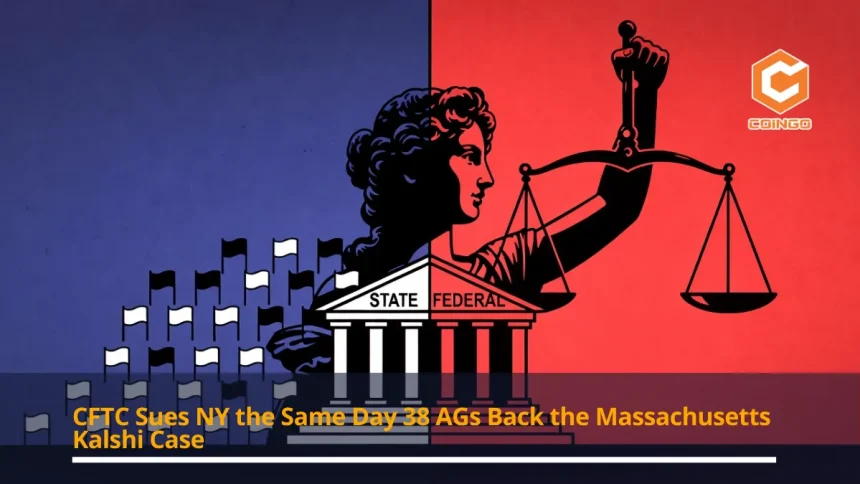
The state-versus-federal fight over prediction markets stopped looking like a slow legal grind on Friday. It became a same-day exchange of fire.
In the morning, New York Attorney General Letitia James joined 37 other state attorneys general in an amicus brief at the Massachusetts Supreme Judicial Court, asking the court to keep its preliminary injunction against Kalshi in place. By the afternoon, the Commodity Futures Trading Commission had filed its own complaint in the Southern District of New York, naming James, Governor Kathy Hochul, the New York State Gaming Commission, its executive director, and six commissioners as defendants. Three days earlier, James had sued Coinbase and Gemini over the same prediction-market contracts.
Four states sued by the CFTC in three weeks. One bipartisan brief signed by 38 AGs in a single afternoon. Same fight, two different courtrooms.
What the CFTC is actually asking for
The CFTC’s complaint is not a damages case. It asks the Southern District of New York to declare that federal law gives the agency exclusive jurisdiction over event contracts when those contracts are listed on a CFTC-registered exchange, and to permanently block New York from enforcing state gambling law against those exchanges.
The legal anchor is the Commodity Exchange Act and the Supremacy Clause. The CFTC says Congress already designed the framework, the agency already runs it, and state gambling enforcement on top of that framework is preempted. The complaint cites an October cease-and-desist letter the New York State Gaming Commission sent Kalshi over sports-related event contracts, plus this week’s civil suits against Coinbase and Gemini, as the conduct that crossed the line.
CFTC Chairman Michael Selig framed it directly. New York is the latest state to ignore federal law, his words, and the agency will no longer sit idly by. He has been moving in this direction since taking over the agency four months ago, withdrawing a Biden-era proposal that would have banned political event contracts and warning state regulators in February that pushback was coming.
The 38-state coalition is broader than the headline
The amicus brief filed in Massachusetts is the part that actually surprised people. Thirty-seven attorneys general plus DC, drawn from states that have won, lost, and not yet litigated, signed onto the same argument. Arizona, Connecticut, and Illinois, the three states the CFTC sued earlier this month, all signed. Tennessee and New Jersey, where federal courts have ruled in Kalshi’s favor, also signed. The breadth tells the story. State AGs across the political spectrum read Kalshi’s preemption argument as a threat to a power they all use, regardless of how their own court fights have gone. The coalition’s argument is that Dodd-Frank was written to address the financial instruments behind the 2008 crisis, not to legalize sports gambling nationwide.
The brief notes that Kalshi users wagered more than $1 billion every month on the platform in 2025, with sports betting accounting for around 90% of that volume in some months. The states’ position is that calling those contracts swaps does not change what they functionally are.
Where the courts have landed so far
Court outcomes have been split, and the split is geographic and tactical.
| State | Action | Status | Outcome So Far |
|---|---|---|---|
| New Jersey | Tried to enforce against Kalshi | Lost at Third Circuit (2-1) | Kalshi wins |
| Tennessee | Tried to ban Kalshi | Federal injunction granted Feb 2026 | Kalshi wins |
| Nevada | Banned event contracts | Ban extended this month | State wins |
| Arizona, Connecticut, Illinois | CFTC sued each on April 2 | Pending | Open |
| Massachusetts | Lawsuit vs Kalshi at top court | 38 AG amicus brief filed Friday | Pending |
| New York | Sued Coinbase, Gemini, joined amicus | CFTC filed federal countersuit Friday | Open |
The pattern is uneven. Kalshi has won the federal cases that have reached the appellate level. States have held their ground at the trial court level in Nevada. The Massachusetts case at the state Supreme Judicial Court and the New York case in federal court are the next two pressure points.
Why this is escalating now
The political backdrop matters. James and Hochul, both Democrats, framed the federal lawsuit as the Trump administration prioritizing big corporations over consumers. Selig is a Trump appointee. The amicus brief is bipartisan, which complicates the partisan reading. Republican attorneys general from states like Tennessee and Arizona signed alongside Democratic AGs. The disagreement is not Democrats versus Republicans. It is states versus the federal preemption argument that cuts across both parties. Coingo previously covered the federal government’s broader campaign against state gambling regulators, and the framework has only sharpened since.
Two parallel cases will set the boundary. If the New York federal court rules for the CFTC, operators can list event contracts nationwide without satisfying separate state gaming frameworks for the same activity. If the Massachusetts state court rules for the AG coalition, prediction market operators face a patchwork of state regimes, narrower launch footprints, and added partnership friction.
Selig’s strategy is now visible. Rather than wait for guidance to clarify the boundary, he is using litigation in four states to force a nationwide answer. New York is the largest of those four by market and political weight.
Whichever way the courts go first, the other case is still pending.