
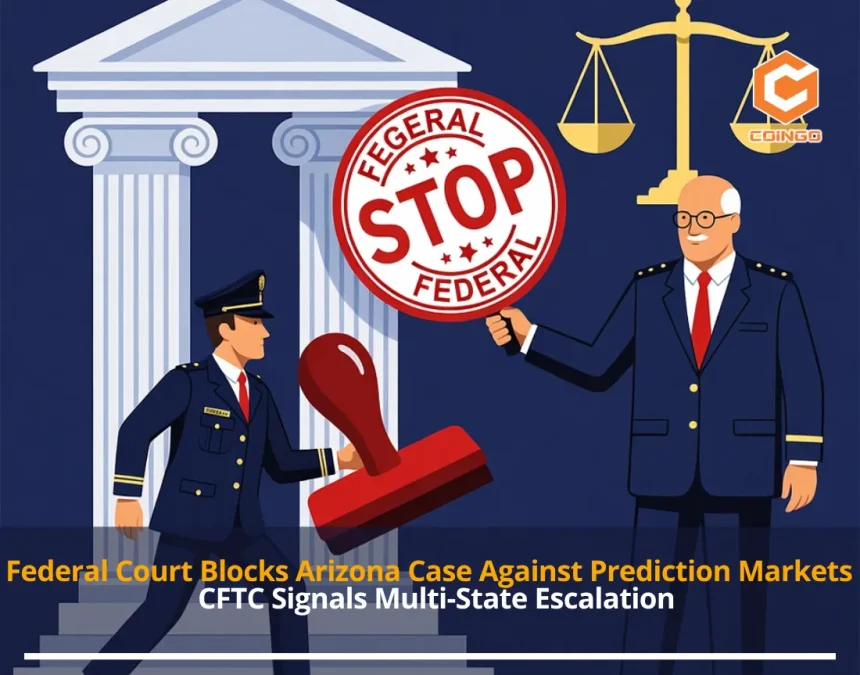
Court Grants Restraining Order, Arizona Criminal Case Paused
The US District Court for the District of Arizona granted the Commodity Futures Trading Commission (CFTC) a temporary restraining order on April 10, 2026, blocking Arizona from continuing criminal proceedings against CFTC-regulated designated contract markets. The order was issued at the CFTC’s direct request and represents the first court-level resolution in a rapidly escalating jurisdictional dispute between federal derivatives regulators and state law enforcement.
The restraining order follows the CFTC‘s filing of motions for both temporary and preliminary injunctions just two days prior. The speed of the court’s response — granting temporary relief within 48 hours of the federal filing — signals that the district court found the CFTC’s preemption argument sufficiently credible to halt state proceedings while the broader jurisdictional question is resolved.
The Core Dispute: Federal Derivatives Law vs State Gambling Statutes
Arizona’s enforcement actions against prediction market platforms were grounded in state gambling statutes — laws designed to regulate betting and gaming activity at the state level. The CFTC’s position is unambiguous: those statutes are preempted by federal derivatives law when applied to platforms that operate as CFTC-regulated designated contract markets.
The distinction matters because designated contract markets are licensed and supervised entities under the Commodity Exchange Act — they operate under federal compliance frameworks that include risk management requirements, reporting obligations, and regulatory oversight. Arizona’s application of criminal gambling law to entities operating under federal license creates a direct conflict between state and federal authority.
CFTC Chairman Michael S. Selig was pointed in his characterization of Arizona’s approach:
“Arizona’s decision to weaponize state criminal law against companies that comply with federal law sets a dangerous precedent, and the court’s order today sends a clear message that intimidation is not an acceptable tactic to circumvent federal law.”
Three States in the CFTC’s Crosshairs: Arizona, Connecticut, Illinois
The Arizona restraining order is one front in a coordinated federal legal campaign. The CFTC simultaneously filed litigation against Arizona, Connecticut, and Illinois — all three states having taken or threatened enforcement actions against prediction market platforms operating under federal oversight. The simultaneous multi-state approach signals that the CFTC is not treating these as isolated disputes but as a systemic threat to its exclusive jurisdiction over event-based derivatives.
Selig’s public statement after the Arizona ruling reinforced the multi-state intent, framing the court order as a precedent that applies beyond Arizona. The CFTC’s language around “fragmented enforcement” and the risk it poses to institutional adoption of prediction markets and DeFi integrations suggests the agency is also positioning this battle for the broader regulatory debate around digital asset markets — not just for traditional event contracts.
Why This Matters Beyond Prediction Markets
The jurisdictional question at stake in the CFTC-Arizona dispute has implications that extend well beyond prediction markets. The core principle being litigated is whether states can apply their own criminal or regulatory frameworks to federally licensed financial entities — and if they can, under what conditions.
For the crypto industry, this precedent is directly relevant. Prediction markets that operate on-chain, event-based derivatives settled in stablecoins, and DeFi protocols that function as de facto derivatives platforms all sit in the intersection of federal and state regulatory authority. A clear judicial confirmation of CFTC preemption over state gambling law would establish a protective framework for federally compliant platforms against state-level enforcement overreach.
The temporary restraining order is not a final ruling — it preserves the status quo while the preliminary injunction proceedings move forward. But CFTC Chairman Selig’s framing of the court’s decision as a message against “intimidation” suggests the agency views the initial ruling as validation of its position, and that further escalation against the remaining states is likely if those jurisdictions do not stand down voluntarily.