

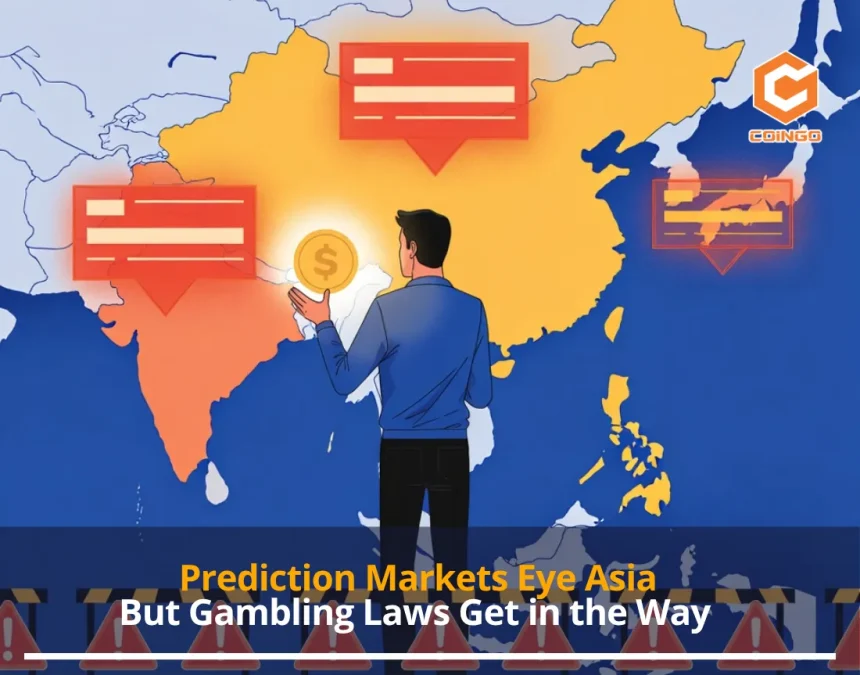
Big Market, Bigger Legal Problem
Prediction market platforms are moving into Asia with a familiar playbook: target demand first, figure out regulation later. The region makes sense on paper. Three Asian economies ranked among the world’s top five by GDP in 2024, and South Korea is consistently one of the most active retail crypto markets globally, with the Korean won ranking as the top-traded fiat currency in crypto in Q1 2024, according to Kaiko.
The obstacle is not market size. It is classification. Across China, India, South Korea, and Japan, no specific framework exists for blockchain-based prediction markets. What does exist are strict gambling laws, and regulators in each country are increasingly asking whether these platforms fall under them.
Country by Country
China bans crypto trading and mining outright. Online gambling is illegal outside two state-run lotteries. Some users reach platforms via VPN, but that does not eliminate legal exposure for participants.
India imposes heavy crypto taxation and has no prediction market framework. The Reserve Bank of India stated in April 2026 it is exploring specific guidelines after flagging concerns about unregulated growth in the sector.
South Korea has among the highest retail crypto participation rates in the world, but gambling is illegal for residents outside a narrow set of state-run exceptions. The law applies to offshore platforms as well. Individuals caught gambling face fines up to 10 million won, with repeat offenders facing up to three years in prison. The Financial Supervisory Service began reviewing prediction market platforms in early 2026.
Japan defines gambling as betting property on a contest of chance and treats it as a criminal offense by default. Horse racing, pachinko, and state lotteries are the only carved-out exceptions. Blockchain prediction markets fit none of them.
“In these jurisdictions, authorities often classify activities involving wagering on uncertain outcomes as gambling, which is heavily restricted or outright prohibited outside of tightly controlled state-run exceptions.” —

The Classification Debate
The industry argues prediction markets are not gambling. Jaewon Kim of research firm Four Pillars puts it this way: gambling is a closed loop where outcomes have no informational value beyond determining the winner. Prediction markets aggregate collective expectations about real-world events and produce probability signals that can be more accurate than expert forecasts or polls, as seen in the 2024 U.S. election cycle.
That argument has already failed in at least one court. A Nevada judge ruled in 2025 that prediction market contracts on sports and political events constitute unregulated gambling, rejecting the financial instrument framing. The case is under appeal. Asian regulators are watching.
Table 1 — Prediction Markets Status Across Key Asian Markets
| Market | Gambling Law | Prediction Markets Status |
|---|---|---|
| China | Illegal (state lotteries only) | No framework; VPN access only, user legal risk |
| India | Varies by state | No framework; RBI exploring guidelines (April 2026) |
| South Korea | Illegal (narrow exceptions) | No guidance; FSS review underway in 2026 |
| Japan | Illegal (racing, pachinko excepted) | No specific guidance; legal gray zone |
What Happens Next
If regulators treat prediction markets as financial instruments, the sector can seek licenses and operate transparently. If they are absorbed into gambling law, the window closes. That decision is now in the hands of the same regulators who have spent decades enforcing the region’s most restrictive gambling frameworks.