


The Economics Broke First
The numbers are straightforward. According to CoinShares’ Q1 2026 mining report, the weighted average cash cost to produce one Bitcoin among publicly listed miners rose to approximately $79,995 in Q4 2025. Bitcoin has traded in the $67,000-$70,000 range through March 2026. That is a loss of roughly $13,000-$19,000 per coin mined.
Hashprice, the metric that determines miner revenue per unit of computing power, hit an all-time post-halving low of roughly $28-$35 per petahash per day in early March. The April 2024 halving cut block rewards to 3.125 BTC per block. Unless Bitcoin moves back toward $100,000, pure mining operations are structurally unprofitable.
$70 Billion in AI Contracts and Counting
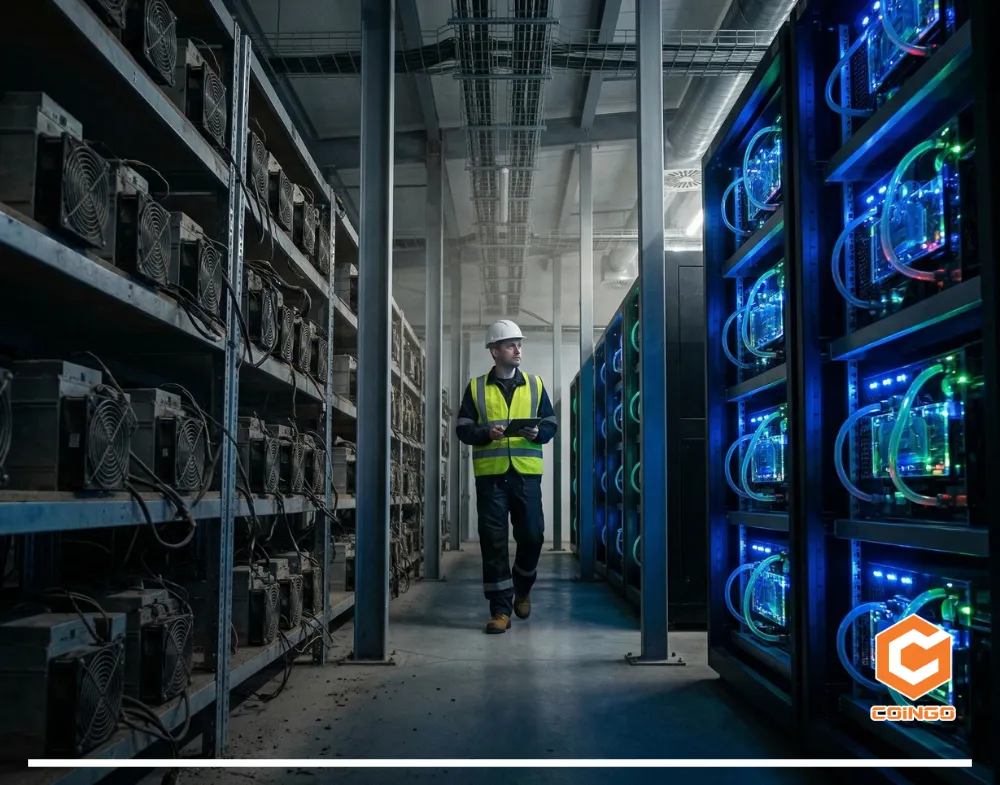
The response has been a wholesale pivot. Over $70 billion in cumulative AI and high-performance computing contracts have now been announced across the public mining sector. These are not exploratory deals. They are multi-year, multi-billion dollar commitments with the biggest names in tech.
Core Scientific expanded its deal with CoreWeave to $10.2 billion over 12 years. TeraWulf has $12.8 billion in contracted HPC revenue. Hut 8 signed a $7 billion, 15-year lease with Fluidstack for AI infrastructure at its River Bend campus. MARA Holdings launched a joint venture with Starwood Capital Group targeting 1 gigawatt of near-term AI capacity, with a roadmap to 2.5 GW.
The economics explain the speed. AI infrastructure costs $8-15 million per megawatt compared to roughly $700K-$1M for mining. But it generates 80-90% operating margins from stable, long-term contracts. Mining margins, by comparison, fluctuate daily with BTC price.
| Company | AI/HPC Deal | Value |
|---|---|---|
| Core Scientific | CoreWeave colocation (12 years) | $10.2 billion |
| TeraWulf | Contracted HPC revenue | $12.8 billion |
| Hut 8 | Fluidstack AI lease (15 years) | $7 billion |
| MARA Holdings | Starwood JV (1 GW capacity) | Multi-billion (undisclosed) |
| IREN | Microsoft cloud expansion | $1.9 billion prepayment |
| Riot Platforms | Texas Triangle AI colocation | In development |
Mining Revenue Is Shrinking Fast
CoinShares projects that mining revenue could plummet from around 85% of total revenue in early 2025 to less than 20% by the end of 2026 for companies that have secured AI contracts. Some are already well into the transition. Core Scientific’s AI colocation revenue already accounts for 39% of its total. TeraWulf is at 27%. IREN is at 9% and scaling rapidly.
By late 2026, listed miners could derive as much as 70% of their revenue from AI, up from roughly 30% today. These are no longer mining companies that happen to have data centers. They are data center operators that happen to still mine Bitcoin on the side.
What Miners Bring to the Table
The pivot works because Bitcoin miners built exactly what AI companies need: large-scale facilities with cheap power, high-voltage grid connections, cooling infrastructure, and fiber connectivity. Power interconnection queues for new data center builds now stretch 3-5 years in major markets. Miners already have those connections live.
But the conversion is not trivial. ASIC hardware used for Bitcoin mining is useless for AI workloads. Miners must acquire GPUs like NVIDIA’s H100 or Blackwell GB200, install liquid cooling systems, overhaul networking to InfiniBand or 100G Ethernet, and build entirely new software stacks around PyTorch, Kubernetes, and Slurm. The capital cost is significant, and many miners are selling BTC reserves to fund it.
The Bitcoin Security Question
There is a downstream consequence that is less discussed. Bitcoin’s network hashrate peaked at 1,160 EH/s in October 2025 and has since declined. Mining difficulty dropped 7.76% recently, the second-biggest decline of 2026. As miners redirect power capacity toward AI, the computing resources securing the Bitcoin network shrink.
This does not threaten Bitcoin’s survival. But it changes the security profile. If the largest publicly listed miners derive 70% of revenue from AI by year-end, their incentive to maintain mining operations depends entirely on BTC price recovery. Below $80,000, the economics push more hashrate offline. Above $100,000, the pivot slows. The price of Bitcoin is now, more directly than ever, the price of its own security.
The price of Bitcoin is now, more directly than ever, the price of its own security. Below $80,000, the economics push more hashrate offline. Above $100,000, the AI pivot slows.
A One-Way Door
MARA CEO Fred Thiel framed the shift clearly: “By 2028, you’ll either be a power generator, be owned by one, or be partnered with one.” The miners that have already signed multi-year AI contracts are not going back to pure mining. The infrastructure is being physically converted. Air-cooled ASIC halls are being gutted and replaced with liquid-cooled GPU clusters.
Over $500 billion in hyperscaler AI infrastructure investment is expected globally in 2026. Microsoft, Google, Meta, and Amazon are all competing for the same resource: pre-energized, high-capacity sites with grid connections that miners already own. The Bitcoin mining industry built the infrastructure. AI is now paying for it.
The Bitcoin mining industry built the infrastructure. AI is now paying for it. Over $500 billion in hyperscaler investment is expected globally in 2026.