
Fragmentation across Ethereum L2s has reached structural limits
Ethereum’s Layer-2 ecosystem has expanded rapidly, but growth has come with a cost. Liquidity is now spread across multiple rollups, creating inefficiencies in capital allocation and user experience.
With an estimated **$40 billion** distributed across **10+ major L2 networks**, users are often forced to bridge assets manually. Each bridge introduces latency, fees, and risk, turning what should be a seamless ecosystem into a fragmented environment.
This fragmentation is no longer just a UX issue. It directly impacts DeFi efficiency, pricing consistency, and protocol composability across chains.
Table 1 — Ethereum L2 Fragmentation Snapshot
| Metric | Current State |
|---|---|
| Total L2 Value | ~$40 Billion |
| Number of Major L2s | 10+ |
| Liquidity Distribution | Fragmented |
| User Experience | Bridge-dependent |
What is the Ethereum Economic Zone (EEZ)?
Announced on **March 29 at EthCC Cannes**, the **Ethereum Economic Zone (EEZ)** is a coordination initiative developed by **Gnosis** and **Zisk**, with backing from the **Ethereum Foundation**.
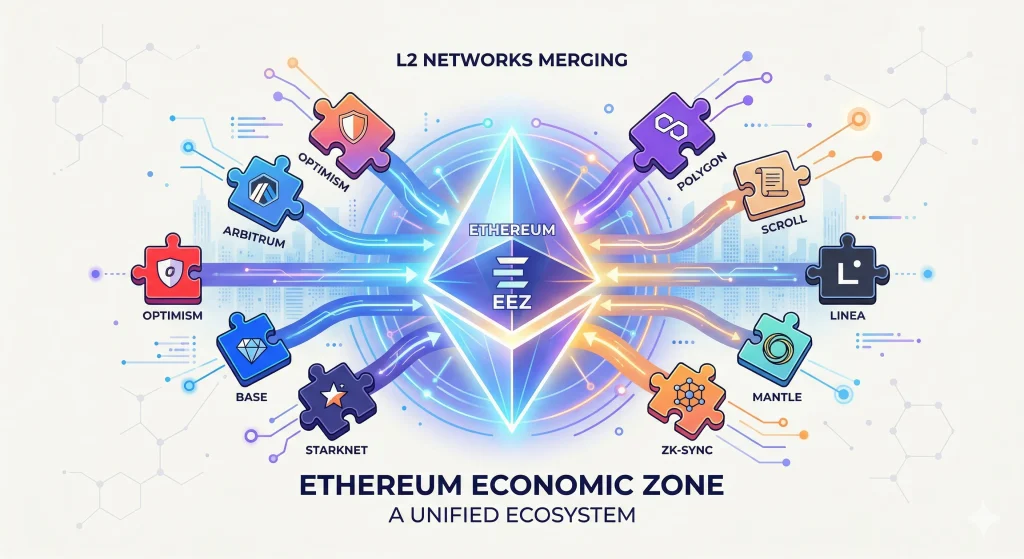
Rather than introducing a new chain, EEZ aims to create a unified economic layer across existing L2s. Founding members include major DeFi players such as **Aave**, **Centrifuge**, and **Titan**, signaling early institutional alignment within the ecosystem.
The concept of an “economic zone” reframes Ethereum scaling. Instead of competing silos, L2s are treated as interconnected zones within a broader financial system.
How EEZ could change the structure of L2 interactions
At its core, EEZ focuses on coordination rather than replacement. The initiative is expected to standardize how liquidity, assets, and protocols interact across Layer-2 networks.
This could include shared liquidity frameworks, unified standards for cross-chain interactions, and improved routing between L2 environments. Instead of isolated liquidity pools, capital could move more efficiently across the ecosystem.
If implemented effectively, this would reduce reliance on traditional bridging mechanisms and create a more fluid capital environment across Ethereum.
What it means for users and protocols
For users, the impact is immediate in theory. Fewer manual bridges, more consistent pricing, and smoother interaction between applications across chains.
For protocols, especially DeFi platforms, unified liquidity means deeper markets and improved capital efficiency. This can directly affect yield generation, borrowing costs, and overall protocol performance.
In practical terms, EEZ could transform Ethereum from a collection of fragmented networks into a coordinated financial system.
The challenge of coordination
While the vision is clear, execution remains uncertain. Previous attempts at cross-chain coordination have struggled due to misaligned incentives and governance complexity.
Each Layer-2 network operates with its own economic model and priorities. Aligning these under a shared framework requires both technical integration and economic agreement.
The presence of major players and Ethereum Foundation support increases credibility, but the success of EEZ will ultimately depend on sustained collaboration across competing ecosystems.