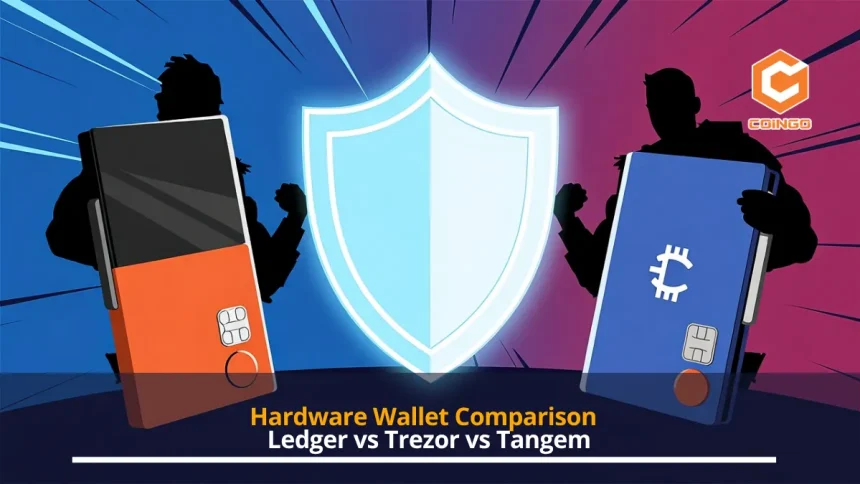
Three brands, three philosophies. Ledger leads on asset coverage and ecosystem depth. Trezor leads on transparency and post-quantum readiness. Tangem eliminates seed phrases entirely. This guide breaks down which one fits your needs.
Hardware wallets remain the gold standard for crypto self-custody in 2026. But the market has changed significantly. Ledger overhauled its product line with touchscreen devices and Bluetooth connectivity. Trezor launched the industry’s first post-quantum hardware wallet. And Tangem built a card-based system that removes seed phrases from the equation altogether. Each approach solves different problems, and the right choice depends on what you actually need to protect, how much you hold, and how comfortable you are with technical complexity.
Quick Comparison: Ledger vs Trezor vs Tangem
| Feature | Ledger | Trezor | Tangem |
|---|---|---|---|
| Top Model | Flex ($249) / Stax ($399) | Safe 5 ($169) / Safe 7 ($249) | Wallet 2.0 (~$55) |
| Supported Assets | 15,000+ | 1,000+ (native + 3rd party) | 6,000+ |
| Seed Phrase | 24 words (Recover opt-in) | 12-24 words + Shamir | No seed phrase |
| Connectivity | USB-C, Bluetooth, NFC | USB-C only | NFC only (tap to phone) |
| Open Source | ~95% (OS partially closed) | Fully open source | Partially open source |
| Secure Element | CC EAL5+/EAL6+ | EAL6+ + TROPIC01 | CC EAL6+ (Samsung) |
| Post-Quantum Ready | Not announced | Yes (Safe 7) | No |
| Mobile Support | iOS + Android (Bluetooth) | Android full / iOS view-only | iOS + Android (NFC) |
| Best For | Active traders, large portfolios | Privacy-focused, technical users | Beginners, mobile-first users |
Ledger: Broadest Ecosystem, Highest Profile Target
Ledger is the most widely used hardware wallet brand in the world, with a product line now spanning three price tiers: the Nano S Plus ($79), the Flex ($249), and the Stax ($399). The newer Flex and Stax models feature E Ink touchscreens, Bluetooth connectivity, and battery life up to 10 hours. Ledger supports over 15,000 coins and tokens through Ledger Live, its companion app, which also integrates staking, NFT management, and dApp connectivity.
Ledger’s security architecture centers on a proprietary Secure Element chip (CC EAL5+/EAL6+ certified), which isolates private keys from the rest of the device. The operating system is approximately 95% open source, with the Secure Element firmware remaining closed. Ledger argues this is necessary for hardware-level tamper resistance, but critics point out it prevents full independent verification.
The elephant in the room is data security. In January 2026, a breach at Ledger’s payment partner Global-e exposed customer names, addresses, and order information. In April 2026, a fake Ledger Live app on the Apple App Store drained $9.5 million from over 50 victims before Apple removed it. Ledger’s hardware remains unbroken, but the ecosystem around it has become a high-value target. Ledger also offers Ledger Recover ($9.99/month), which splits your seed phrase into three encrypted fragments stored by independent custodians. The feature is opt-in and controversial among privacy advocates.
Cold Wallet vs Hot Wallet: Which Is Right for Your Holdings
Trezor: Full Transparency and Post-Quantum Firsts
Trezor has been the standard-bearer for open-source hardware wallets since 2014. Its current lineup includes the Safe 3 ($79-$129), Safe 5 ($169), and the flagship Safe 7 ($249). Trezor supports over 1,000 assets natively through Trezor Suite, with additional coverage available through third-party wallet integrations like Electrum, Sparrow, and MetaMask.
Trezor’s defining characteristic is full transparency. Its firmware is 100% open source, meaning anyone can audit the code running on the device. The Safe 5 introduced a color touchscreen with haptic feedback, and the Safe 7 added IP67 water and dust resistance, wireless charging, and a dual secure element design combining an EAL6+ chip with the TROPIC01, a fully auditable secure chip.
The Safe 7 is also the world’s first hardware wallet with post-quantum cryptography. It implements SLH-DSA-128 for firmware updates, device authentication, and boot processes. Every Safe 7 ships with a post-quantum device certificate. While quantum computing is not yet a practical threat to crypto, Trezor is the only manufacturer actively building defenses against it.
Trezor also supports Shamir Backup (SLIP-39), which splits your seed phrase into multiple shares. You define how many shares are needed to reconstruct the key, meaning no single piece of paper can compromise your wallet. The trade-off: Trezor’s iOS app operates in view-only mode, making it less suitable for mobile-first users.
Tangem: No Seed Phrase, No Complexity
Tangem takes a fundamentally different approach. Instead of a USB device with a screen, Tangem wallets are NFC-enabled cards roughly the size and thickness of a credit card. You tap the card to your phone to sign transactions. There is no screen, no battery, no USB cable, and no seed phrase.
During setup, the card’s embedded Samsung S3D350A Secure Element (CC EAL6+ certified) generates a private key that never leaves the chip. Backup works by cloning the key onto two additional cards included in the standard 3-card pack (~$55). If you lose one card, the other two serve as backups. If you lose all three cards, your funds are gone. There is no recovery phrase to fall back on.
Tangem supports over 6,000 coins and tokens through its mobile app, with built-in buy, sell, swap, and staking functionality. Setup takes under 3 minutes. The cards are waterproof, dust-proof, and rated for a 25-year lifespan. For users who find seed phrases intimidating or risky, Tangem removes the single biggest point of failure in traditional hardware wallets.
The trade-off is that Tangem’s firmware cannot be updated after manufacturing. If a vulnerability is discovered in the card’s firmware, it cannot be patched on existing devices. Users would need to purchase new cards with updated firmware. Tangem also lacks a built-in display, meaning transaction details must be verified on the phone screen rather than on the device itself.
Which Wallet Fits Which User
Choose Ledger if you manage a diverse portfolio across many blockchains, actively trade or use DeFi, and want the broadest ecosystem with desktop and mobile support. The Flex is the best balance of features and price. Be prepared to verify every app download carefully and accept the trade-off of Bluetooth connectivity.
Choose Trezor if you value full transparency, want to verify every line of code running on your device, or prioritize future-proofing against quantum threats. The Safe 5 is the sweet spot for most users. The Safe 7 is for those who want the most advanced security architecture available. Accept that mobile support is limited on iOS.
Choose Tangem if you are new to self-custody, want the simplest possible setup, or need a wallet you can carry in your physical wallet without drawing attention. Tangem is the hardest to mess up, making it ideal for family members or anyone uncomfortable managing a 24-word backup. Accept that firmware is not updatable and large, complex DeFi operations may feel limited without an on-device display.
All three wallets keep your private keys offline and are dramatically safer than leaving funds on centralized platforms. The differences are about philosophy, not about whether one is fundamentally insecure. In 2026, the real risk is not in the hardware. It is in the human decisions around it: how you store your backup, where you download your software, and whether you verify before you sign.