
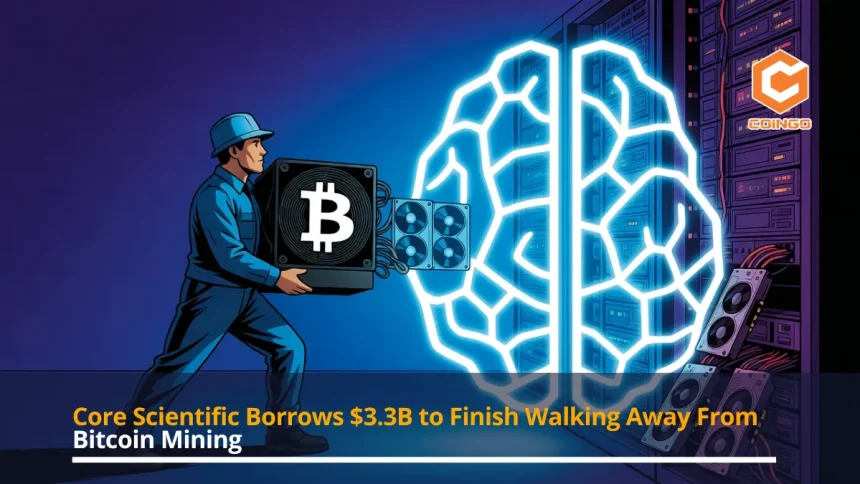
Core Scientific announced on April 21 that its subsidiary Core Scientific Finance I LLC will offer $3.3 billion in senior secured notes due 2031. The debt is backed by the company’s data center subsidiaries with first-priority liens on substantially all of their assets. Proceeds will repay existing short-term borrowings under a 364-day credit facility, fund a debt service reserve, and bankroll new high-density colocation builds in Georgia, Texas, North Carolina, and Oklahoma.
The raise sits inside a much larger story. Core Scientific (CORZ) is one of North America’s biggest former Bitcoin miners and now a compute infrastructure operator whose single most important counterparty is CoreWeave. The six data center facilities this capital will fund are already fully contracted under a 12-year agreement with CoreWeave that could generate roughly $10 billion in revenue, according to a person with direct knowledge reported by Bloomberg.
From Bankruptcy to the AI Debt Market in 28 Months
Core Scientific was founded in 2017 and grew into one of the largest Bitcoin miners in North America before filing for Chapter 11 in December 2022, squeezed by high power costs and the post-2022 crypto drawdown. The company emerged from reorganization in January 2024, relisted on Nasdaq under the ticker CORZ, and has been systematically unwinding its mining exposure ever since. CFO Jim Nygaard confirmed the company now holds under 1,000 Bitcoin, a sharp drop from its peak inventory.
The pace of capital gathering has been aggressive. In March, Core Scientific secured a $1 billion credit agreement with Morgan Stanley. The company subsequently added a $500 million credit facility from JPMorgan Chase, bringing total funded commitments to $1 billion before this bond offering. Last month it also sold $175 million worth of Bitcoin to further fund the pivot. CORZ shares have climbed more than 200% over the past year and sit at a $6.27 billion market cap.
Bitcoin Miners Are Becoming AI Companies and Selling BTC to Fund the Shift
The Bond Is Part of an AI Infrastructure Debt Boom
The Core Scientific issuance lands inside a broader high-yield wave. Industry trackers have logged roughly $17.9 billion raised this year in AI infrastructure debt, with issuers tapping junk-bond markets to finance the staggering capital needs of data center buildouts. Edged Compute is separately marketing a $1.3 billion bond deal to fund facilities leased to CoreWeave and an Alibaba unit, underscoring how concentrated the counterparty risk has become around a handful of hyperscalers.
The structural logic of these deals is straightforward. Long-term leases from creditworthy counterparties like CoreWeave allow operators to lock in predictable cash flows, which makes senior secured debt the efficient financing instrument. Equity raises would dilute shareholders who already rewarded the AI pivot with the CORZ rally. Debt lets the company scale the physical footprint without handing over the upside.
What It Signals for the Mining Industry
Core Scientific is not alone in the migration. MARA Holdings, Riot Platforms, Hut 8, and IREN have each pursued different versions of the same strategy, redirecting infrastructure built for hashrate into AI and high-performance computing hosting. IREN alone has spent roughly $800 million on data center and related infrastructure in recent quarters.
The economics explain the exit. Bitcoin miners depend on the ratio of Bitcoin price to energy cost, which is volatile and compressed further by halvings. AI compute hosting produces contracted, long-duration revenue that lenders understand and price cleanly. A site that can be repurposed from ASIC racks to GPU racks without losing its power contract is a more valuable asset as AI hosting than as mining capacity.
For the Bitcoin network, the second-order effect is gradual hashrate redistribution away from publicly traded miners that have better capital alternatives. Private miners with lower cost bases and operators in regions with subsidized power continue to pick up share. The infrastructure that once defined the public mining sector is now mostly spoken for by AI workloads under contracts that extend past the next two Bitcoin halvings.
Core Scientific still carries a $1.16 billion total debt load and posted a net loss of $0.88 per share over the last twelve months. The $3.3 billion offering does not eliminate execution risk, it finances it. Whether the CoreWeave contract cash flows materialize as projected over the next twelve years is the only question that actually matters for CORZ holders now.