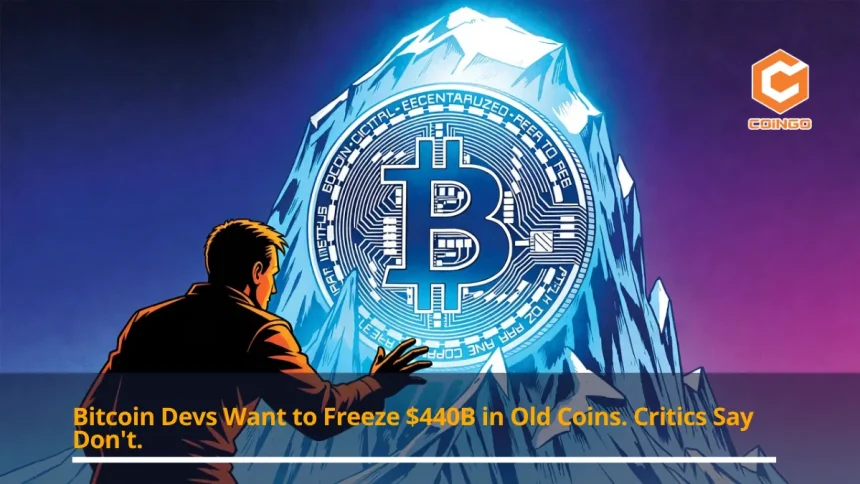
About 5.6 million Bitcoin sit in wallets that have not moved in over a decade. They are worth roughly $440 billion at current prices. They are also, according to a growing number of Bitcoin developers, the single biggest vulnerability the network has against future quantum computing attacks. The proposal on the table is to freeze them. The proposal has split the Bitcoin community in half.
If it goes through, multiple analysts told CoinDesk it would mark Bitcoin’s worst single-day repricing since the 2009 launch. The reason is not the lost supply itself. It is what freezing those coins would say about every other coin on the chain.
Lopp’s BIP-361 and the Quantum Argument
The proposal is Bitcoin Improvement Proposal 361 (BIP-361), introduced earlier this month by core Bitcoin developer Jameson Lopp and a team of contributors. The mechanism is simple in principle: phase out Bitcoin’s current cryptographic signatures over time, invalidate transactions from wallets still using vulnerable signature schemes, and effectively freeze any coin that has not migrated to a quantum-resistant standard.
Lopp himself does not love the idea. He told CoinDesk earlier this month he would rather not see anyone’s coins frozen at all. But given the alternative — quantum computers eventually cracking the cryptography behind 5.6 million dormant Bitcoin and draining $440 billion into the hands of attackers — he sees the freeze as the lesser of two harms. “I’m thinking adversarially about a potential future threat,” he said.
The threat is not science fiction. An Italian researcher recently executed the largest quantum attack on cryptographic keys to date, earning a 1 BTC bounty for the demonstration. IBM has laid out a public roadmap to break the kind of keys Bitcoin actually uses by 2028. The window between “interesting research milestone” and “actively dangerous to the network” has narrowed faster than most people in the industry expected.
What the Market Would Actually Do
The most direct argument against the freeze came from Samuel “Chad” Patt, founder of Op Net. His point is not philosophical. It is operational. “Freezing any coins, even ‘lost’ ones, tells the market that all roughly 19.8 million BTC currently in circulation are conditionally owned,” Patt said. “Institutional risk desks do not care about the reason, they care about the precedent.”
That is the part that matters for price. Bitcoin’s whole pitch to institutional buyers is that it cannot be confiscated, frozen, or unilaterally seized. The moment one entity — even the network itself, even with the best intentions — takes that ability away, the entire risk model recalculates. Funds that hold Bitcoin specifically because of its censorship-resistant property would face new questions from compliance and risk teams. Some would unwind.
Jason Fernandes, a self-described pragmatic maximalist and co-founder at AdLunam, agrees with Patt’s repricing thesis but thinks an actual quantum break would be far worse. “Institutions won’t just price precedent, they’ll price whether the system can survive a break in its core assumptions,” he said. In his framing, the freeze is a controlled detonation. The alternative is an uncontrolled one.
The Maximalist Split Nobody Saw Coming
Bitcoin maximalists are not united on this. That alone is news. The community that has spent fifteen years agreeing on the value of immutable property rights is now openly split on whether immutability survives contact with quantum reality.
Even non-Bitcoiners have weighed in. Cardano’s Charles Hoskinson called BIP-361 a hard fork that would strand 1.7 million BTC, framing the proposal as both technically and politically untenable. The pushback has come from inside Bitcoin and from outside it.
Khushboo Khullar, venture partner at Lightning Ventures, called the freeze a “deeply flawed approach” that “directly undermines Bitcoin’s core principles of immutability, permissionlessness, and no central enforcement.” She added that any such move would require a contentious hard fork and would violate the network’s decentralized ethos.
Mati Greenspan, another maximalist analyst, framed the alternative starkly: “If quantum computers ever crack early Bitcoin wallets, it won’t trigger a rollback or a freeze; it will trigger the largest bug bounty in human history.” His preferred path is the one most Bitcoin maximalists eventually default to. Do nothing. Let the market sort it out.
Then there are the pragmatists. Ken Kruger, founder of Moon Technologies, said the quantum threat may force tradeoffs the community will not enjoy. “It’s extremely challenging to build systems that are truly future-proof, and while Bitcoin has come quite close, quantum may pose a threat that requires tradeoffs participants won’t be happy with.” The pragmatists are not arguing the freeze is good. They are arguing that the alternative is worse.
What This Means for Satoshi’s Coins
The 5.6 million dormant Bitcoin figure includes the roughly 1 million coins attributed to Satoshi Nakamoto. Most active Bitcoin wallets are reasonably safe from the quantum threat — Satoshi’s are not, because they sit in early wallet formats that were never upgraded, at addresses no one has touched since the network’s earliest days. Under BIP-361, Satoshi’s coins would be among the first frozen if the proposal passes.
This adds a layer that goes beyond market mechanics. Satoshi’s coins have always been treated as part of Bitcoin’s mythology — the founder’s stash that was never spent, never moved, never used to dump on the market. Freezing them resolves the long-tail risk that they ever could be. It also requires the network to make a permanent statement about coins it cannot prove are actually lost. Lopp acknowledges the awkwardness directly. He hopes the proposal is never activated. He wrote it because he could not see a better defense.
The Timing Problem
Bitcoin’s quantum vulnerability is real but it is not immediate. Bitcoin developers recently reproduced IBM’s quantum cryptography results and confirmed the math is sound. The current consensus is that practical quantum attacks against Bitcoin’s actual cryptography are still years away. The window for migration exists. Whether the community uses it is a different question.
Other chains are not waiting. Dogecoin executed its first experimental post-quantum transaction on mainnet earlier this month, a small but symbolic move toward quantum-resistant signature schemes. Bitcoin has the brand strength and the developer talent to do something similar. What it does not have is a coordination mechanism for forcing a network-wide migration. BIP-361 is one attempt. There will be others.
What Happens Next
BIP-361 is a proposal, not a decision. Bitcoin Improvement Proposals require rough consensus from miners, node operators, exchanges, and developers before they activate, and the current debate suggests rough consensus is nowhere close. The most likely outcome over the next twelve months is more debate, more counter-proposals, and slow movement toward a quantum-resistant signature standard that does not require freezing anything.
But the conversation is now public, and that changes the price calculus. Every institutional risk desk now has the freeze scenario in its model. The probability is low. The pricing impact, if it happens, is severe. Whether you think Lopp is right or wrong, the market will start factoring in the precedent the moment a freeze becomes more than a hypothetical. That moment may already be here.