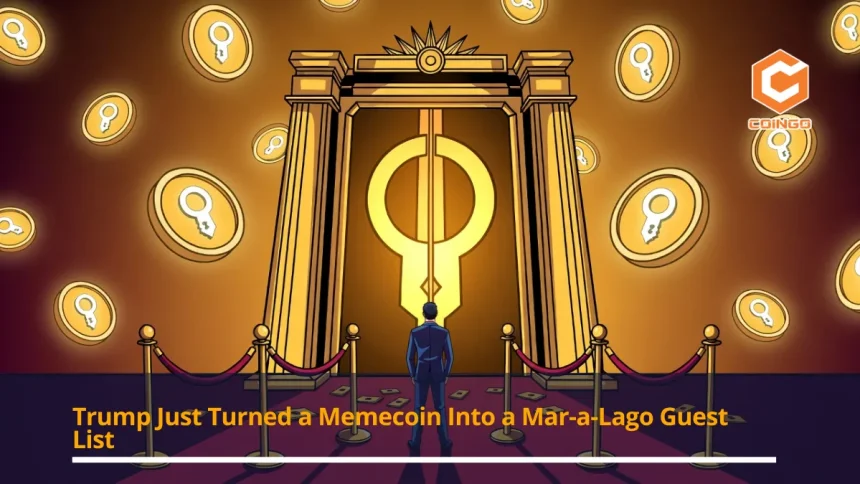
President Trump is set to headline a crypto conference at Mar-a-Lago on Saturday, with the guest list determined entirely by holdings of the $TRUMP memecoin. Attendance is limited to the top 297 wallets, and the top 29 holders receive direct access at a private reception. The token is named after the President, the venue is owned by the President, and the attendees are selected based on how much of that token they hold.
How the Guest List Was Built
The mechanics of the event are what is driving most of the conversation. There is no application process, no industry committee, and no public sale of tickets. The selection method is purely on-chain: wallets ranked by $TRUMP holdings, with two cutoffs.
| Tier | Number of Wallets | Access Level |
|---|---|---|
| Top 29 wallets | 29 | Private reception with direct access |
| Top 297 wallets | 297 | Main keynote attendance |
| All other holders | Hundreds of thousands | No event access |
This structure produces a tight loop of incentives. Anyone who wanted access to the President in person at his own residence had a clear, public, and tradable pathway to do so by acquiring more of his token. Wallets accumulated in the days leading up to the event, with on-chain analysts noting concentrated buying behavior consistent with positioning for the cutoff.
The Conflict of Interest Question
Democratic senators have already described the structure as an egregious conflict of interest, arguing that it blurs lines that are typically kept separate. The argument is straightforward: a sitting president cannot create a financial product whose ownership grants direct personal access to him without raising governance questions that go beyond optics.
The concern is not abstract. Token prices respond to perceived access value. If the market believes that owning $TRUMP yields proximity to the President, demand for the token reflects that belief. The token holders who get into the room are by definition the people who paid the most into a financial instrument that benefits the President’s family and business interests, since the token’s economics route value back through entities tied to the Trump organization.
There is little indication that any immediate regulatory action will be taken before the event itself. The debate is sitting in the political and public arena rather than the legal one for now. Several congressional inquiries have been opened, but inquiries move on a different timeline than a Saturday keynote.
Why the Market Is Watching the Speech
Beyond the politics, traders are watching for what Trump actually says during the keynote. Bitcoin has been trending higher in recent weeks and broader crypto sentiment has been improving, so any directly positive policy messaging could amplify that momentum.
When a sitting president speaks directly to a highly invested audience, the impact is rarely subtle. Markets that react quickly to narrative shifts are particularly sensitive to specific policy mentions: the CLARITY Act timeline, stablecoin rule progress, federal posture toward state-level prediction market actions, and the broader regulatory roadmap for digital assets are all live questions where any forward-looking comment could move prices.
The token itself has its own dynamic. $TRUMP holders who do not make the cutoff still own a position whose value is tied to the perceived political and cultural relevance of the President. A speech that lands well for the audience in the room can lift sentiment more broadly. One that does not can do the opposite.
A Structure That Tests the Boundaries
This event sits in territory that did not exist before this cycle. There is no clean precedent for a sitting president speaking at his own venue to a guest list curated by holdings of a financial product he profits from. It is either a creative way to engage a specific audience or a governance issue that raises open questions about how far the integration of politics and crypto should go.
Either way, the precedent matters. If the format works, in the sense of producing positive outcomes for both the token and the President’s standing, it becomes a template. Future political figures looking at the playbook see a working example of how to monetize access through a tradable instrument while remaining inside whatever legal definition currently applies. If it does not work, the backlash sets a different kind of precedent. Saturday is the test.