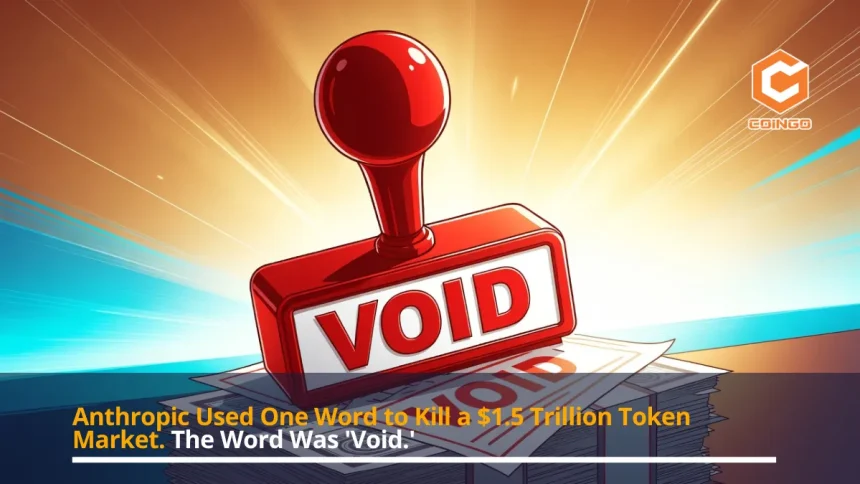
Anthropic updated its investor warning page on Monday with language that left no room for interpretation. Any sale or transfer of Anthropic stock without board approval is “void.” Not restricted. Not under review. Void. OpenAI posted near-identical language the same day. Both companies named names.
The fallout was immediate. Anthropic PreStocks, a Solana-based token issued by a platform called PreStocks, dropped 38% in a week. OpenAI PreStocks fell 46%. Combined market cap went from roughly $17 million to under $11 million. On Hyperliquid, Anthropic perpetual futures dropped 23% before recovering.
How PreStocks Worked. And Why It Broke.
PreStocks issues tokens on Solana that claim to represent indirect economic exposure to private company shares. The structure uses special purpose vehicles: a legal shell buys shares in the target company, pools outside money, and issues tokens against that position. Buyers get no equity. No shareholder rights. No voting power. Just “economic exposure tied to reserve backing,” according to the platform’s own terms. That structure carries many of the same warning signs as a rug pull: no attestation reports, thin liquidity, and implied valuations disconnected from underlying assets.
The numbers tell the story. PreStocks showed an implied Anthropic valuation above $1.5 trillion. The platform held roughly $23 million in total assets. Anthropic liquidity on the platform: $333,000 in stablecoins and $18,000 in SOL. If early buyers tried to exit at the same time, there was not enough liquidity to pay them out.
Anthropic Named Forge Global. That Changes Everything.
Anthropic did not just target fringe platforms. It listed Open Door Partners, Unicorns Exchange, Pachamama, Lionheart Ventures, Sydecar, Upmarket, and new offerings on Forge Global and Hiive as unauthorized. Forge Global is one of the most established private-share marketplaces in the secondary market. Putting it on the same list as unknown SPV operators sends a signal: Anthropic is not distinguishing between gray market and legitimate secondary trading. Both are void.
The problem with layered SPV structures is not new to crypto. Uphold marketed CredEarn as safe before the underlying yield source collapsed. The pattern is similar: a product that promises exposure to something valuable, backed by a structure that cannot deliver on its claims at scale. PreStocks never published the attestation reports it promised at launch. That alone should have been the red flag.
Why ‘Void’ Matters More Than ‘Restricted’
Crypto lawyer Gabriel Shapiro pointed out the legal weight of the word choice. “Void” under Delaware law means the transaction never existed. A buyer has no rights, no equitable defenses, no claim. “Voidable” would mean the company could challenge the transfer but the buyer might argue good faith. Anthropic chose the stronger word. That means any SPV that acquired Anthropic shares without board approval holds nothing. And anyone who bought tokens backed by that SPV holds a claim on nothing.
The enforcement precedent for unauthorized token offerings is real. The DOJ opened a $40 million compensation fund for OneCoin victims after 12 years of litigation. PreStocks is nowhere near that scale. But the legal architecture is the same: tokens sold as exposure to something the issuer does not actually control.
Anthropic Is Worth $380 Billion. That Is the Demand Problem.
Anthropic’s annualized revenue jumped from $9 billion at end of 2025 to $30 billion by April 2026. Amazon has committed up to $25 billion in investment. At those growth rates, investors who cannot get in through official channels will keep looking for side doors. A Bay Area investment banker recently offered his $4.8 million home in exchange for Anthropic shares rather than cash.
That demand is why PreStocks and similar platforms exist. It is also why both companies posted their warnings on the same day. The side doors are getting nailed shut. Whether regulators follow with enforcement or let the “void” designation do the work on its own is the next question.