What Happened This Week
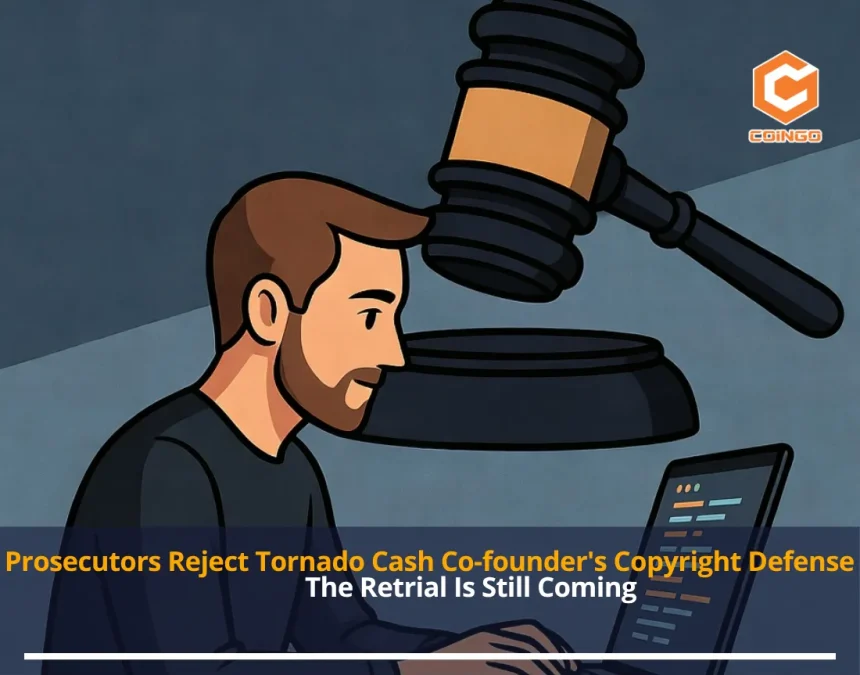
On April 8, 2026, US Attorney for the Southern District of New York Jay Clayton — former SEC Chairman, now SDNY’s top prosecutor — filed a response in the US District Court for the Southern District of New York rejecting Roman Storm’s motion to use a recent Supreme Court civil copyright case as part of his defense against the two remaining criminal charges.
Storm’s lawyers had filed a notice stating they intended to rely on the 2026 Supreme Court ruling in Cox Communications, Inc. v. Sony Music Entertainment — a civil copyright infringement case involving secondary liability — to argue that Storm’s knowledge of and intent to participate in criminal activity was limited or absent.
Clayton’s response was categorical. He stated that Storm’s conduct “bears no resemblance” to the conduct at issue in Cox, which involved civil copyright liability rather than criminal money laundering or sanctions violations. Clayton further stated there was no evidence that Storm implemented any effective anti-money laundering measures, and that Storm’s framing of Tornado Cash as a legitimate privacy tool was “window dressing at best and outright misdirection at worst.”
“The defendant’s conduct simply is not comparable to the conduct at issue in Cox. In any event, a civil copyright case has no relevance here in the first place.” — Jay Clayton, US Attorney for the Southern District of New York
Prosecutors and defense attorneys are scheduled to meet with Judge Katherine Polk Failla on Thursday, April 9, 2026 — the same day Storm’s Rule 29 motion for acquittal on his August 2025 conviction is also scheduled for argument.
The Case Timeline: From Arrest to Retrial
Understanding the current filing requires the full timeline. Roman Storm, co-founder of Tornado Cash, was arrested in August 2023. Tornado Cash is a non-custodial cryptocurrency mixing protocol built on Ethereum that obscures transaction trails by pooling user deposits and issuing cryptographically anonymous withdrawal credentials. Prosecutors alleged the protocol facilitated more than $1 billion in illegal transactions, including transfers by the North Korean Lazarus Group and other sanctioned actors.
Storm’s first trial concluded in August 2025 with a split verdict. The jury convicted him of conspiracy to operate an unlicensed money transmitting business — a charge carrying up to five years in prison. However, after four weeks of testimony and multiple days of deliberation, the jury deadlocked on the two more serious counts: conspiracy to commit money laundering and conspiracy to violate U.S. sanctions. Under federal procedure, a hung jury on those counts means the government can pursue a retrial without double jeopardy concerns.
In March 2026, SDNY prosecutors filed a letter to Judge Failla requesting a retrial date of October 5 or October 12, 2026, noting they were prepared to proceed as early as spring but acknowledged defense availability constraints. Storm’s defense team argued that scheduling was premature while the Rule 29 acquittal motion remained pending. Prosecutors moved forward with the request regardless. A guilty verdict on the two retrial counts could carry a maximum sentence of 40 years.

Table 1 — Roman Storm: Case Status Summary (April 2026)
| Charge | Status | Max Sentence |
|---|---|---|
| Conspiracy to operate an unlicensed money transmitting business | Convicted (August 2025) — Rule 29 motion for acquittal pending | Up to 5 years |
| Conspiracy to commit money laundering | Jury deadlocked — retrial proposed October 2026 | Up to 20 years |
| Conspiracy to violate U.S. sanctions | Jury deadlocked — retrial proposed October 2026 | Up to 20 years |
The Copyright Defense and Why Prosecutors Rejected It
Storm’s legal team’s decision to invoke Cox Communications, Inc. v. Sony Music Entertainment reflects an attempt to establish precedent around secondary liability for platform operators who facilitate third-party conduct. In the Cox case, the Supreme Court addressed whether an internet service provider could be held civilly liable for copyright infringement carried out by its subscribers — concluding that the provider must have actual knowledge of specific infringement and fail to act on it to be liable.
The defense argument was that Storm, like Cox, operated infrastructure used by others and lacked direct control over or knowledge of specific illegal transactions passing through the Tornado Cash protocol. The implication: if civil copyright law requires specific knowledge and inaction to establish secondary liability, criminal money laundering charges should require at least the same level of intent.
Clayton’s rejection of this framing rested on two arguments. First, the factual comparison fails: the Cox case involved civil liability for copyright infringement, not criminal conspiracy charges. The legal standards, evidentiary burdens, and policy considerations are categorically different. Second, the government maintains that Storm was not a passive platform operator — prosecutors argue he actively designed Tornado Cash to resist anti-money laundering measures and had actual knowledge of the protocol’s use by sanctioned actors.
Whether a jury in a retrial will find this argument persuasive on the money laundering and sanctions counts is a separate question. The August 2025 jury’s deadlock on those counts after hearing four weeks of evidence indicates at least some jurors found the government’s case insufficiently proven — which is precisely the unresolved tension a retrial is intended to address.
The Government’s Internal Contradiction
The Storm retrial is proceeding in the middle of a formal policy reversal at the DOJ — and that tension is now explicit in the public record.
In April 2025, then-Deputy Attorney General Todd Blanche issued a memo stating that the DOJ “is not a digital assets regulator” and directing prosecutors to stop targeting crypto platforms — including mixing and tumbling services — for the acts of end users or unwitting regulatory violations. The memo called for an end to “regulation by prosecution” and instructed that enforcement should focus on terrorism financing, narcotics, organized crime, and fraud — not using criminal cases to impose regulatory structures.
Blanche did not name Storm in the memo. But he wrote that the department would “not pursue actions against the platforms that criminal enterprises utilize to conduct their illegal activities” — language Storm cited directly on X when prosecutors announced the retrial request.
The same shift has played out across other federal agencies. Paul Atkins has spent twelve months at the SEC dismantling the enforcement-first posture of the previous administration, replacing it with a rulemaking-first framework. The DOJ memo and the SEC’s Reg Crypto proposal share the same underlying principle: regulators should write rules, not impose them through prosecutions. Storm’s retrial sits awkwardly inside that broader policy realignment, where the prosecutors pursuing him are operating against the explicit direction issued from the top of their own department.
The policy landscape has since shifted further. In March 2026, the U.S. Treasury submitted a report to Congress under the GENIUS Act explicitly acknowledging that “lawful users of digital assets may leverage mixers to enable financial privacy when transacting through public blockchains”, including to shield personal wealth, business dealings, and charitable donations. The Treasury did not endorse Tornado Cash specifically and maintained that mixers are frequently misused for money laundering — but the document represents a significant departure from the framing used in the original indictment.
Last week, President Trump fired Attorney General Pam Bondi and appointed Todd Blanche — the same official who wrote the anti-regulation-by-prosecution memo — as acting head of the Justice Department. How Blanche will use his new authority to direct DOJ policy on cases like Storm’s, and how long he will remain in the role pending Senate confirmation of a replacement, remains unclear. As of the Tuesday filing, Clayton’s office is moving forward with the retrial regardless.
“The 2 counts = up to 40 years in federal prison — for writing open-source code. For a protocol I don’t control. For transactions I never touched. A jury already couldn’t agree this was criminal. But the SDNY prosecutors want to keep trying with the hope of getting a different answer.” — Roman Storm, on X
What This Case Means for Developer Liability
The Roman Storm prosecution has become the most consequential test of developer liability for decentralized protocol code in U.S. legal history. The central question the case poses is whether a developer who writes non-custodial, open-source smart contract code — code the developer does not control after deployment — can be held criminally responsible for illegal transactions carried out by third parties using that code.
The argument for criminal liability, as the government frames it: Storm knew Tornado Cash was being used by sanctioned actors, made no serious effort to implement compliance measures, and actively marketed the protocol as a tool for bypassing financial surveillance. Intentional facilitation of crime, the government argues, does not become protected because it is implemented through software.
The argument against, as the defense and much of the crypto industry frame it: holding developers liable for how others use their code sets a precedent that could chill open-source software development broadly. The code does not discriminate between users. Storm neither held funds in custody nor authorized individual transactions. The same principle that protects a road builder from liability for a getaway driver would, in this framing, protect a protocol developer from liability for bad actors who use an anonymized transaction tool.
The crypto industry has rallied significantly around Storm’s defense. The Solana Policy Institute donated $500,000 to Storm’s and Alexey Pertsev’s legal defense funds. The Ethereum Foundation directed privacy-focused funding to the defense. The Free Roman Storm campaign reported total defense funding above $5 million by January 2026. Storm has disclosed that those funds are now near exhaustion.
The DeFi Education Fund called the retrial decision “incredibly disappointing” and cited what it described as prosecutorial failures in the first trial, including “irrelevant witnesses, a lack of understanding of their own blockchain forensic evidence, and multiple legal and logical fallacies” in the government’s developer-liability theory. Legislators have also responded: a bill to protect blockchain developers from prosecution has been introduced in Congress, though it has not yet passed.
The government’s enforcement posture also exposes a paradox sitting underneath the case. Tether has frozen more than $4.4 billion in USDT in coordination with US authorities, with the largest single action — $344 million — executed on Tron in coordination with OFAC just weeks ago. The same federal agencies that increasingly rely on stablecoin issuers to police illicit flows are simultaneously pursuing a developer who built code that does not custody funds at all. Whether non-custodial protocol design is something the legal system can prosecute the same way it prosecutes regulated intermediaries is the question October’s retrial will test.
The October 2026 retrial, if it proceeds, will offer the clearest legal test yet of whether the U.S. criminal justice system distinguishes between writing code that can be used to commit crimes and committing crimes through code. How Judge Failla resolves Thursday’s acquittal argument may determine whether that test ever reaches a second jury.