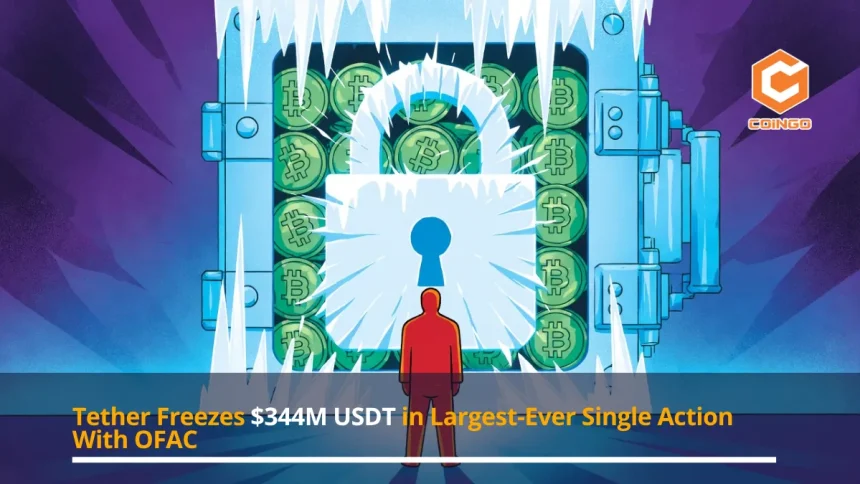
Tether froze $344 million in USDT across two Tron addresses on April 23, executing its largest single enforcement action on record. The freeze was coordinated with the US Office of Foreign Assets Control and multiple federal law enforcement agencies, targeting wallets flagged for sanctions evasion and criminal network activity. The action roughly doubles the previous high of $182 million blacklisted across five Tron wallets in January, and brings Tether’s cumulative frozen assets to more than $4.4 billion since it began publishing enforcement data.
Two Wallets, One Coordinated Freeze
The two blacklisted addresses held $212.9 million and $131.3 million respectively, both on the Tron network. Tether said US authorities shared intelligence linking the wallets to unlawful conduct before the freeze was executed, preventing further movement of funds. The issuer did not name the individuals or groups behind the addresses, and the announcement did not specify the exact criminal activity under investigation.
CEO Paolo Ardoino framed the action as routine rather than exceptional, saying USDT is not a safe haven for illicit activity and that Tether acts immediately when credible links to sanctioned entities or criminal networks are identified. The company retains administrative control over the USDT smart contract on every supported network, giving it the technical ability to block transfers from any flagged address at the token-contract level.
How This Freeze Compares to Recent Enforcement Actions
The April 23 freeze sits at the top of a growing list of coordinated blacklist events. Tether’s enforcement activity has scaled steadily as its cooperation network with law enforcement has expanded.
| Date | Amount | Network | Trigger |
|---|---|---|---|
| April 23, 2026 | $344 million | Tron | OFAC and US law enforcement |
| January 11, 2026 | $182 million | Tron | US Treasury sanctions |
| July 2024 | $29.6 million | Tron | Huione Group investigation |
Tether now works with more than 340 law enforcement agencies in 65 countries and has supported over 2,300 global cases. Of the $4.4 billion in total frozen assets, roughly $2.1 billion is tied to US authorities. The Department of Justice has previously acknowledged Tether’s role in seizures of nearly $61 million and approximately $225 million connected to pig butchering fraud.
Stablecoin Centralization Back in Focus
The scale of the freeze renews the long-running debate over issuer control in fiat-backed stablecoins. USDT’s circulating supply sits above $187 billion and represents roughly 64% of the global stablecoin market, which means Tether’s ability to freeze individual wallets has systemic reach.
Supporters of the model argue that the enforcement record demonstrates the advantage of public blockchains over traditional banking rails: wallets can be flagged, funds can be traced in real time, and assets can be frozen before they move downstream. Critics point out that the same capability that enables sanctions compliance also makes USDT fundamentally different from decentralized assets, with unilateral freeze authority concentrated in a single issuer.
That centralization question is also where the long-tail USDT collapse scenario diverges from a typical stablecoin de-peg. A freeze authority that can lock $344 million in a single coordinated action is the same authority that would have to manage an unwind under stress, with regulators, law enforcement, and redemption queues all pulling in different directions at once. The April 23 action is a stress test on the upside, where coordination produces a clean outcome. The scenario nobody has run yet is what the same machinery looks like when the pressure flips.
The pressure on stablecoin issuers is likely to increase as US regulatory frameworks move forward. The GENIUS Act and ongoing work on broader market structure legislation both include provisions that would formalize the kind of freeze-and-coordinate model Tether already operates. The April 23 action reads less as an outlier and more as a preview of how large-scale stablecoin enforcement will look under the regulated regime now taking shape.