
The Filing
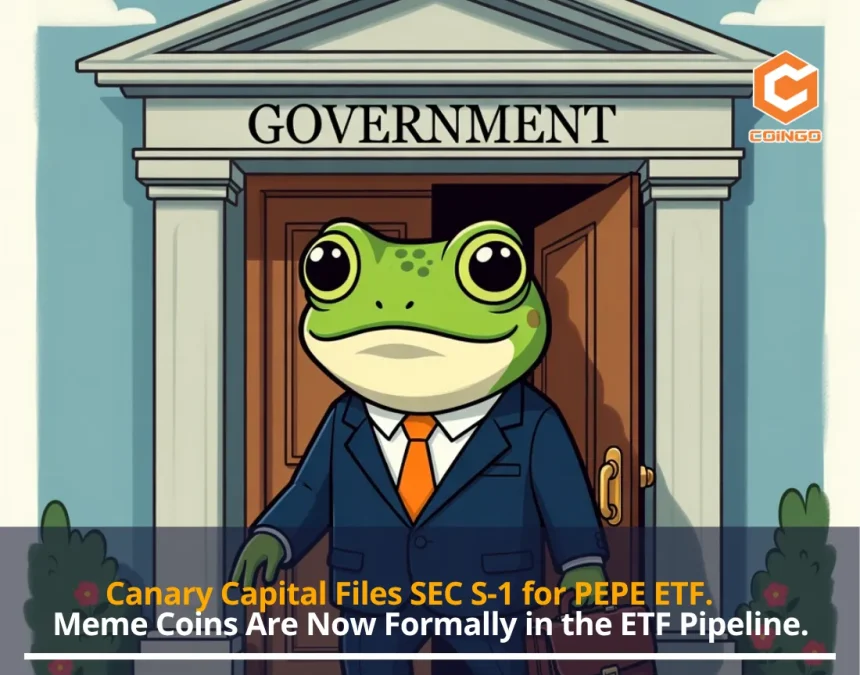
Canary Capital Group submitted a Form S-1 registration statement to the U.S. Securities and Exchange Commission on April 8, 2026 for the Canary PEPE ETF. The proposed fund would hold PEPE directly as its primary asset, tracking the token’s price through a benchmark calculated from major PEPE trading venues. Shares would be issued in 10,000-share baskets — the same structure used for Bitcoin and Ethereum spot ETFs.
The fund would hold no derivatives or leveraged instruments. A custodian would secure the PEPE holdings. Up to 5% of assets may initially be held in ETH to cover Ethereum network transaction fees required when moving PEPE, with that portion expected to decrease over time as fees are paid down. The filing warns that ongoing operational expenses could gradually reduce the trust’s PEPE holdings, and that investors could lose their entire investment.
PEPE is an ERC-20 meme token launched on Ethereum in April 2023, inspired by the Pepe the Frog internet character. It has no stated utility beyond cultural and community appeal. The S-1 is explicit about this: the filing states that PEPE’s value is driven primarily by online popularity, cultural relevance, and social sentiment rather than any underlying blockchain function or commercial use case.
The Regulatory Context: Meme Coins Are Already in the ETF Market
What makes the Canary filing meaningful is the landscape it enters. Meme coin ETFs are no longer theoretical. The Grayscale Dogecoin Trust ETF, trading under the ticker GDOG on NYSE Arca, has been live since November 24, 2025. A March 2026 prospectus supplement and annual report confirmed the product is fully operational in the U.S. market. A Dogecoin ETF was approved and is trading — that precedent now exists.
The institutional ETF wrapper has been working. BlackRock’s IBIT pulled in $269 million on its best day in five weeks, demonstrating that the regulated wrapper structure attracts capital that does not directly hold spot crypto. Whether that structural demand extends to a sentiment-driven asset with no utility claim is the question the PEPE filing puts to the SEC.
BONK, a Solana-based meme token, has also entered the pipeline. Tuttle Capital filed for a Bonk Income Blast ETF in September 2025, and separate SEC filings show a 2X Long Bonk Daily Target ETF was included in an earlier leveraged crypto ETF registration package. Tuttle separately sought approval for leveraged products tied to TRUMP and MELANIA tokens, part of a broader wave of filings testing what the current SEC under the Atkins administration will permit.
Canary Capital has been among the most active filers in this space. The firm has previously submitted applications for Solana, XRP, Litecoin, and HBAR ETFs, as well as a spot ETF tied to Trump’s TRUMP meme coin in 2025. The PEPE filing follows the same legal structure: a Delaware statutory trust established before the formal S-1 submission, using CSC Delaware Trust Company as registered agent — the same setup used for other crypto ETF applications.
What the Filing Admits and What It Does Not Resolve
The S-1 is unusually candid about risk. The prospectus acknowledges that PEPE spot markets are relatively new and largely unregulated, leaving the product exposed to price manipulation, custody failures, and disruptions on the Ethereum network. It notes that the aggregate value of outstanding PEPE is far smaller than Bitcoin and could be eclipsed by other assets developing more rapidly.
The filing also acknowledges directly that PEPE lacks the transactional utility that gives other digital assets a grounding beyond speculation. The Canary PEPE ETF, if approved, would be a pure sentiment vehicle — a regulated wrapper around an asset that by the fund manager’s own description has no fundamental valuation anchor.
Whether the SEC will approve it is a separate question. The agency has up to 240 days to act on an ETF filing, though that timeline can be extended. The current regulatory environment under Chair Paul Atkins has been meaningfully more permissive toward crypto products than the Gensler era. Dogecoin’s approval set a precedent. What remains to be determined is whether that precedent extends to tokens with even less established market history and no utility claim at all — or whether the SEC draws a line somewhere between DOGE and PEPE in the meme coin spectrum.