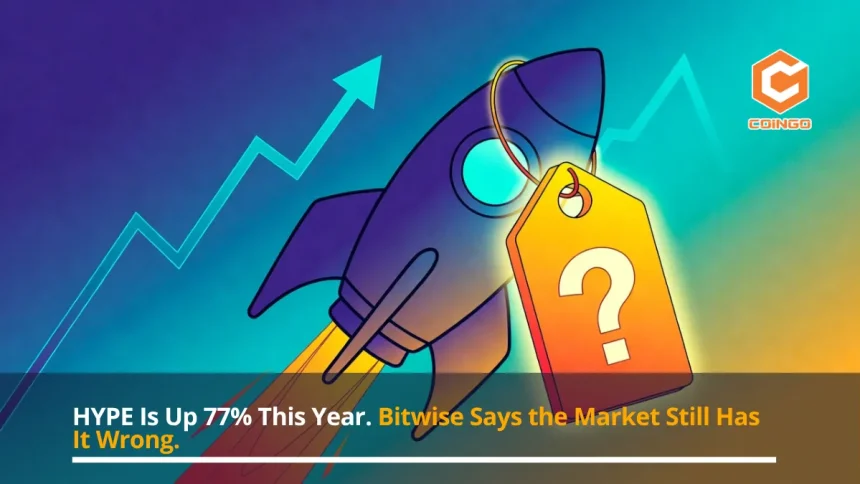
Bitwise just told its clients that Hyperliquid’s HYPE token is one of the most mispriced assets in crypto. This from a firm that manages billions in digital assets and just launched a HYPE ETF on the New York Stock Exchange under the ticker BHYP.
That is not a neutral observation. It is a position.
HYPE is up 77% year-to-date, making it the best-performing large-cap crypto asset of 2026. It trades around $48, within $11 of its all-time high. The platform processed $170 billion in trading volume over the past month. And Bitwise’s CIO Matt Hougan is arguing that all of that is still not enough.
Two Errors, According to Hougan
The first error is a category mistake. Investors look at Hyperliquid and see a crypto perpetual futures exchange. They price it like one. But the platform now gets nearly half its volume from non-crypto assets: commodities, S&P 500 futures, pre-IPO stocks, and prediction markets. Hougan expects non-crypto assets to reach 70% of total volume by year-end.
That shift started accelerating when Hyperliquid integrated prediction markets directly into its perps engine. The SpaceX pre-IPO contract that launched last week under a synthetic perpetual structure drove HYPE up 7% in a single session while Bitcoin was falling. The platform is pulling in volume that has nothing to do with crypto prices.
The second error is an anchoring mistake. People compare HYPE to older DeFi tokens where fees go to a treasury or get distributed unevenly. Hyperliquid routes 99% of trading fees into buying back HYPE. More trading, more buybacks. No ambiguity in the value accrual mechanism.
The Buyback Model Is the Entire Thesis
This is where Hougan’s argument gets specific. HYPE is the only top-15 token where 97% of revenue goes back to holders. Hougan puts the real number at 99% when you count the full fee routing. That makes HYPE more comparable to a stock with a buyback program than to a governance token sitting in a DAO treasury.
The numbers back the model. Hyperliquid returned $51 million to token holders in 30 days while spending zero on incentives. No liquidity mining. No emission schedules propping up yield farms. Revenue comes from real trading fees, and it flows to token holders through buybacks. Hougan compared it to Robinhood or CME Group rather than to Uniswap or dYdX.
The ETF Race Is Already On
21Shares launched the first U.S. spot HYPE ETF under the ticker THYP on May 12. It drew $5 million in inflows within days. Bitwise followed on May 15 with BHYP on the NYSE, charging a 0.34% sponsor fee. Here is the unusual part: Bitwise committed to using 10% of BHYP’s management fees to buy and hold HYPE tokens on its own balance sheet. That means the ETF issuer is not just offering exposure. It is accumulating the underlying asset alongside its clients.
Two competing HYPE ETFs trading in the same week is a signal. It means institutional product manufacturers believe there is allocator demand for a token that most retail investors still associate with a leverage trading platform.
The $600 Trillion Number
Hougan’s memo contains a number that is easy to dismiss: $600 trillion. That is the total addressable market he assigns to Hyperliquid if it successfully becomes a multi-asset trading platform spanning crypto, equities, commodities, and prediction markets. The global derivatives market alone exceeds $700 trillion in notional value. Hougan has a track record of making expansive market-sizing arguments, including his case that Bitcoin’s target market exceeds gold’s $38 trillion cap. Whether you buy the $600 trillion frame or not, the directional argument is clear: Hyperliquid is not competing with crypto exchanges. It is competing with financial infrastructure.
The platform is still not available to U.S. users. It would need to integrate into the domestic regulatory system before American capital can flow in directly. Arthur Hayes is bullish. Bitwise is bullish and putting money behind it. The token is $11 from its all-time high. And the CIO of one of the largest crypto asset managers just called it mispriced. The market will decide whether that is analysis or marketing.