The Origin Story: From Dirt Floor to Binance
CZ was born in rural China in a home with no running water. His family emigrated to Canada when he was a teenager. He worked part-time jobs, studied computer science, and built a career in financial technology — designing trading infrastructure at Bloomberg before recognizing blockchain as the next structural shift in 2013.
Binance was founded in July 2017 in Shanghai, during the peak of the ICO boom. CZ recalls that the platform’s name was not his idea. He had already written the whitepaper when he invited Yi He — now Binance co-founder and CZ’s partner — to the office. She saw the draft and dismissed the original name as sounding like a supermarket. “Binance,” she suggested. CZ accepted immediately. She was surprised he didn’t want to think longer.
- The Origin Story: From Dirt Floor to Binance
- The 2017 China Ban: SIM Cards Out, Plane to Tokyo
- Vitalik, Tokyo and the Ethereum Regret
- LUNA: 1.6 Billion Dollars They Chose Not to Sell
- FTX: The Bologna Sandwich Call and Caroline Ellison’s Fatal Mistake
- Gary Gensler: Sushi in Tokyo, Then a Lawsuit
- Prison, ICE and the Incident He Called Appalling
- What the Book Does — and Does Not — Do
Within six months of launch, Binance was the world’s largest crypto exchange by trading volume. That pace of growth was not the result of marketing spend — it was the result of speed. Binance listed tokens faster than anyone else, charged lower fees, and built a mobile experience when competitors were still desktop-first. CZ’s framing throughout the book is that product quality and user focus drove the rise. Critics would note that regulatory minimalism was also a structural advantage.
The 2017 China Ban: SIM Cards Out, Plane to Tokyo
One of the book’s most vivid scenes describes the night CZ learned China would ban crypto exchanges — on September 4, 2017. He found out a day early through a voice message in his email.
An emergency meeting was called with senior staff. CZ, Yi He, and another executive decided to fly immediately to Tokyo. Yi He, drawing on instinct from spy films she had watched, insisted they remove SIM cards from their phones before leaving — to avoid being tracked. CZ did so without argument.
“He Yi had the idea because of films she had watched. I listened and took the SIM card out.” — CZ, Freedom of Money
The other executives remained in Shanghai temporarily. Binance survived the ban by being offshore before enforcement began. It was the first of many moments in the book where CZ credits Yi He’s instincts — and his willingness to act on them without overthinking — as decision points that shaped Binance’s survival.
Vitalik, Tokyo and the Ethereum Regret
Perhaps the most personally revealing passage in the book involves Vitalik Buterin. CZ first met Vitalik at the Bitcoin Conference in Las Vegas in December 2013. Vitalik was 19 years old and writing for Bitcoin Magazine. He was already describing a concept called Ethereum — a blockchain on which anything could be programmed.
In 2015, Vitalik stayed at CZ’s apartment in Tokyo. He slept in a bunk bed with CZ’s eight-year-old son. During that stay, he taught CZ’s son the mathematical concept of infinity. CZ and Vitalik had long discussions about whether it was genuinely possible to build a programmable blockchain system. Vitalik believed it was. CZ, despite following Ethereum and knowing Vitalik personally, never invested.
“Thanks to Vitalik, I was also following Ethereum. But I never invested. What a huge opportunity I missed. I could have made hundreds of times the profit. Maybe if I had made that profit, I wouldn’t have founded Binance. Binance wouldn’t exist today. Fate has a different plan for everyone.” — CZ, Freedom of Money
This passage functions simultaneously as genuine regret and a rhetorical pivot. CZ acknowledges the missed opportunity, then reframes it as the cause of Binance’s existence. The implicit argument: the loss was the gift. Whether readers find this convincing depends on how much they believe in the narrative of destiny versus the narrative of risk aversion.
LUNA: 1.6 Billion Dollars They Chose Not to Sell
The Terra/LUNA collapse in May 2022 wiped approximately $60 billion in market value in a matter of days. Binance had been an early investor — putting in roughly $3 million in 2018. By the time of the collapse, the position was worth approximately $1.6 billion in LUNA tokens.
CZ describes extended internal debate about whether to reduce the position before or during the collapse. The team decided not to sell. The stated reason: they did not want to be seen as the institutional seller that exited before retail investors could. CZ describes holding through the crash and still holding the majority of those tokens today — at near-zero value.
This section is one of the book’s more striking moments of apparent financial self-disclosure. A $1.6 billion position held through a 99% collapse, by choice, to avoid reputational harm. Whether this reads as principled or as a rationalization of a decision not to exit is something each reader will determine differently. It does reveal how CZ thinks about the relationship between Binance’s market position and its public behavior during industry crises.
FTX: The Bologna Sandwich Call and Caroline Ellison’s Fatal Mistake
The FTX section is the most consequential part of the book and the most carefully constructed. CZ’s account of the November 2022 collapse begins with a phone call from Sam Bankman-Fried as FTX was beginning to unravel. According to CZ, SBF requested several billion dollars in emergency funding.
“He asked for a couple of billion dollars nonchalantly, as if he were ordering a bologna sandwich.” — CZ, Freedom of Money
CZ signed a non-binding Letter of Intent to potentially acquire FTX — he states explicitly in the book that this was never a serious acquisition attempt. He describes the LOI as a formality to assess whether users could be protected, with no commitment of capital or intent to close. His team was given 24 hours to assess FTX’s balance sheet. They never received a complete one. The deal was abandoned.
On the actual mechanism of collapse, CZ points squarely at Caroline Ellison, then CEO of Alameda Research, FTX’s sister trading firm. When Ellison publicly offered to buy Binance’s FTT token holdings at $22 per token — an attempt to stabilize the price — CZ argues she made a fatal mistake.
“She had just revealed her floor price.” — CZ, Freedom of Money
Professional traders immediately shorted FTT through the $22 level. The token fell to $15, then $10, then $5. Within 72 hours, approximately $6 billion had exited FTX. The rest is documented history.
The book also discloses the existence of “Exchange Collaboration” — a Signal group set up by FTX’s Zane Tackett during the earlier Terra/LUNA collapse, which included CZ, SBF, and others. The group later drew scrutiny from the DOJ and SEC over potential market coordination. CZ flatly denies any collusion.
Gary Gensler: Sushi in Tokyo, Then a Lawsuit
One of the book’s more politically charged disclosures involves former SEC Chair Gary Gensler. CZ writes that he first met Gensler in 2018 and, at some point, offered him a role as a Binance adviser. Gensler declined.
The two later met for sushi at the Okura hotel in Tokyo in March 2019. The relationship was cordial at the time. Gensler subsequently became SEC Chairman in 2021 under the Biden administration and led an aggressive enforcement campaign against the crypto industry, including a lawsuit accusing CZ and Binance of securities violations. That lawsuit was withdrawn after President Trump took office.
CZ presents this timeline without overt commentary — but the sequencing does the work. The man he tried to hire, had dinner with, and cultivated a relationship with later became the architect of the most significant legal challenge Binance faced. The book does not suggest impropriety. It lets the facts speak.
Prison, ICE and the Incident He Called Appalling
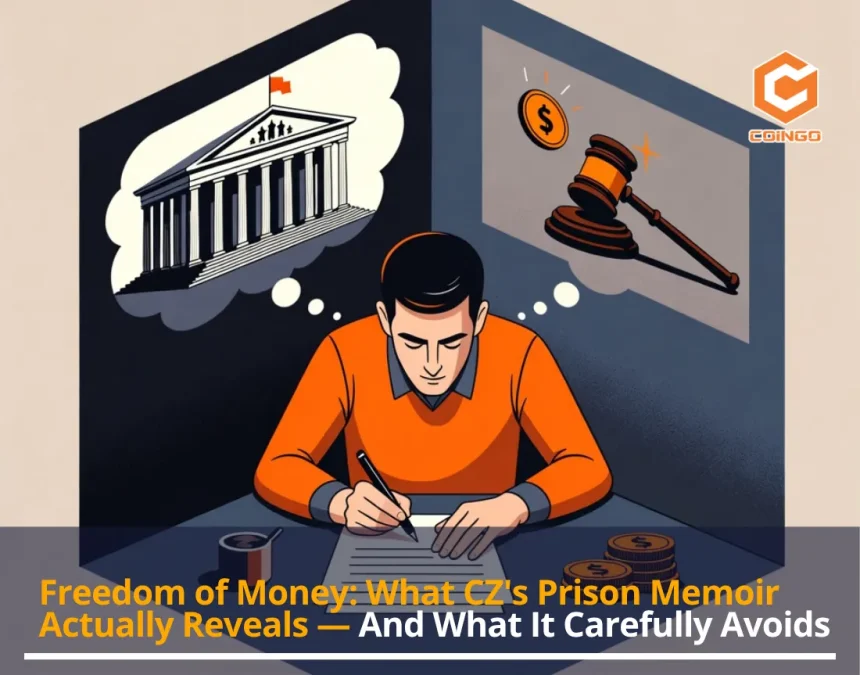
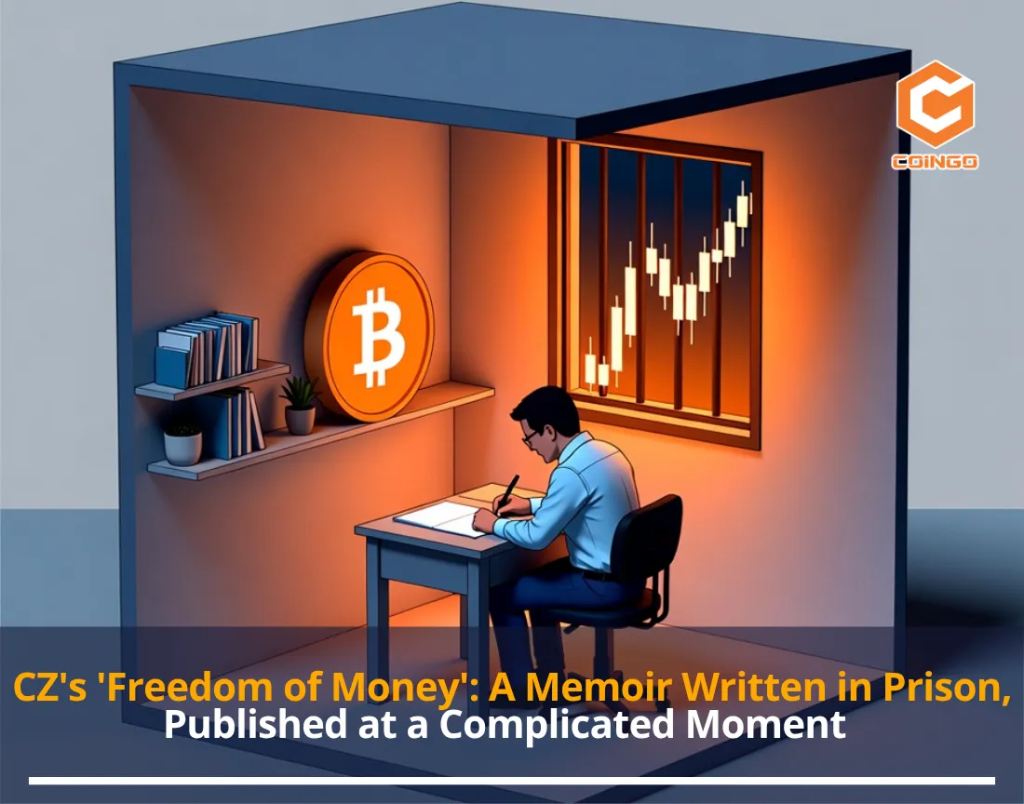
CZ pleaded guilty to a Bank Secrecy Act violation in November 2023 and served a four-month sentence at a federal prison facility in 2024. He wrote most of Freedom of Money during that sentence — in a controlled environment with no distractions, no team to manage, and time to reflect on a company he had built over seven years.
The book includes a previously undisclosed incident: near the end of his sentence, the Department of Homeland Security placed an immigration detainer on him over a visa overstay. CZ had remained in the United States only because federal authorities had ordered him to stay as a condition of his plea. He describes being detained again, briefly, after serving his sentence — an experience he calls both appalling and revealing about the bureaucratic realities of being a foreign national in the U.S. legal system.
He was ultimately released. President Trump pardoned CZ later that year, clearing his criminal record — though the compliance restrictions from the DOJ settlement, which bar him from managing Binance operationally, remain in effect. Richard Teng continues to serve as CEO. CZ retains approximately 90% ownership.
What the Book Does — and Does Not — Do
Freedom of Money is a memoir that controls its own narrative carefully. CZ is transparent about personal regret — the Ethereum miss, the LUNA decision — but those admissions are structurally safe. They cost him nothing in legal terms and humanize him in ways that serve the book’s rehabilitation arc.
The FTX section is detailed on mechanics and carefully evasive on motive. CZ is clear that he never wanted FTX and never trusted SBF. He is less clear on the question of whether Binance’s release of its FTT holdings — the move that catalyzed the bank run — was a competitive act, a protective act, or both. The book presents it as the latter. Reasonable people reading the sequence of events will reach their own conclusions.
The DOJ settlement framing is the book’s most deliberate construction. CZ consistently describes the charges as a single compliance violation from Binance’s early growth phase — not fraud, not intentional sanctions evasion, not deliberate AML failure. The DOJ’s own filings, court testimony, and the $4.3 billion settlement figure — the largest financial penalty in DOJ history for a financial institution at the time — tell a more complex story. The book is CZ’s version. It does not replace the record.
What Freedom of Money does accomplish is significant: it gives the most complete first-person account of how Binance was actually built, what CZ was thinking during the industry’s most consequential crises, and what it costs to fight the U.S. federal legal system as a non-citizen founder of a globally significant financial institution. For anyone trying to understand not just what happened at Binance but why — this is the primary source. Read alongside the DOJ filings and the public record, it is considerably more valuable than read alone.