
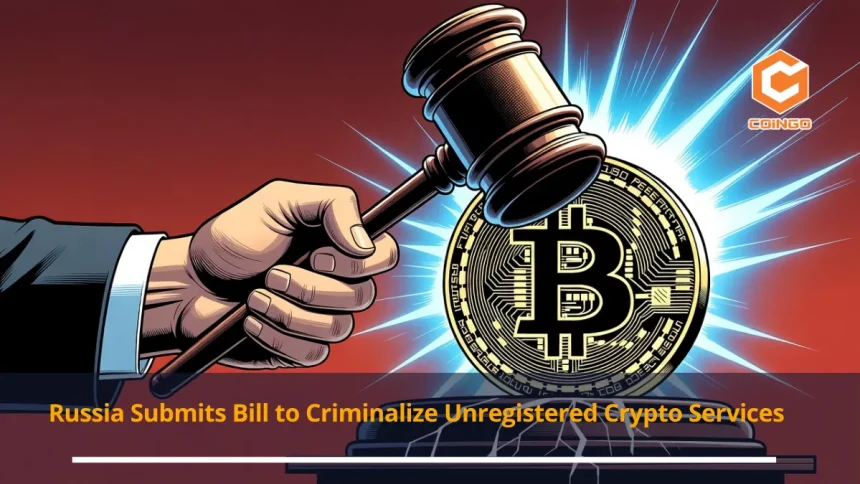
Russia’s government submitted a bill to the State Duma on April 17 that would attach criminal liability to any entity operating crypto services without registration from the Bank of Russia. The draft law targets individuals and groups “carrying out activities related to the organization of digital currency circulation” outside the country’s regulatory framework. Penalties range from fines of up to 1 million rubles ($13,100) to prison sentences of up to seven years for organized groups. Russia’s Supreme Court has already pushed back, calling the measure “premature” until the country’s broader Digital Currency and Digital Rights law takes effect.
Fines, Forced Labor, and Up to Seven Years Behind Bars
The bill proposes a tiered penalty structure. Individuals operating without Bank of Russia registration would face fines of up to $4,000 and up to four years in prison. For organized groups, or cases involving large-scale damage or income, the penalties escalate significantly.
| Offense | Fine | Prison |
|---|---|---|
| Individual operating without Bank of Russia registration | Up to $4,000 | Up to 4 years |
| Organized group or large-scale income/damage | Up to 1M rubles ($13,100) or salary equivalent for up to 5 years | Up to 7 years (or 5 years compulsory labor) |
The bill also proposes fines equal to the convicted person’s salary or other income for a period of up to five years, adding an earnings-based component to the penalty structure. The legislation builds on a package of bills initially proposed in March 2026 that included criminal penalties for illegal crypto miners. This latest bill extends those penalties to all unregistered digital asset services, including exchanges, custodians, and intermediaries.
Americans Lost Over $11 Billion to Crypto Scams in 2025. The FBI’s IC3 Report Shows How.
Supreme Court Calls Bill “Premature”
Russia’s Supreme Court told Russian media outlet RBC that the bill lacks “reasoned justification” for imposing criminal penalties at this stage. The court argued that enforcement is premature until Russia enacts its comprehensive Digital Currency and Digital Rights law, which is expected to take effect in July 2026. Without that foundational legislation defining what activities are legal and which require licensing, the court suggested it would be difficult to fairly prosecute individuals under the proposed criminal provisions.
From Gray Zone to Regulated Market: Russia’s Crypto Timeline
The criminalization bill is part of a broader effort by Russian authorities to formalize what has been a largely unregulated market. In December 2025, the Bank of Russia published a conceptual regulatory framework that would create a licensed crypto market while maintaining a ban on using digital currencies for domestic payments. Under the proposal, cryptocurrencies are recognized as monetary assets that can be bought and sold, but not used as legal tender.
| Date | Milestone |
|---|---|
| Dec 2025 | Bank of Russia publishes crypto regulation concept, submits legislative proposals to government |
| Mar 2026 | Package of bills proposed including criminal penalties for illegal crypto miners |
| Apr 17, 2026 | New bill submitted to State Duma criminalizing unregistered crypto services |
| Jul 1, 2026 | Target date for Digital Currency and Digital Rights law to take effect |
| Jul 1, 2027 | Criminal liability for illegal crypto intermediation scheduled to begin |
The Bank of Russia’s framework introduces a two-tier investor model. Non-qualified investors would be limited to purchasing only the most liquid cryptocurrencies after passing a mandatory knowledge test, with annual purchases capped at 300,000 rubles (~$3,800) per intermediary. Qualified investors would face fewer restrictions. Existing financial institutions, including exchanges, brokers, and trust managers, would be able to offer crypto services under their current licenses with additional compliance requirements.
$15 Billion in Fees Leaving the Country
The regulatory push has an economic dimension. Sergey Shvetsov, chairman of the supervisory board of the Moscow Exchange, has said that Russian users currently pay approximately $15 billion in fees to international cryptocurrency exchanges annually. The Moscow Exchange has signaled its intent to enter the crypto market and capture those fees domestically.
Chainalysis has ranked Russia among the world’s top 10 countries for crypto adoption, with more than $376 billion in crypto transactions between July 2024 and June 2025. Central Bank Governor Elvira Nabiullina has described cryptocurrencies as too volatile and often used for opaque transactions, making them unsuitable as legal tender outside controlled experimental zones. Russia could begin blocking websites of major crypto exchanges that are not registered domestically as early as this summer.
Grinex Hack Underlines the Security Argument
The bill’s timing coincides with a high-profile security failure. Grinex, a sanctioned, Russia-linked crypto exchange based in Kyrgyzstan, halted trading on April 16 after losing more than 1 billion rubles (~$13.7 million) in a hack. The company attributed the attack to “entities of hostile states” and filed a criminal complaint. The incident gives Russian lawmakers an immediate example of the risks that unregulated crypto operations pose, strengthening the case for mandatory registration and oversight.
Regulation, Not Prohibition
Russia is not banning crypto. Ownership, purchase, sale, and mining of cryptocurrencies remain legal and have been recognized as taxable property since 2025. What the government is doing is moving the market from a gray zone into a tightly supervised structure where operating without a license carries criminal consequences. Whether the Duma passes the bill in its current form depends on resolving the Supreme Court’s objections and finalizing the broader digital currency law expected in July.