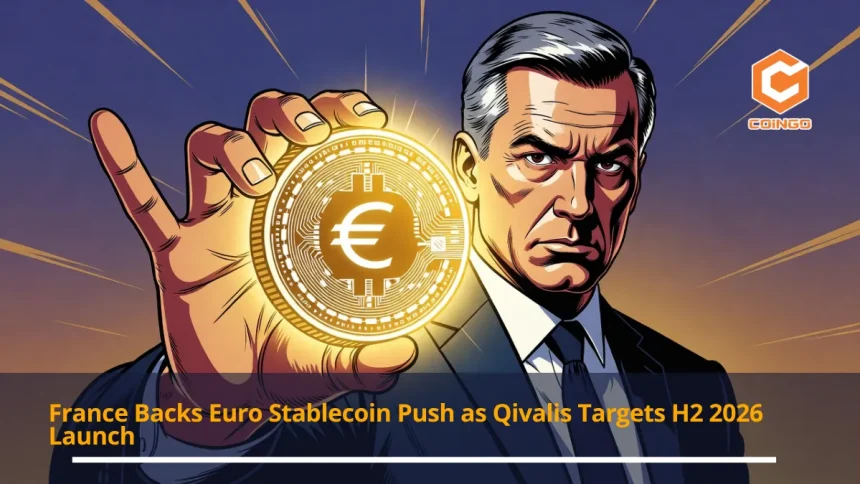
French Finance Minister Roland Lescure has publicly endorsed the Qivalis initiative, a consortium of 12 major European banks working to launch a euro-pegged stablecoin in the second half of 2026. Speaking at a crypto conference in Paris on April 17, Lescure said the current share of euro-denominated stablecoins compared to dollar-backed tokens is unacceptable and urged banks to accelerate work on tokenized deposits. The endorsement signals a clear policy shift in Paris toward bank-issued digital euros and an effort to counter what officials increasingly describe as “digital dollarization” of European payment rails.
Lescure Calls for Euro-Native Stablecoins to Match Dollar Dominance
In a pre-recorded message shared at the Paris event, Lescure described the gap between euro and dollar stablecoin volumes as “not satisfactory.” He specifically referenced the Qivalis project, saying “that is what we need, and that is what we want,” and called on European banks to explore tokenized deposit issuance alongside stablecoin efforts.
- Lescure Calls for Euro-Native Stablecoins to Match Dollar Dominance
- Qivalis: 12 Banks, One Euro Stablecoin, MiCA License Pending
- 1:1 Backing, 24/7 Redemption, Sovereign Bond Reserves
- The Euro’s 0.2% Share of On-Chain Activity
- Stablecoin Yield Remains a Regulatory Flashpoint
- Europe’s Two-Track Digital Euro Strategy
The remarks mark a shift from France’s earlier, more cautious stance on private-sector stablecoins. Officials have traditionally prioritized the European Central Bank’s digital euro project over private alternatives. Lescure’s explicit backing of Qivalis suggests Paris now sees private, regulated stablecoins as complementary tools for preserving the euro’s relevance on blockchain infrastructure.
Japan’s Stablecoin Framework: Who Can Issue, Who Gets Blocked, and What Comes Next
Qivalis: 12 Banks, One Euro Stablecoin, MiCA License Pending
Qivalis was first announced in September 2025 by nine founding banks: ING, UniCredit, CaixaBank, Danske Bank, Raiffeisen Bank International, KBC, SEB, DekaBank and Banca Sella. BNP Paribas joined in December 2025, followed by DZ BANK and BBVA, bringing the total to 12. The consortium’s combined client base reaches roughly 150 million customers across Europe.
The Amsterdam-based entity is led by CEO Jan-Oliver Sell, former head of Coinbase Germany, and chaired by Sir Howard Davies, former chairman of the UK’s Financial Services Authority and NatWest. Qivalis is currently seeking authorization from the Dutch Central Bank (DNB) as an Electronic Money Institution under the EU’s Markets in Crypto-Assets (MiCA) framework, with a commercial launch targeted for H2 2026.
| Bank | Country | Joined |
|---|---|---|
| ING | Netherlands | Sep 2025 |
| UniCredit | Italy | Sep 2025 |
| CaixaBank | Spain | Sep 2025 |
| Danske Bank | Denmark | Sep 2025 |
| Raiffeisen Bank International | Austria | Sep 2025 |
| KBC | Belgium | Sep 2025 |
| SEB | Sweden | Sep 2025 |
| DekaBank | Germany | Sep 2025 |
| Banca Sella | Italy | Sep 2025 |
| BNP Paribas | France | Dec 2025 |
| DZ BANK | Germany | Feb 2026 |
| BBVA | Spain | Feb 2026 |
1:1 Backing, 24/7 Redemption, Sovereign Bond Reserves
The Qivalis stablecoin will maintain 1:1 euro backing, with at least 40% of reserves held in bank deposits and the remainder allocated to high-quality, short-term sovereign bonds diversified across multiple EU member states. The structure is designed to avoid concentration risk in any single country’s debt. Token holders will have access to 24/7 redemption, a requirement aligned with MiCA’s standards for e-money tokens.
The consortium is also in advanced discussions with crypto exchanges, market makers and liquidity providers to ensure the token is listed on regulated platforms from day one. Spanish exchange Bit2Me has confirmed holding talks with a participating bank. Member banks will additionally distribute the stablecoin directly through their own corporate and institutional channels.
The Euro’s 0.2% Share of On-Chain Activity
The urgency behind the initiative is grounded in numbers. While the euro accounts for roughly 20% to 25% of global financial activity in traditional markets, its share of on-chain transactions sits at approximately 0.2%, according to Qivalis CEO Jan-Oliver Sell. Dollar-denominated stablecoins, led by Tether’s USDT at roughly $186 billion in market cap, account for about 99% of all stablecoin supply in circulation.
Euro-denominated stablecoins, by contrast, totaled only around €395 million in supply as of late 2025. Circle’s EURC currently leads the euro stablecoin market with over 50% share and a market cap of approximately $460 million. Societe Generale’s EURCV and a handful of smaller MiCA-compliant tokens make up the rest. S&P Global Ratings has projected the euro stablecoin market could reach up to €1.1 trillion by 2030, a potential 1,600x increase from its 2025 base.
Stablecoin Yield Remains a Regulatory Flashpoint
Lescure’s support for euro stablecoins comes alongside ongoing tension over stablecoin yield. Banque de France Governor François Villeroy de Galhau said at the World Economic Forum in January that tokenization and stablecoins would be “the name of the game” in 2026, but opposed interest-bearing stablecoins, warning they could destabilize financial systems.
The yield question is equally contentious across the Atlantic. In the U.S., the CLARITY Act, a crypto market structure bill that passed the House of Representatives in July, has been stalled in the Senate amid disagreements over stablecoin yield treatment, tokenized equities, and ethics provisions. No compromise had been announced as of the date of Lescure’s remarks.
Europe’s Two-Track Digital Euro Strategy
Qivalis is unfolding alongside the ECB’s own digital euro initiative, creating a dual-track approach: central bank money on one side, and regulated private stablecoins on the other. Sell has said the two are complementary rather than competitive, describing a monetary stack where central bank money operates on centralized systems while blockchain use cases require a euro-native asset on public networks.
If Qivalis secures its EMI license and launches on schedule, it will be one of the largest coordinated efforts by European banks to enter the stablecoin market. With 12 banks, 150 million clients, and explicit political backing from France, the consortium represents the clearest institutional signal yet that Europe does not intend to let its on-chain payment infrastructure default to the dollar.