
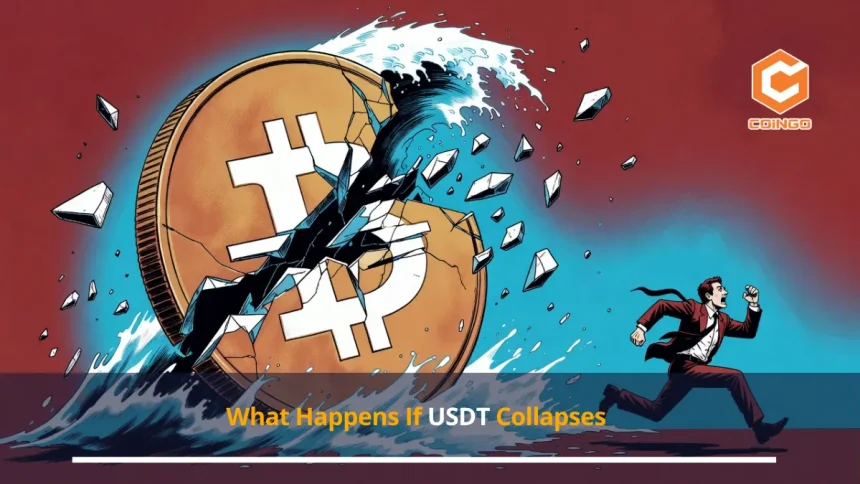
USDT is the single most important piece of infrastructure in crypto. It is the default quote currency on centralized platforms, the dominant settlement layer in DeFi lending pools, and the primary on-ramp for hundreds of millions of users in emerging markets. Its market cap exceeds $187 billion, with over 60% of all supply circulating on Tron alone. Roughly 500 million people interact with USDT globally. If this stablecoin were to lose its peg in a meaningful and sustained way, the consequences would ripple far beyond the Tether treasury. This analysis maps out exactly what those consequences would look like.
What USDT Actually Backs and Why It Matters
Tether’s reserves have evolved significantly since its early days of questionable commercial paper holdings. As of the most recent attestation, the reserve composition is approximately 74-82% U.S. Treasuries, with the remainder spread across reverse repurchase agreements (~11%), secured loans (~8%), gold holdings worth approximately $17.4 billion, and Bitcoin reserves exceeding 97,000 BTC (roughly $7.1 billion). Total reported reserves stand at approximately $193 billion against $186.5 billion in liabilities, providing an excess buffer of around $6.3 billion.
Tether’s U.S. Treasury exposure ranks it roughly 17th worldwide among all holders, ahead of several sovereign nations. The company reported more than $10 billion in net profit for 2025, driven primarily by Treasury yields. These numbers paint a picture of a well-capitalized entity. But the critical weakness has never been the reserves themselves. It is the verification gap. Tether publishes quarterly attestations through BDO Italia, not full audits. These attestations verify that reported amounts equal or exceed liabilities at a single point in time, without substantive verification of asset nature, quality, or liquidity.
This matters because in a crisis, confidence collapses faster than balance sheets. The question is not whether Tether has the reserves. It is whether the market believes it can access them fast enough.
USDT vs USDC: Which Stablecoin Is Safer for Long-Term Holding
The DeFi Domino Effect
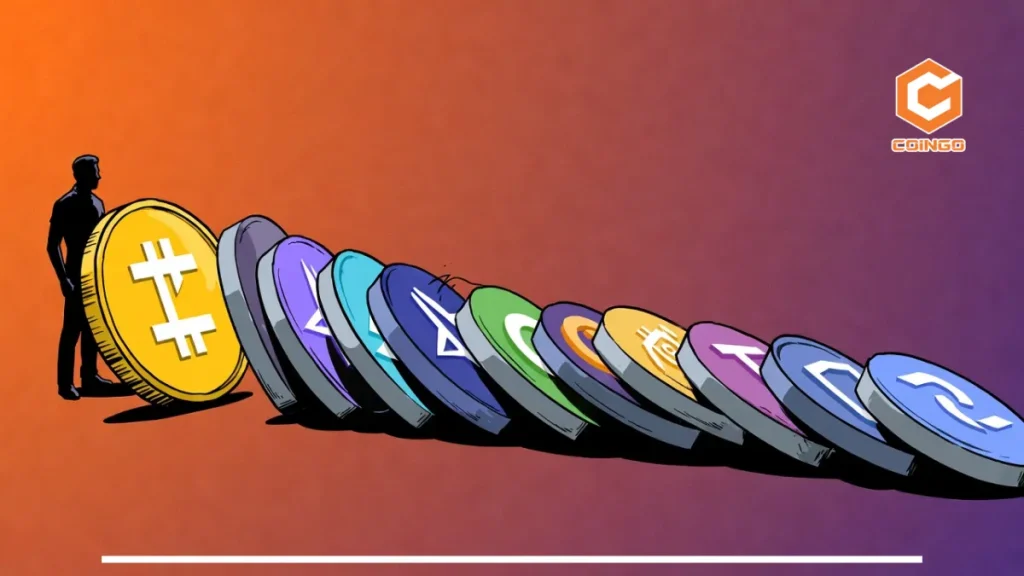
The first and most immediate impact of a USDT collapse would hit decentralized finance. USDT is deeply embedded in the liquidity infrastructure of every major DeFi protocol.
On Curve Finance, the 3pool (which holds USDT, USDC, and DAI) is one of the deepest stablecoin liquidity pools in existence. During past mini-depegs, USDT’s share of this pool surged from its normal 33% to over 70% as holders rushed to swap USDT for USDC or DAI. In a full collapse, USDT would flood these pools entirely, draining all other stablecoin reserves and effectively breaking the pool’s ability to function.
On lending protocols like Aave and Compound, USDT is used both as collateral and as borrowed debt. If USDT depegs significantly, borrowers who took loans in USDT would see their debt shrink in real value, but those who posted USDT as collateral would face immediate liquidation. The cascading liquidations would generate billions in forced selling across ETH, WBTC, and other collateral assets, driving prices lower in a self-reinforcing loop.
The UST/Luna collapse in May 2022 offers a direct precedent. That algorithmic stablecoin’s failure erased over $50 billion in combined UST and LUNA market cap and caused an estimated $400 billion in broader crypto market losses. USDT is roughly 3.7x larger than UST was at its peak. The proportional damage would be unprecedented.
Centralized Platforms Would Face a Liquidity Crisis
Most major centralized platforms use USDT as their primary trading pair. On Binance alone, average daily USDT trading volume exceeds $36 billion. A USDT collapse would instantly create a pricing vacuum. Every USDT-denominated pair would become unreliable, and traders would rush to convert holdings into BTC, ETH, or USDC.
This flight would create extreme volatility in both directions. BTC and ETH prices quoted in USDT would spike artificially as traders dumped the stablecoin, while prices on USDC or fiat-denominated pairs could crash as selling pressure overwhelmed order books. The divergence between USDT-quoted and USDC-quoted prices would create confusion, arbitrage chaos, and potential exchange downtime.
Platforms would also face a collateral problem. Many perpetual futures contracts are margined in USDT. A depeg below $0.95 could trigger mass liquidations across leveraged positions, compounding the sell-off. During the May 2022 USDT mini-depeg, the price dipped briefly to approximately $0.95 on some venues before arbitrage restored parity within hours. A sustained depeg would overwhelm that arbitrage mechanism.
Emerging Markets Would Lose Their Dollar Rail
Perhaps the least discussed but most consequential impact would hit emerging market users. Over 60% of USDT circulates on Tron, and a significant portion of that volume serves as a dollar-denominated payment and remittance rail in Latin America, Southeast Asia, Africa, and parts of the Middle East.
For millions of users in countries with volatile local currencies, USDT is not a trading instrument. It is a savings vehicle and a way to send money across borders cheaply. A collapse would wipe out savings for people who have no recourse to Tether’s redemption mechanism, since the minimum redemption threshold is $100,000. Retail holders would be entirely dependent on secondary market liquidity, which would evaporate in a crisis.
Tether has also been linked to sanctions evasion and illicit finance. Reports indicate that Iran’s central bank acquired over $500 million in USDT to circumvent sanctions. A collapse could disrupt these unofficial financial channels, creating geopolitical ripple effects beyond the crypto market.
The USDC Migration Scenario
In every past USDT stress event, the immediate beneficiary has been USDC. During the June 2023 Curve 3pool imbalance, USDT’s dominance briefly dipped while USDC gained roughly $5 billion in market cap within days. A full USDT collapse would accelerate this shift dramatically.
Circle‘s USDC currently sits at approximately $75 billion in market cap. It is regulated under U.S. money transmitter laws, publishes monthly reserve reports through Deloitte, and has positioned itself as the compliance-friendly alternative. But USDC has its own history of stress: during the Silicon Valley Bank collapse in March 2023, USDC depegged to $0.88 when $3.3 billion of Circle’s reserves were trapped in the failing bank.
A USDT collapse would test whether USDC’s infrastructure can absorb the sudden demand. The stablecoin market would likely need to absorb $100+ billion in displaced liquidity. No single stablecoin is currently equipped for that volume. The result would be a period of extreme fragmentation, with multiple stablecoins competing for dominance and none providing the seamless liquidity that USDT currently offers.
What Past Depegs Tell Us About the Risk
| Event | Date | Low Price | Recovery Time |
|---|---|---|---|
| UST/Luna Collapse | May 2022 | $0.00 (total failure) | Never recovered |
| USDT Mini-Depeg | May 2022 | ~$0.95 | Hours |
| USDC SVB Depeg | March 2023 | $0.88 | ~48 hours |
| USDT Curve Pool Imbalance | June 2023 | ~$0.997 | Same day |
| USDT Feb 2026 Outflow | February 2026 | Peg held | $15B supply drop |
The pattern is clear: minor depegs recover quickly through arbitrage, but each event tests the system’s resilience. The February 2026 episode was notable because USDT supply dropped by $15 billion, the largest decline since the FTX collapse, even though the peg held. This suggests that large holders are already positioning for scenarios where confidence wavers.
Could It Actually Happen
A full USDT collapse remains a low-probability, high-impact event. Tether’s reserve composition has improved dramatically since 2021, when it held significant commercial paper including Chinese state-owned bank securities. The shift to predominantly U.S. Treasuries makes a solvency-driven collapse unlikely under normal conditions.
The more realistic risk vector is regulatory. The EU’s MiCA framework already forced Tether off European exchanges in late 2024 because the company chose not to pursue compliance. The U.S. GENIUS Act, if passed, would impose stricter reserve transparency and liquidity standards on stablecoin issuers. A U.S. enforcement action, a freeze order on Tether’s Treasury holdings, or a loss of banking access could trigger the kind of confidence crisis that no reserve buffer can absorb.
The other risk is structural. Tether has never undergone a full audit. Its quarterly attestations, while improved, still carry a reporting lag of approximately three months. In a market where billions can move in minutes, a three-month information gap is a vulnerability, not a feature.
How to Position for USDT Risk
The goal is not to predict whether USDT will collapse. It is to build a portfolio and operational setup that can withstand it if it does.
Diversifying stablecoin exposure across USDT, USDC, and DAI reduces concentration risk. Keeping significant holdings in non-stablecoin assets like BTC and ETH provides a hedge, since these assets would likely see USDT-denominated prices spike during a depeg event. Using cold wallets for stablecoin storage ensures access is not dependent on exchange solvency. And monitoring Curve 3pool composition in real time provides an early warning system. When USDT’s share of the pool starts climbing above 40-50%, that is a signal that smart money is rotating out.
USDT’s dominance is both its strength and its systemic risk. The crypto market has built its entire liquidity infrastructure on the assumption that one dollar equals one USDT. If that assumption breaks, nothing in the market is priced correctly. The probability may be low. But the impact would redefine the industry.