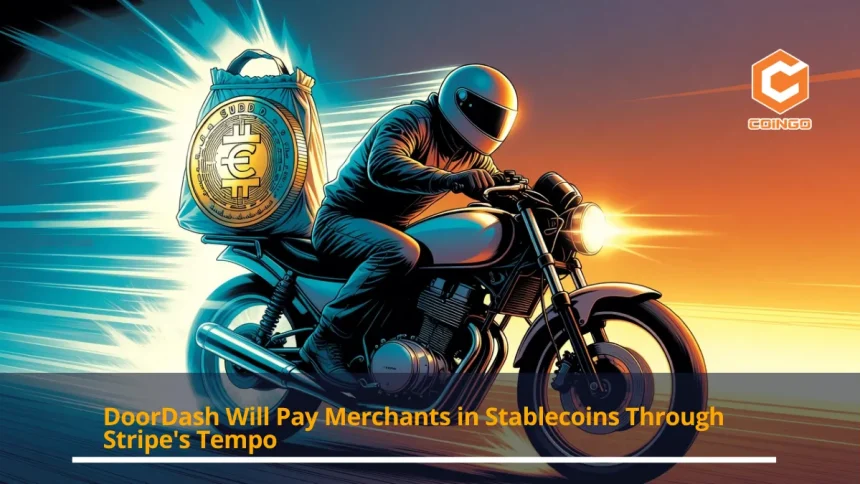
DoorDash is partnering with Tempo, the payments-focused blockchain built by Stripe and venture firm Paradigm, to bring stablecoin-powered payouts to its global marketplace. The move would allow merchants and delivery workers across more than 40 countries to receive payments via stablecoin rails instead of traditional banking infrastructure. DoorDash co-founder Andy Fang said there is “real promise with stablecoins transforming financial infrastructure.” A Paradigm spokesperson declined to disclose the exact launch date.
What Tempo Brings to the Table
Tempo launched in March 2026 after raising $500 million at a $5 billion valuation in October 2025. Unlike general-purpose blockchains, Tempo was built specifically for payment workloads. Its architecture includes sub-second settlement, fixed dollar-denominated fees, reserved blockspace for payment transactions, private payment channels, and built-in account abstraction for batching payouts and sponsoring gas fees.
The design is intentional: eliminate the congestion and unpredictable costs that have made networks like Ethereum impractical for high-volume commercial payments. For a platform like DoorDash, which processes billions in annual payment volume across consumers, merchants, and drivers, settlement speed and cost predictability are non-negotiable requirements.
Tempo’s alliance network extends well beyond DoorDash. Partners already building on the network include Visa, Mastercard, Fifth Third Bank, Klarna, UBS, Howard Hughes Holdings, and Stripe itself. Stripe is using Tempo as core infrastructure for its money movement products, allowing businesses to send, receive, and hold stablecoins alongside traditional currencies through Stripe Connect.
Stripe’s Stablecoin Strategy Is Accelerating
The DoorDash partnership is the latest move in Stripe’s rapidly expanding stablecoin playbook. The payments giant, which processes nearly $2 trillion in annual payment flows, has been integrating stablecoin rails across its product suite since mid-2025.
In June 2025, Stripe partnered with Shopify to let millions of merchants across 34 countries accept USDC payments. By October 2025, Stripe launched stablecoin-based subscription payments, building a smart contract that allows customers to save a crypto wallet as a recurring payment method without re-signing each transaction. Some of Stripe’s fastest-growing clients, particularly AI companies, have seen roughly 20% of their payment volume shift to stablecoins because they settle faster and cost half as much to process.
Neetika Bansal, Stripe’s head of Connect and money management, said the goal is to make global payments “fast, cheap and borderless.” Tempo serves as the blockchain layer that makes this possible at scale, while Stripe handles the merchant-facing integration that businesses already use.
Why This Matters for Stablecoin Adoption
Stablecoin transaction volumes hit $33 trillion in 2025, up 72% year-over-year, driven largely by B2B settlements. But most of that volume has remained within crypto-native infrastructure: centralized platforms, DeFi protocols, and cross-border remittance corridors. The DoorDash integration represents something different. It puts stablecoin rails underneath a consumer-facing platform that millions of non-crypto users interact with daily.
For merchants and delivery workers, the value proposition is straightforward: faster settlement, lower fees, and no dependency on fragmented regional banking systems that can delay payouts by days. For the stablecoin industry, DoorDash is a proof point that stablecoins can function as working money, not just trading collateral or speculative instruments.
The regulatory backdrop also supports the timing. The U.S. GENIUS Act has given corporate treasury teams a clearer framework for using digital dollars in commercial operations. Combined with Tempo’s institutional partner list and Stripe’s distribution reach, the infrastructure for mainstream stablecoin payments is now in place. The question is no longer whether stablecoins will enter everyday commerce. It is how quickly the transition happens.