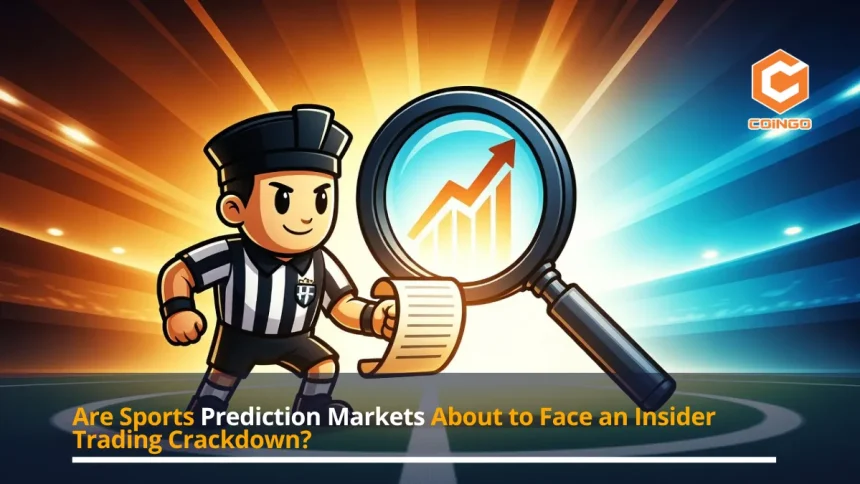
CFTC Chairman Mike Selig said Tuesday that his agency is now in talks with every major U.S. professional sports league about policing insider trading on prediction markets. He disclosed this at a FINRA conference in Washington, D.C. MLB already signed a data-sharing memorandum in March. The NBA submitted a formal regulatory proposal. The NCAA wants college sports contracts suspended entirely.
The NFL held out the longest. It is now at the table too.
MLB Got There First. Here Is What the Deal Looks Like.
The CFTC-MLB memorandum is the first formal information-sharing agreement between a federal regulator and a professional sports organization for prediction markets. Polymarket already holds exclusive prediction market partnerships with MLB, the NHL, MLS, and UFC. The MLB deal goes further: it sets up confidential data sharing, integrity monitoring, and a framework for joint investigations.
MLB also filed public comments with the CFTC asking exchanges to consult with leagues before listing contracts, share trade data on request, verify customer identity, restrict access to people under 21, use only official game data for settlement, and ban or limit contracts on player injuries, officiating, and discipline.
That is a long list. Most of it did not exist six months ago.
The MrBeast Case Gave the CFTC Its Template
Selig cited a specific case to illustrate where insider trading risk sits. Kalshi flagged an incident involving YouTube creator MrBeast in which an employee allegedly traded ahead of market-moving information tied to online content releases. The exchange caught it through its own surveillance. Selig held that up as proof that exchanges are the “first line of defense.”
He then described hypothetical sports scenarios: a trainer trading on a nonpublic injury report, a team staffer betting against their own player before a game. The point was clear. These markets create new insider trading surfaces that do not exist in traditional sports betting.
Five or Six States Sued. The CFTC Says It Will Keep Going.
Selig said the CFTC has already sued “about five or six states” that tried to block federally regulated event contracts under state gambling laws. The federal government effectively declared war on state gambling regulators earlier this year, and Selig made clear that posture is not changing. A Third Circuit ruling in April backed the CFTC, holding that event contracts are swaps under federal jurisdiction, not state-regulated gambling. A Ninth Circuit case is still pending. If it disagrees, the Supreme Court gets involved.
“Different products, parallel regimes,” Selig said, comparing prediction contracts to casino betting. He was not being diplomatic. He was drawing a legal line.
An $8.6 Billion Market That Did Not Exist Two Years Ago
Context matters. Prediction markets did $8.6 billion in volume in April alone. Kalshi doubled its valuation to $22 billion in five months. Robinhood distributes Kalshi contracts to its retail user base. Paradigm, the crypto venture firm, is building a professional trading terminal specifically for prediction markets and exploring bundled prediction market indices.
This is no longer a crypto niche. When the CFTC chairman sits down with NFL executives to discuss data-sharing protocols, prediction markets have crossed into mainstream finance. The question is no longer whether they survive. It is who writes the rules.
ETFs Are Next. The SEC Is Watching.
Selig said the CFTC expects prediction markets to spread into mainstream investment products. Regulators are reviewing exchange-traded products and funds linked to prediction market strategies. The SEC is coordinating. SEC Chair Paul Atkins spoke at the same FINRA conference later that afternoon.
Prediction market ETFs would put these contracts inside retirement accounts and index funds. That changes the stakes entirely. A YouTube employee trading on a MrBeast video is one thing. A pension fund holding a basket of event contracts while a team trainer bets against his own player is something else. The CFTC knows this. That is why every league got a phone call.