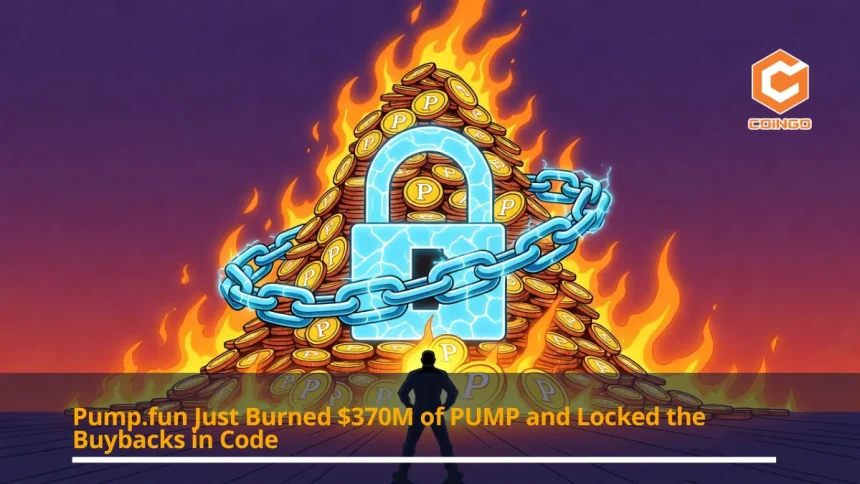
Pump.fun executed two large onchain burns on Wednesday totaling approximately $370 million worth of PUMP tokens. The first burn alone destroyed 128.22 billion PUMP, valued at roughly $233 million according to data flagged by Lookonchain. The platform continued buying back and burning additional supply throughout the day. By the time the dust settled, circulating supply had been reduced by 36%.
The structural change accompanying the burns is what makes this different from a typical buyback announcement. Going forward, 50% of net fees from three core Pump.fun products — Bonding Curve, Pumpswap, and Terminal — will route directly into open-market PUMP purchases and immediate burns through a smart contract that has been locked for 12 months. The team cannot pause it, modify it, or redirect the funds. The mechanism is now part of the platform’s code, not its discretion.
What Actually Changed in the Mechanism
The previous Pump.fun buyback model routed 100% of platform revenue into PUMP purchases. The new structure splits that 50/50 between automated buybacks-and-burns and discretionary operations or strategic reinvestment. On its face, that looks like a reduction. The economic interpretation is the opposite.
Under the old model, 100% of revenue went to buybacks at the team’s discretion. The team could pause the program, redirect funds, or wind it down at any time. The market priced that risk accordingly. Under the new model, 50% of revenue is mathematically committed for 12 months. The team has zero control over that half. The other 50% covers operational runway and growth investment without the team needing to choose between sustaining the burn and funding the business.
For a platform that has generated more than $1 billion in lifetime revenue since launching, the math on the new structure is significant. At even a fraction of historical run-rate, half of net fees produces continuous, automated, irreversible burn pressure on PUMP supply for the next year. The revenue base does not need to grow for the mechanism to be meaningful. It just needs to keep operating.
How the Market Reacted
PUMP rose roughly 7% in the hours following the announcement. 24-hour trading volume jumped 137.87% to $161 million as activity concentrated around the news. Market capitalization reached $631.68 million against a fully diluted valuation of $1.9 billion. The supply destruction is real, but the price reaction is restrained relative to the magnitude of the mechanic change.
Context explains the muted response. PUMP is still trading roughly 84% below its all-time high of $0.01214, set in July 2025 when the platform’s $600 million ICO sold out in 12 minutes before the token collapsed. Anyone holding from that ICO is deeply underwater. Anyone buying today is doing so against a backdrop of memecoin market exhaustion, repeated supply expansion, and the structural difficulty of sustaining attention on launchpad tokens through a market downcycle.
The 7% reaction also reflects how the broader memecoin market is pricing structural news right now. Vitalik Buterin’s unsolicited memecoin liquidations have been pumping individual tokens 120% on attention alone, while genuine tokenomics improvements at major platforms produce single-digit moves. The market is rewarding visibility, not fundamentals. Pump.fun delivered fundamentals.
What This Looks Like in Tokenomics Terms
Most token burn announcements in crypto are essentially marketing events. A team picks a number, executes a one-time burn, and waits for the price reaction. The supply impact is real but bounded. Reading tokenomics carefully usually means filtering for which announcements are structural and which are theater. The Pump.fun mechanism is structural.
The 12-month lock is the part that matters. A discretionary burn program creates supply pressure as long as the team is willing to maintain it. A locked smart contract creates supply pressure for as long as the platform generates revenue, regardless of what the team wants. Investors who hold PUMP through this period are betting on Pump.fun’s revenue base, not on team commitment to a buyback policy.
There is one important caveat. The total supply impact depends on how much revenue the platform actually generates over the 12 months. Memecoin launchpad activity peaked in 2024 and has been trending down since. If revenue contracts significantly, the 50% allocation buys back fewer tokens than the headline math suggests. The mechanism is locked, but its output scales with platform performance.
The Broader Memecoin Market Context
Pump.fun became the dominant Solana memecoin launchpad through 2024 and into 2025. The platform processed billions in cumulative volume and generated a hit list of viral tokens. The downside of that scale was constant scrutiny. A 2025 report alleged that 98.6% of tokens launched on the platform were fraudulent. The ICO that raised $600 million in 12 minutes was followed within months by an 84% price collapse from the all-time high.
The structural changes announced today are an attempt to address two problems at once. Concentrated insider holdings and discretionary buyback policies have been recurring red flags across the memecoin sector. ZachXBT’s recent investigations into RAVE and MemeCore have made tokenomics a primary concern for retail buyers across the entire memecoin category, not just a niche analytical filter. The pressure has come from another direction too. Memecoins built around political access and one-off attention events have made the entire category look more like a marketing vehicle than a financial product. Pump.fun moving toward irreversible buybacks is a response to that broader credibility problem.
Whether it works depends on what “works” means. If the goal is to stabilize PUMP’s price discovery and rebuild some trust with holders, the mechanism is well-designed. If the goal is to recover the all-time high, the math is harder. PUMP needs roughly a 6x rally just to retest its July 2025 peak. Token burns can support price. They cannot manufacture the kind of speculative demand that produced the original launch number.
What to Watch From Here
Three numbers matter over the next 12 months. The first is Pump.fun’s monthly revenue. The buyback mechanism scales directly with platform fees. Sustained or growing revenue translates into sustained burn pressure. Declining revenue cuts the supply impact in proportion. Onchain data will make this measurable in near-real-time.
The second is supply trajectory. The 36% one-day cut is dramatic. The slow drip of automated burns over 12 months is what determines whether PUMP becomes meaningfully deflationary or whether emissions and existing supply offsets neutralize the impact. Public dashboards tracking PUMP circulating supply will tell the story without needing platform announcements.
The third is whether the move sets a precedent. Locked-in revenue-share buybacks are unusual in crypto. Most teams retain discretion specifically because retaining discretion is cheap. If PUMP holders reward the platform for ceding that control, other token issuers will copy the structure. The same week saw Canary Capital file an SEC S-1 for a PEPE ETF, signaling that memecoin tokenomics are starting to get evaluated against the kind of structural standards that financial regulators apply. If the market does not differentiate between locked and discretionary buybacks in price, the experiment ends. The next 12 months are essentially a test of whether structural commitment to tokenomics actually gets priced.