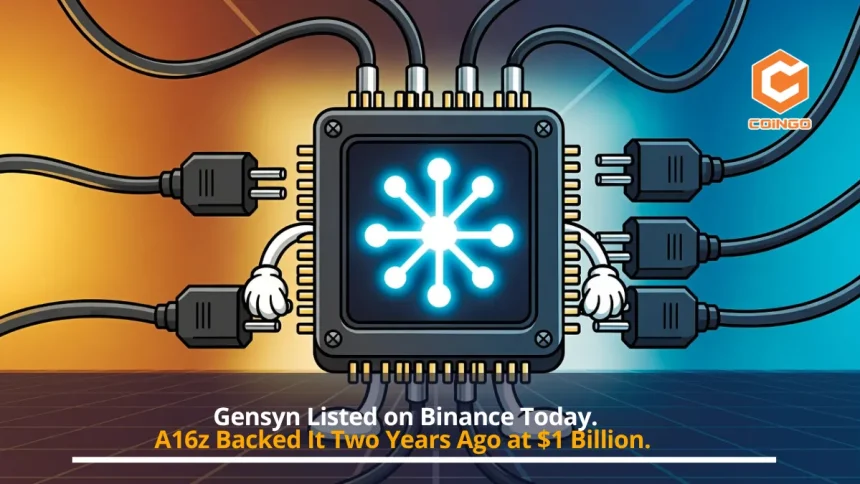
Binance opened spot trading for Gensyn’s AIGENSYN token at 17:00 UTC on May 14 with three pairs: AIGENSYN/USDT, AIGENSYN/USDC, and AIGENSYN/TRY. The exchange attached a Seed Tag, its label for early-stage projects with elevated volatility risk. The token had already jumped 40% in the hours before the listing went live.
This is not Gensyn’s first exchange event. On April 29, Binance Alpha, Gate.io Futures, and Coinbase all listed the token on the same day. AIGENSYN pumped 250% and then dropped 45% within hours. That pattern is the one to watch again.
What Gensyn Actually Does
Gensyn connects idle GPUs and CPUs into a single network for machine learning training. Developers pay to use the compute. Hardware owners get paid for lending it. The protocol uses a system called Proof-of-Learning to verify that the training job ran correctly without a centralized intermediary. Think of it as the GPU lending thesis applied at protocol level: instead of one company renting out GPUs, an open network does it permissionlessly.
Ben Fielding and Harry Grieve founded the project in London in 2020 through the Entrepreneur First accelerator. A16z crypto led a $43 million Series A in 2023, valuing Gensyn at $1 billion fully diluted. Galaxy Digital, CoinFund, and Protocol Labs also invested. Total funding to date: over $78 million.
Delphi: Gensyn Built a Polymarket Competitor That Settles With AI
Gensyn’s flagship product is Delphi, an information markets platform where outcomes are settled by AI rather than human oracles. Market creators earn 1.5% of all trading volume when a market settles. The protocol takes a 0.5% fee on all volume, uses it to buy AIGENSYN tokens, and burns a portion. Fielding calls them “information markets, not prediction markets.” The distinction: anyone can create a market on any topic. No centralized listing committee decides what gets traded.
Delphi runs as a Layer 2 on Ethereum using the OP Stack. Testnet recorded “millions” in trading volume according to Fielding. The mainnet version launched alongside the token generation event in late April.
The Tokenomics Risk Is in the Numbers
Total supply: 10 billion AIGENSYN. Circulating: roughly 1.3 billion. That is 13%. The remaining 87% is locked across team, investor, and ecosystem allocations. At $0.058 per token, the fully diluted valuation sits around $580 million. The circulating market cap is closer to $75 million.
The gap between those two numbers is the risk. Future unlocks will add sell pressure unless demand scales proportionally. Gensyn needs real GPU compute volume flowing through the network to justify the valuation. The shift from mining to AI compute is real and accelerating. Whether Gensyn captures a piece of that demand or remains a token with a narrative is the open question.
What the April 29 Listing Taught the Market
The first multi-exchange listing day produced $92 million in 24-hour volume, a 250% price spike, and a 45% correction from the top. OKX perpetual futures hit $213 million in volume. KuCoin led spot with $25 million. The funding rate on Binance futures reached 0.09%, signaling crowded long positioning. That structure is typical of launch-day speculation, not sustained accumulation. For context, even Avalanche’s 3.5 million daily transaction record did not prevent its token from staying below $10. Network activity and token price do not always move together.
Binance noted it charged zero listing fees for AIGENSYN and allocated 125 million tokens for future marketing campaigns. Withdrawals open May 15 at 16:00 UTC. The Seed Tag stays until Binance decides the project has matured enough to remove it.