
Receiving Bitcoin (BTC) is the most fundamental operation in the decentralized economy — and the one most often glossed over. Unlike a bank transfer where the institution handles routing, error correction, and fraud protection, a Bitcoin transaction places full responsibility on the recipient. A single wrong character in an address, a compromised clipboard, or a misunderstood confirmation threshold can mean permanent loss of funds. This guide walks through the entire process from first principles: what a Bitcoin address actually is, how different wallet types generate and manage them, how to share your address without compromising privacy, and how to verify that incoming funds have actually settled on-chain.
What Is a Bitcoin Address and How Does It Work?
A Bitcoin address is an alphanumeric string — or its QR code equivalent — that identifies a destination on the Bitcoin network where BTC can be received. It functions similarly to a bank account number, except that it is derived from a public key through a series of cryptographic hash functions (SHA-256 followed by RIPEMD-160 for legacy formats, or Bech32/Bech32m encoding for modern formats). The critical distinction: sharing your address lets anyone send you funds, but only the holder of the corresponding private key can spend them.
- What Is a Bitcoin Address and How Does It Work?
- Bitcoin Address Types: Legacy, SegWit, and Taproot
- How to Transfer Bitcoin (Step-by-Step Guide)
- Protecting Your Privacy When Receiving Bitcoin
- Self-Custody vs. Exchange Custody: Where Should You Receive BTC?
- Common Mistakes to Avoid When Receiving Bitcoin
- Frequently Asked Questions
Your wallet software generates these addresses automatically. In 2026, most reputable wallets use Hierarchical Deterministic (HD) key generation, meaning a single seed phrase (typically 12 or 24 words) can derive an unlimited number of addresses. This is the foundation of address rotation — the practice of using a fresh address for every incoming transaction to preserve financial privacy on Bitcoin’s public ledger.
Your Bitcoin address is public and safe to share. Your private key and seed phrase are secret and must never be shared with anyone, under any circumstances. Losing your seed phrase means losing access to your funds permanently.
Bitcoin Address Types: Legacy, SegWit, and Taproot
Not all Bitcoin addresses are created equal. The format you use directly affects transaction fees, wallet compatibility, and privacy characteristics. Understanding the three major address families is essential before you share a receive address with anyone.
| Format | Prefix | Fee level | 2026 status |
|---|---|---|---|
| Legacy (P2PKH) | 1… | HIGHEST | Outdated |
| P2SH-SegWit | 3… | MEDIUM | Compatible |
| Native SegWit (Bech32) | bc1q… | LOW | RECOMMENDED |
| Taproot (Bech32m) | bc1p… | LOWEST | GROWING SUPPORT |
For most users in 2026, Native SegWit (bc1q) is the default recommended format — it offers significantly lower fees than legacy addresses and is universally supported across wallets and exchanges. Taproot (bc1p) addresses provide the lowest fees and enable advanced features like improved multi-signature privacy, but some platforms still don’t accept Taproot deposits. Always confirm the recipient’s supported format before initiating a transfer.
How to Transfer Bitcoin (Step-by-Step Guide)
Step 1 — Choose a wallet
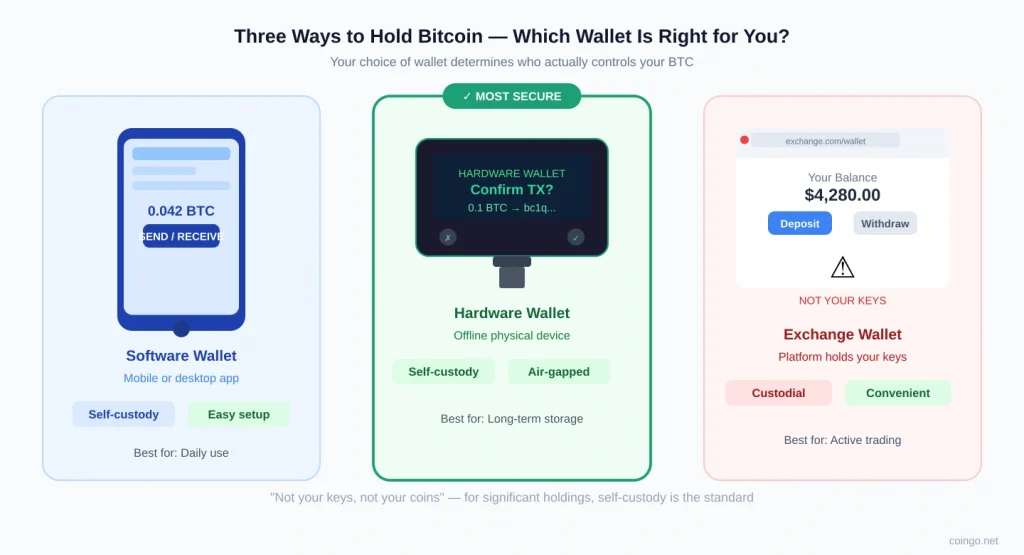
Your wallet is the software (or hardware) that generates and manages your Bitcoin addresses and private keys. The three main categories are software wallets (mobile and desktop apps), hardware wallets (offline USB-like devices), and exchange wallets (custodial accounts on trading platforms). Each involves a different trade-off between convenience, security, and control.
| Feature | Software wallet | Hardware wallet | Exchange wallet |
|---|---|---|---|
| Key control | SELF-CUSTODY | SELF-CUSTODY | EXCHANGE HOLDS |
| Security level | Medium | Highest | Varies |
| Convenience | High | Low | Highest |
| Setup time | ~5 minutes | ~15 minutes | ~2 min + KYC |
| Best for | Daily use | Long-term storage | Active trading |
Step 2 — Secure your seed phrase
When you create a new wallet, the software generates a seed phrase — a sequence of 12 or 24 English words that serves as the master backup for all your private keys. This phrase is the single most important piece of information in your Bitcoin custody setup. Write it down on paper or stamp it into metal. Never store it digitally — no screenshots, no cloud storage, no notes apps. If someone gains access to your seed phrase, they gain access to every address your wallet has ever generated.
Never share your seed phrase with anyone. No legitimate wallet provider, exchange, or support agent will ever ask for it. Any request for your seed phrase is a scam — without exception.
Step 3 — Generate your receive address
Open your wallet and navigate to the “Receive” section. The wallet will display a fresh Bitcoin address as both an alphanumeric string and a QR code. In 2026, this will typically be a Native SegWit (bc1q) or Taproot (bc1p) address. Verify the prefix matches what you expect. If your wallet supports address labeling, tag each address with its purpose (e.g., “Invoice #104” or “Salary March 2026”) for easier bookkeeping.
Step 4 — Share your address with the sender
Send your address to the paying party via a secure channel. The preferred method is to share the QR code directly — this eliminates the risk of manual transcription errors. If you must copy-paste the text string, always verify the first six and last six characters after pasting. Clipboard-hijacking malware is a known attack vector in crypto; it silently replaces your copied address with an attacker’s. For high-value transactions, cross-check the address on a second device before the sender confirms.
Step 5 — Verify on-chain confirmations
After the sender broadcasts the transaction, it enters the mempool — a network-wide queue of unconfirmed transactions awaiting inclusion in a block. Once a miner includes it in a new block, the transaction receives its first confirmation. Each subsequent block adds another confirmation. The industry-standard thresholds in 2026 are:
| Transaction size | Recommended confirmations | Approximate wait |
|---|---|---|
| Small (<$1,000) | 1 CONFIRMATION | ~10 minutes |
| Medium ($1K–$10K) | 3 CONFIRMATIONS | ~30 minutes |
| Large (>$10,000) | 6 CONFIRMATIONS | ~60 minutes |
You can track the status of any incoming transaction using a block explorer — a public tool that lets you search by address or transaction ID (TXID). Once the required number of confirmations is reached, the funds are considered settled and spendable.
Protecting Your Privacy When Receiving Bitcoin
Bitcoin transactions are recorded on a public ledger. Anyone who knows your address can look up its balance and full transaction history using a block explorer. This is why address rotation is critical: by using a new address for every incoming payment, you prevent outside observers from aggregating your total holdings into a single visible balance.
Modern HD wallets handle this automatically. Each time you open the “Receive” screen, the wallet generates the next unused address in the derivation path. You never need to manually create addresses — the wallet manages the rotation for you. All addresses generated from the same seed phrase remain accessible and spendable, even if you’ve moved on to a newer one for receiving.
Never post a single Bitcoin address publicly and ask all payers to send to it. Every payment becomes permanently linked on the blockchain. Use a fresh address per transaction, or consider payment processors that generate unique addresses per invoice automatically.
Self-Custody vs. Exchange Custody: Where Should You Receive BTC?
When you receive Bitcoin on a centralized exchange, the platform holds the private keys on your behalf. This is convenient for active trading but introduces counterparty risk — if the exchange is hacked, goes bankrupt, or freezes withdrawals, your funds may be inaccessible. The collapse of FTX in 2022 demonstrated that even large, seemingly reputable exchanges can fail catastrophically.
Receiving BTC into a self-custody wallet — whether software or hardware — ensures that you alone hold the cryptographic keys required to move the funds. This is the model the Bitcoin network was designed for: peer-to-peer value transfer without trusted intermediaries. For amounts you don’t intend to trade immediately, receiving directly into a hardware wallet like a Ledger or Trezor provides the strongest security guarantees available to individual users.
For businesses and institutional recipients, multi-signature (multi-sig) setups have become the standard. These require two or more private keys to authorize any outgoing transaction — meaning a single compromised device or employee cannot unilaterally move funds. Multi-sig is increasingly used for treasury management, exchange cold storage, and cross-border settlement operations.
Common Mistakes to Avoid When Receiving Bitcoin
Sending to the wrong network. Bitcoin (BTC) and Bitcoin Cash (BCH) addresses can look similar, and Ethereum addresses are completely different. Always confirm you are receiving on the correct network before sharing an address. Funds sent to an incompatible network may be permanently lost.
Reusing addresses. While technically functional, address reuse degrades your privacy and can create complications with accounting and UTXO management. Let your HD wallet generate a new address for each transaction.
Ignoring confirmation thresholds. Treating a zero-confirmation transaction as settled is risky. Until a transaction has been mined into a block, it can theoretically be replaced or dropped from the mempool. Wait for the appropriate number of confirmations based on the transaction value.
Storing seed phrases digitally. Screenshots, cloud notes, email drafts, and password managers are all vulnerable to hacking. Physical backups — paper or metal — stored in secure locations remain the gold standard.
Trusting unverified QR codes. If someone provides a QR code for you to scan, verify that the decoded address matches what you expect. Malicious QR codes can redirect funds to an attacker’s wallet.
Frequently Asked Questions
Is it safe to share my Bitcoin address publicly?
Yes, sharing your Bitcoin address is safe — it only allows others to send you funds. However, anyone with your address can view its transaction history and balance on a block explorer, so use a fresh address for each payment to maintain privacy.
How many confirmations do I need to receive Bitcoin?
For small, low-risk transactions, one confirmation (~10 minutes) is generally sufficient. For larger amounts, waiting for three to six confirmations (30–60 minutes) provides stronger protection against double-spend attacks. Most exchanges require at least three confirmations before crediting a deposit.
Can I receive Bitcoin without a wallet?
Not directly. You need some form of wallet — whether a mobile app, desktop software, hardware device, or exchange account — to generate a Bitcoin address and manage the associated private keys. There is no way to receive BTC without an address.
Do Bitcoin addresses expire?
No. A Bitcoin address remains valid indefinitely. However, for privacy and organizational reasons, best practice is to generate a new address for each transaction rather than reusing old ones.
What happens if I send Bitcoin to the wrong address?
Bitcoin transactions are irreversible. If funds are sent to an incorrect but valid Bitcoin address, they cannot be recovered unless the owner of that address voluntarily returns them. Always double-check addresses before sharing them with senders.
Can I receive Bitcoin on my phone?
Yes. Mobile software wallets are one of the most popular ways to receive Bitcoin. They generate addresses, display QR codes, and track incoming transactions directly on your smartphone. For larger holdings, consider transferring received funds to a hardware wallet for long-term storage.
This guide is for informational purposes only and does not constitute financial or investment advice. Always conduct your own research and consult qualified professionals before making financial decisions. Cryptocurrency transactions are irreversible — exercise caution when managing digital assets.