
Buying Bitcoin (BTC) has never been more accessible — or more nuanced. In 2026, the market offers dozens of regulated on-ramps, from centralized exchanges and brokerage apps to peer-to-peer marketplaces, Bitcoin ATMs, and even indirect exposure through spot Bitcoin ETFs. Each pathway involves different trade-offs in fees, speed, privacy, and regulatory compliance. This guide walks through the complete process from first principles: how to choose a platform, what identity verification entails, how different order types affect your cost basis, and why what you do after the purchase matters just as much as the purchase itself.
Where to Buy Bitcoin: Comparing Your Options
The right platform depends on your goals. A day trader optimizing for liquidity and advanced order types needs a different tool than a first-time buyer making a one-off purchase with a debit card. Here is how the major channels compare in 2026:
| Platform type | Typical fees | KYC | Custody | Best for |
|---|---|---|---|---|
| Centralized exchange | 0.1%–0.6% | Yes | Custodial | Most users |
| Brokerage app | 0.5%–1.5% | Yes | Custodial | Beginners |
| P2P marketplace | 1%–3% | Varies | Self-custody | Privacy-focused |
| Bitcoin ATM | 5%–12% | Often yes | Self-custody | Cash buyers |
| OTC desk | Negotiated | Yes | Varies | Large orders |
| Spot Bitcoin ETF | 0.15%–0.25% ER | Brokerage KYC | Fund holds BTC | Traditional investors |
For the majority of individual buyers in 2026, a centralized exchange remains the most cost-effective option. Fees have compressed significantly since the early days of crypto — competitive platforms now charge between 0.1% and 0.6% per trade, with maker-taker models rewarding limit orders. Spot Bitcoin ETFs have emerged as a compelling alternative for investors who want BTC exposure within a traditional brokerage account, though they come with ongoing expense ratios and do not provide direct ownership of the underlying asset.
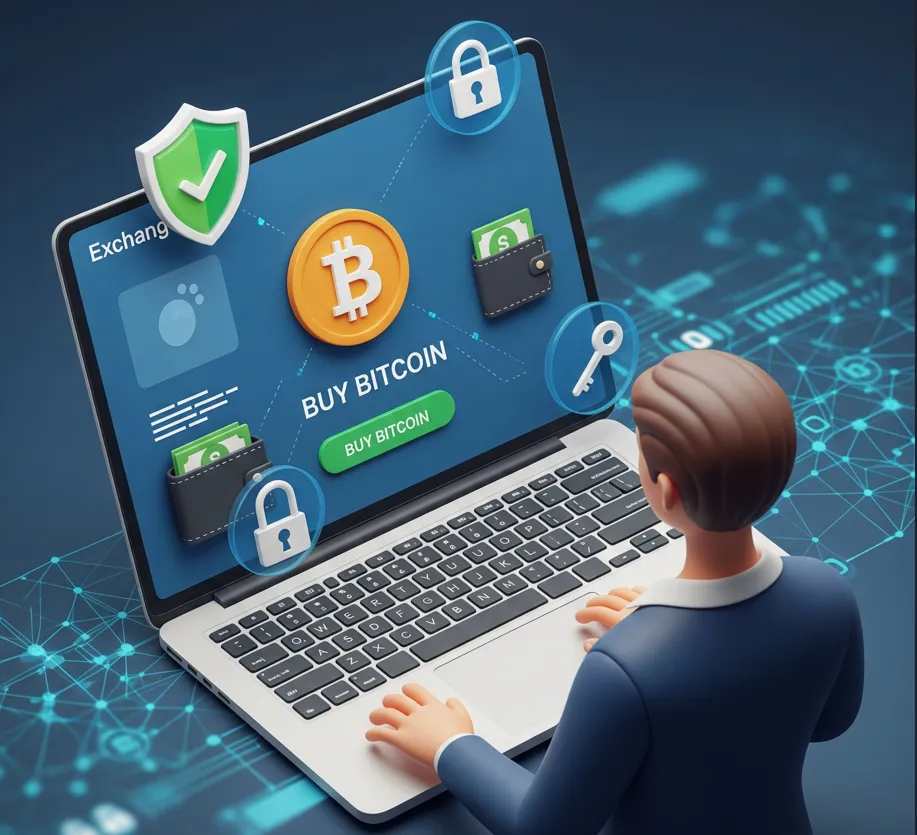
How to Buy Bitcoin: Step-by-Step
Step 1 — Choose a platform and create an account
Select a trading platform that operates in your jurisdiction, supports your preferred payment method, and has a strong security track record. Register with your email address and set a strong, unique password. Enable two-factor authentication (2FA) immediately — preferably using an authenticator app rather than SMS, which is vulnerable to SIM-swap attacks.
Step 2 — Complete identity verification (KYC)
Regulated platforms require Know Your Customer (KYC) documentation before you can deposit funds or trade. This typically involves uploading a government-issued photo ID (passport or national ID card) and sometimes a proof-of-address document (utility bill or bank statement). Verification times range from minutes to 48 hours depending on the platform and volume of applications. Some exchanges offer tiered verification — basic tiers with lower limits may only require an email and phone number, while full access requires complete document submission.
Step 3 — Deposit funds
Fund your account using the method that balances speed and cost for your situation. The most common options in 2026:
| Method | Speed | Typical fee | Limit |
|---|---|---|---|
| Bank transfer (SEPA/ACH) | 1–3 business days | FREE / LOW | High |
| Debit/credit card | Instant | 2%–4% | Medium |
| Stablecoin transfer | Minutes | NETWORK FEE ONLY | Unlimited |
| Wire transfer | Same day | $10–$30 FLAT | Very high |
Bank transfers are almost always the cheapest way to fund a crypto exchange account. Credit card purchases are instant but carry premiums of 2–4% on top of the trading fee — over a full year of recurring purchases, that spread adds up significantly.
Step 4 — Place your order
Navigate to the BTC trading pair (e.g., BTC/USD or BTC/EUR) and choose your order type. The three most relevant options for buyers:
| Order type | How it works | Best for |
|---|---|---|
| Market order | Executes immediately at the current best available price | Speed over price precision |
| Limit order | You set your target price; fills only if the market reaches it | Cost optimization |
| Recurring buy (DCA) | Automated purchases at fixed intervals regardless of price | Long-term accumulation |
For most long-term buyers, Dollar-Cost Averaging (DCA) remains the most statistically robust approach. By purchasing a fixed dollar amount of BTC at regular intervals — weekly, biweekly, or monthly — you eliminate the emotional pressure of trying to time the market and naturally smooth out volatility over time. Many exchanges now offer automated DCA features built directly into the platform.
Step 5 — Withdraw to self-custody
Once your purchase is confirmed, the BTC sits in your exchange account — which means the platform holds the private keys, not you. For any amount you don’t plan to actively trade, the next step is to withdraw to a self-custody wallet where you control the keys. Open your wallet, go to “Receive,” copy your Bitcoin address (preferably bc1q or bc1p format), return to the exchange, and initiate a withdrawal to that address. Always send a small test transaction first, verify it arrives, then transfer the remainder.
Not your keys, not your coins. Exchanges can be hacked, freeze withdrawals, or go bankrupt. The collapse of FTX in 2022 erased billions in customer funds held on the platform. Moving BTC to a hardware wallet after purchase is the industry’s gold standard for asset security.
Buying Bitcoin Through a Spot ETF
Since the approval of spot Bitcoin ETFs in the United States in January 2024, a new class of buyer has entered the market: traditional investors who want BTC exposure without managing wallets, addresses, or private keys. Products like BlackRock’s IBIT and Fidelity’s FBTC can be purchased through any standard brokerage account — the same way you’d buy a stock or index fund.
The trade-off is straightforward: ETFs offer regulatory familiarity and seamless integration with existing portfolios, but you never actually own Bitcoin. The fund holds BTC on your behalf, and you pay an ongoing expense ratio (typically 0.15%–0.25% annually). You cannot withdraw the underlying BTC, send it to another party, or use it in DeFi protocols. For buyers who prioritize sovereignty and direct utility, purchasing actual BTC through an exchange and withdrawing to self-custody remains the preferred approach.
Understanding the True Cost of Buying Bitcoin
The advertised “trading fee” is only one component of the total cost. A complete accounting includes:
Trading fee. The percentage charged per transaction. Ranges from 0.1% on competitive exchanges to 1.5%+ on brokerage apps. Maker orders (limit) are typically cheaper than taker orders (market).
Spread. The difference between the buy and sell price on the order book. On liquid platforms, spreads for BTC/USD are usually tight (0.01–0.05%). On less liquid venues or during volatile periods, spreads can widen significantly, effectively increasing your cost.
Deposit fee. Bank transfers are often free; card payments typically carry 2–4% premiums. This is frequently the largest hidden cost for new buyers.
Withdrawal fee. A flat fee (denominated in BTC) charged when you move coins off the exchange to your own wallet. Ranges from 0.0001 BTC to 0.0005 BTC depending on the platform and network congestion.
Network fee (gas). The Bitcoin network charges a transaction fee paid to miners for including your transaction in a block. This varies with demand — during congestion spikes, fees can rise from under $1 to $20+. SegWit and Taproot addresses reduce this cost.
Common Mistakes to Avoid When Buying Bitcoin
Buying with a credit card without checking fees. The convenience premium of 2–4% sounds small but compounds dramatically with recurring purchases. A $500 monthly DCA with a 3% card fee costs $180/year in unnecessary fees alone.
Leaving BTC on the exchange indefinitely. Exchanges are custodial. If the platform is hacked or becomes insolvent, funds held on it may be lost. Withdraw to self-custody after every significant purchase.
Trying to time the market. Bitcoin’s price history is littered with periods where waiting for “the dip” resulted in buying higher. DCA eliminates this emotional trap by removing the timing decision entirely.
Using SMS-based 2FA. SIM-swap attacks remain one of the most common vectors for exchange account takeover. Use an authenticator app or a hardware security key instead.
Ignoring tax obligations. In most jurisdictions, buying Bitcoin is not a taxable event — but selling, swapping, or spending it is. Keep records of every purchase price and date to calculate your cost basis accurately when the time comes.
Frequently Asked Questions
How much money do I need to buy Bitcoin?
There is no minimum amount required to own Bitcoin. BTC is divisible to eight decimal places (the smallest unit, 0.00000001 BTC, is called a satoshi). Most exchanges allow purchases starting from as little as $1 or $10. You do not need to buy a full coin.
Is it safe to buy Bitcoin in 2026?
Buying Bitcoin through a regulated, reputable exchange is broadly considered safe. The primary risks are post-purchase: leaving funds on a custodial platform, losing your seed phrase, or falling for phishing scams. Using a hardware wallet and strong authentication practices mitigates these risks.
What is the best time to buy Bitcoin?
There is no universally “best” time. Bitcoin’s price is volatile and influenced by macroeconomic conditions, regulatory developments, and market sentiment. Dollar-Cost Averaging removes the timing question by spreading purchases across regular intervals, which has historically outperformed lump-sum timing attempts for most retail buyers.
Can I buy Bitcoin anonymously?
Most regulated platforms require KYC. Peer-to-peer marketplaces and some Bitcoin ATMs offer varying degrees of privacy, but typically with higher fees and lower limits. Fully anonymous purchase methods are becoming increasingly rare as global AML regulations tighten.
What is the difference between buying Bitcoin and a Bitcoin ETF?
Buying actual Bitcoin gives you direct ownership — you hold the private keys (in self-custody) and can send, receive, or use BTC freely. A Bitcoin ETF gives you price exposure through a traditional brokerage account, but the fund holds the coins on your behalf. You cannot withdraw, transfer, or use the underlying BTC.
Do I pay taxes when I buy Bitcoin?
In most jurisdictions, simply purchasing Bitcoin with fiat currency is not a taxable event. Taxes are triggered when you sell BTC for fiat, swap it for another cryptocurrency, or use it to purchase goods or services. Consult a tax professional familiar with digital asset regulations in your country.
Buying is only half of it. Once the BTC lands in your wallet, knowing how to send and receive Bitcoin safely matters just as much. Get the address wrong and the funds are gone.
This guide is for informational purposes only and does not constitute financial or investment advice. Cryptocurrency investments are volatile and carry risk. Always conduct your own research and consult qualified professionals before making financial decisions.