
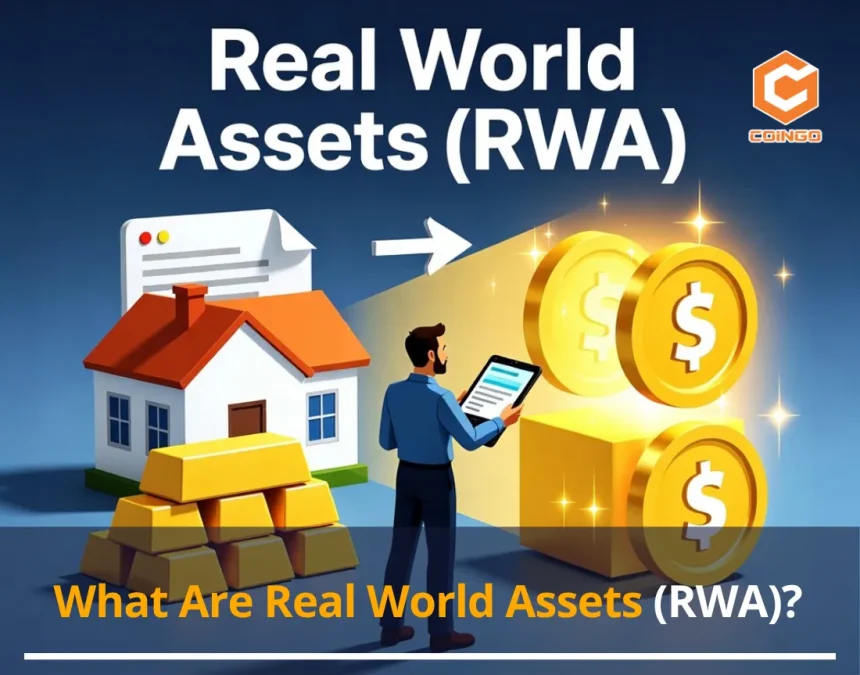
The Core Concept: Bringing Physical Assets On-Chain
Real World Assets — commonly abbreviated as RWA — are tokenized representations of assets that exist outside the blockchain. A government bond, a commercial real estate property, a gram of gold, a private credit loan, an invoice: each of these can be converted into a digital token that lives on a blockchain and carries the same economic rights as the underlying asset.
The process is called tokenization. It involves placing the underlying asset into a legal structure — typically a trust or a special purpose vehicle (SPV) — that establishes ownership rights. A blockchain token is then minted to represent a claim against that structure. From that point, the token can be transferred, traded, used as collateral, or fractionalized, all without the friction of moving the underlying asset itself.
- The Core Concept: Bringing Physical Assets On-Chain
- Why Tokenization Solves Real Problems
- How Tokenization Actually Works
- The Asset Classes Being Tokenized
- Institutional Adoption: Who Is Building Here
- RWAs in DeFi: Collateral, Yield, and Composability
- Risks That Cannot Be Ignored
- Regulatory Landscape: Clarity Is Coming, But Slowly
- Where the Sector Stands in April 2026
The distinction between RWAs and native crypto assets like Bitcoin or Ether is fundamental. Native crypto assets exist only on-chain — they have no off-chain counterpart. RWA tokens are different: their value derives from an asset in the real world, and that off-chain asset must be properly held, verified, and legally maintained for the token to retain meaning.
Why Tokenization Solves Real Problems
Traditional financial assets carry structural limitations that have persisted for decades. Real estate requires large minimum investment, slow settlement, and geographic restrictions. Private credit is accessible only to institutions. Government bonds, while liquid in wholesale markets, require intermediaries to access retail. Fine art and commodities are illiquid and difficult to divide.
Tokenization addresses each of these constraints directly:
Fractional ownership: A $25 million commercial building can be divided into 2,500,000 tokens at $10 each, allowing investors to hold a proportional economic interest without purchasing the whole asset. This lowers entry barriers across asset classes that were previously available only to institutional or high-net-worth investors.
24/7 settlement: Blockchain-based tokens settle near-instantly and trade around the clock, unlike traditional securities markets that operate within defined hours and clear on T+1 or T+2 schedules. This creates a more efficient capital deployment environment for institutions and removes time-zone friction for global investors.
Liquidity for illiquid assets: Assets like real estate, private credit, and infrastructure projects are structurally illiquid — converting them to cash typically requires weeks or months. Tokenization enables holders to trade their position on secondary markets without requiring the underlying asset to change hands.
Programmable yield: Smart contracts can automate interest payments, dividend distributions, and coupon accruals directly to token holders on a defined schedule. This eliminates settlement intermediaries and reduces the operational cost of yield distribution.
Global accessibility: A tokenized U.S. Treasury product can be purchased by an investor in Southeast Asia with a crypto wallet, bypassing the account minimums, intermediary relationships, and geographic restrictions that would otherwise apply. Blockchain infrastructure does not recognize borders in the way that traditional financial infrastructure does.
“Tokenization democratizes investments, reduces transaction costs, and facilitates 24/7 global markets. It bridges TradFi and DeFi, unlocking trillions in previously illiquid assets.” — RedStone/Gauntlet/RWA.xyz Standards Report, March 2026
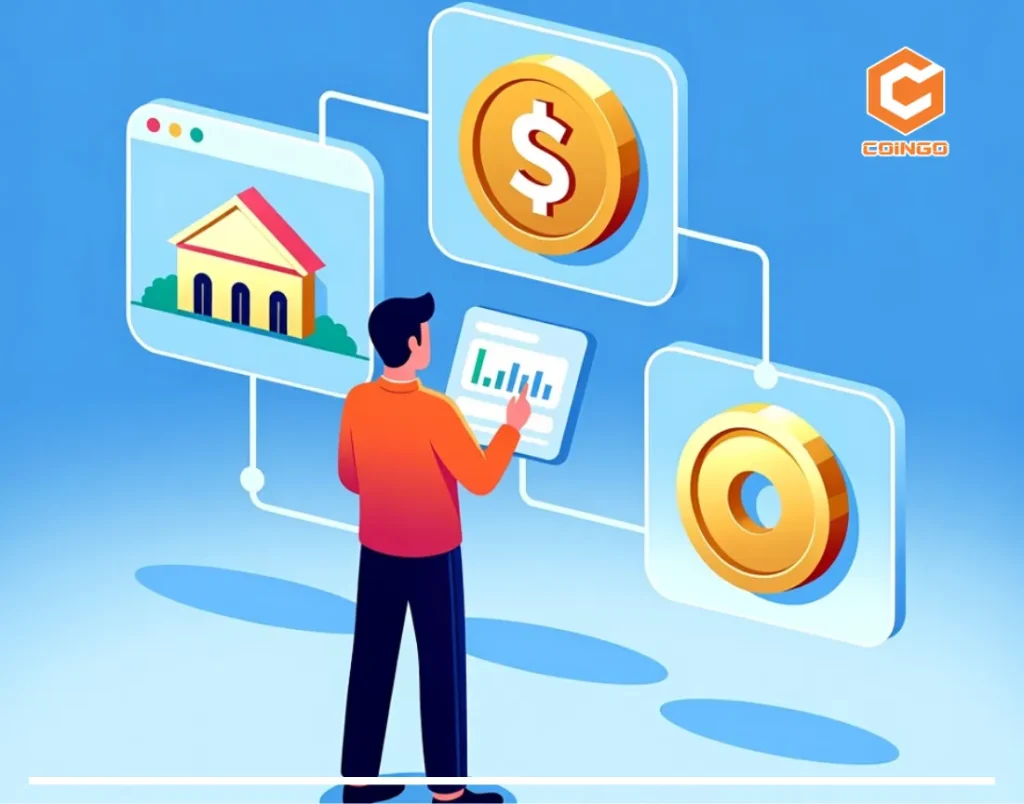
How Tokenization Actually Works
The tokenization process follows a structured sequence that combines legal, custodial, and technical steps:
1. Legal structuring: The asset owner places the underlying asset into a legal wrapper — a trust, SPV, or similar entity recognized in the relevant jurisdiction. This entity defines ownership rights, investor protections, and the conditions under which the token can be redeemed.
2. Custody: The underlying asset must be securely held. For financial assets like Treasuries, this means a licensed custodian holds the securities. For physical assets like gold, it means certified vault storage with regular audits. The custodian relationship is the link between the token and the real-world asset.
3. Token minting: A smart contract on a blockchain (most commonly Ethereum, which hosts over 60% of all tokenized RWA value) mints tokens representing ownership or income claims against the legal structure. The token standard, transfer restrictions, and compliance rules are encoded in the smart contract.
4. Verification and oracles: Oracles — systems that read real-world data and report it on-chain — provide price feeds, proof-of-reserve attestations, and yield accrual data to the smart contract. The quality of the oracle layer directly affects the reliability of the tokenized asset as a financial instrument.
5. Distribution and trading: Tokens are distributed to investors and can be traded on secondary markets, used as collateral in DeFi lending protocols, or included in liquidity pools. The composability of blockchain-based tokens — the ability to interact with other smart contracts — is what distinguishes RWAs from simply digitizing an asset record.
Table 1 — RWA Tokenization: Traditional Finance vs. Tokenized Structure
| Attribute | Traditional Asset | Tokenized RWA |
|---|---|---|
| Settlement time | T+1 to T+2 (or longer) | Near-instant, 24/7 |
| Minimum investment | High (often institutional) | Fractional — any amount |
| Geographic access | Restricted by jurisdiction | Global via crypto wallet |
| Liquidity | Market hours only | Continuous secondary markets |
| Yield distribution | Manual, periodic | Automated via smart contract |
| Transparency | Custodian/broker-mediated | On-chain, publicly auditable |
| Use as DeFi collateral | Not possible | Composable across protocols |
The Asset Classes Being Tokenized
The RWA sector has expanded well beyond its early focus on stablecoins and government bonds. As of April 2026, active tokenization is occurring across multiple asset classes, each with distinct characteristics and investor dynamics:
U.S. Treasuries and government bonds: The largest category by on-chain value, with $5.8 billion tokenized as of March 2026. Short-term Treasury products denominated in stablecoins allow investors to earn yield on government debt without holding a traditional brokerage account. Daily yield accruals and 24/7 liquidity have made these products particularly attractive for DeFi protocols seeking yield on idle stablecoin reserves.
Private credit: The fastest-growing category, up 180% year-over-year with over $3.2 billion in on-chain loans originated. Tokenized private credit brings institutional lending to DeFi: borrowers access capital through on-chain credit markets, and lenders receive tokenized representations of their loan positions. Structured yield, ranging from 8–15% depending on borrower risk, has attracted significant DeFi capital away from native crypto yield sources.
Real estate: Tokenized residential and commercial properties allow investors to hold fractional ownership and receive proportional rental income. Regulatory complexity — particularly around property law and securities classification — has slowed this category relative to financial assets, but institutional pilots are expanding. Deloitte projects $1 trillion in tokenized private real estate funds by 2035.
Commodities: Gold is the most developed commodity category, with tokenized gold products backed by physically allocated metal held in certified vaults. Tokenized gold rose 227% in a recent measurement period, driven by demand for yield-bearing gold structures that allow holders to earn a return on their gold exposure rather than holding a static store of value.
Equities and funds: Tokenized U.S. stocks and ETFs, available to non-U.S. investors through regulated structures, emerged as a significant new category in late 2025. One platform became the largest tokenized equities venue by TVL within 48 hours of launch, accumulating over $650 million and $12 billion in cumulative trading volume.
Carbon credits, infrastructure, and intellectual property: Emerging categories where tokenization enables fractional access to assets with no established retail market. Solar farm receivables, toll road revenue, and royalty streams are being brought on-chain with varying degrees of regulatory clarity across jurisdictions.
Institutional Adoption: Who Is Building Here
The most significant development in RWA tokenization over the past 18 months has been the entry of major traditional financial institutions — not as observers, but as issuers and infrastructure providers.
BlackRock launched the BUIDL fund — the BlackRock USD Institutional Digital Liquidity Fund — on Ethereum in partnership with Securitize. The fund holds short-term U.S. Treasuries and repos, distributes yield daily to token holders, and has been integrated into multiple DeFi protocols as collateral. By March 2026, BUIDL held $1.9 billion in assets, making it the single largest tokenized fund product.
Franklin Templeton operates a tokenized government money market fund on Stellar and Polygon. The firm’s CEO has described tokenized assets as “the biggest opportunity in finance”, contrasting it directly with native crypto speculation.
Goldman Sachs and BNY Mellon have partnered on tokenized money-market funds. JPMorgan has issued tokenized asset-backed securities. Standard Chartered’s CEO has stated that the majority of transactions may eventually settle on blockchain.
On the DeFi side, MakerDAO (now Sky) — the protocol behind the DAI stablecoin — holds over $2 billion in tokenized RWA collateral backing its stablecoin peg. RWAs generated nearly 80% of MakerDAO’s fee revenue over the past year, demonstrating that real-world yield can anchor decentralized financial infrastructure at scale.
Table 2 — RWA Market by Asset Category (March 2026)
| Asset Category | On-Chain Value | YoY Growth | Key Characteristic |
|---|---|---|---|
| U.S. Treasuries | $5.8 billion | ~200% | Dominant category; DeFi collateral use |
| Private Credit | $3.2B+ originated | +180% | Highest yield; fastest growing |
| Tokenized Gold | 227% growth (period) | Rapid | Yield-bearing structures emerging |
| Real Estate | ~$20B globally | Moderate | Regulatory complexity limits pace |
| Tokenized Equities | $650M+ TVL | New category | Non-U.S. access to U.S. stocks |
| Total (ex-stablecoins) | $26.4 billion | +300% vs. 1yr prior | Source: RWA.xyz, March 2026 |
RWAs in DeFi: Collateral, Yield, and Composability
The defining shift in RWA tokenization over the past year has not been the issuance of new tokens — it has been what happens after issuance. Tokenized RWAs have moved from sitting idle in wallets to being actively deployed as collateral in DeFi lending markets.
This integration works as follows: a tokenized Treasury or private credit token is deposited into a DeFi lending protocol as collateral. The protocol lends against that collateral in stablecoins. The borrower deploys the borrowed capital for additional yield, while the lender earns interest. The entire cycle operates on smart contracts without requiring any intermediary to approve or settle positions.
The implications are significant. Institutions that hold tokenized assets can access liquidity without selling. DeFi protocols gain exposure to stable, yield-generating collateral with real economic backing — reducing their dependence on volatile native crypto assets. One major DeFi lending protocol had over $620 million in RWA deposits by March 2026, with another reaching $423 million in total market size.
Ethereum dominates as the settlement layer, hosting over 60% of all tokenized RWA value. Polygon, Stellar, Avalanche, and Arbitrum host meaningful share of the remainder, reflecting competition among blockchains to attract institutional tokenization activity.
Risks That Cannot Be Ignored
RWA tokenization introduces a distinct risk profile that differs from both native crypto assets and traditional financial instruments. Understanding these risks is essential before evaluating any tokenized product.
Counterparty and custody risk: The most fundamental risk in tokenized RWAs is not on-chain — it is off-chain. The trust or SPV holding the underlying asset must remain solvent, honest, and legally compliant. If the entity managing a tokenized Treasury fund misappropriates assets or fails to maintain proper reserves, token holders could lose principal regardless of what the blockchain records. Proof-of-reserve audits reduce but do not eliminate this risk.
Oracle risk: RWAs used as DeFi collateral depend on oracle systems to report accurate prices and valuations on-chain. Incorrect oracle data can trigger improper liquidations or allow undercollateralized borrowing. Most protocols use a combination of price feeds and manual attestations, but the oracle layer remains a point of failure.
Regulatory fragmentation: A tokenized asset that is legal to hold in Singapore may not be accessible to U.S. investors. Transfer restrictions encoded in smart contracts may not align with the laws of every jurisdiction. Cross-border enforcement of token holder rights remains largely untested in courts. Regulatory classification — whether a token constitutes a security, a commodity, or something else — varies by jurisdiction and can change.
Liquidity risk on secondary markets: While U.S. Treasuries have deep underlying markets, the tokens representing them often trade thinly on secondary platforms. Redemption windows may be monthly or quarterly rather than continuous, meaning a token holder cannot always convert to cash at the time they choose.
Smart contract risk: Tokenized RWAs are high-value targets. Smart contract vulnerabilities can result in loss of funds regardless of the quality of the underlying asset. Independent audits reduce but cannot eliminate this risk, particularly as contract complexity increases with composability across DeFi protocols.
Lack of standardization: Token structures, legal wrappers, compliance modules, and settlement mechanisms vary significantly across issuers and platforms. This fragmentation limits interoperability, creates friction in secondary markets, and makes comparative evaluation difficult for investors.
Regulatory Landscape: Clarity Is Coming, But Slowly
Regulation has been the most significant constraint on RWA tokenization adoption. In early 2025, the SEC and CFTC released a joint guidance document classifying 16 digital tokens as commodities — the first definitive classification in over a decade. The U.S. GENIUS Act has established federal rules for tokenized assets and stablecoin issuance, providing a legal framework that has accelerated institutional product development.
The EU’s Markets in Crypto-Assets (MiCA) regulation, effective July 2026, creates a unified framework for crypto-asset issuers and service providers operating in European markets. Hong Kong’s Stablecoins Ordinance, passed in August 2025, introduced licensing and reserve requirements for compliant issuers. Singapore, the UAE, and Japan have each developed jurisdiction-specific frameworks for tokenized securities.
The global regulatory principle emerging across jurisdictions is “same activity, same risk, same regulatory outcome”: if a tokenized instrument performs the same economic function as a regulated security, it should be subject to the same rules. This principle is shaping how tokenized RWAs are classified, issued, and distributed across major financial markets.
Despite this progress, regulatory fragmentation remains the primary barrier to cross-border tokenized asset markets. The legal infrastructure for global secondary trading of tokenized securities — including investor protections, dispute resolution, and transfer restriction enforcement across jurisdictions — is still being developed.
Where the Sector Stands in April 2026
Tokenized RWA value on public blockchains exceeded $26 billion in early 2026, having grown approximately fourfold in one year according to RWA.xyz data. Six asset categories have individually crossed the $1 billion threshold: private credit, commodities, U.S. Treasuries, corporate bonds, non-U.S. government debt, and institutional alternative funds.
Longer-range projections vary substantially. Standard Chartered projects a market reaching $30 trillion by 2034. McKinsey’s base case estimates $2 trillion by 2030. Ripple and BCG forecast $18.9 trillion by 2033 at a 53% compound annual growth rate. These projections share a common assumption: that regulatory clarity and infrastructure maturity will unlock institutional allocation at a scale that dwarfs current figures.
The infrastructure for issuing, transferring, and custodying tokenized assets on-chain is functional. The legal and compliance frameworks are being built in real time. The question is not whether real-world assets will move on-chain — the direction is established. The question is how fast, through which channels, and which jurisdictions will set the rules that govern it.