
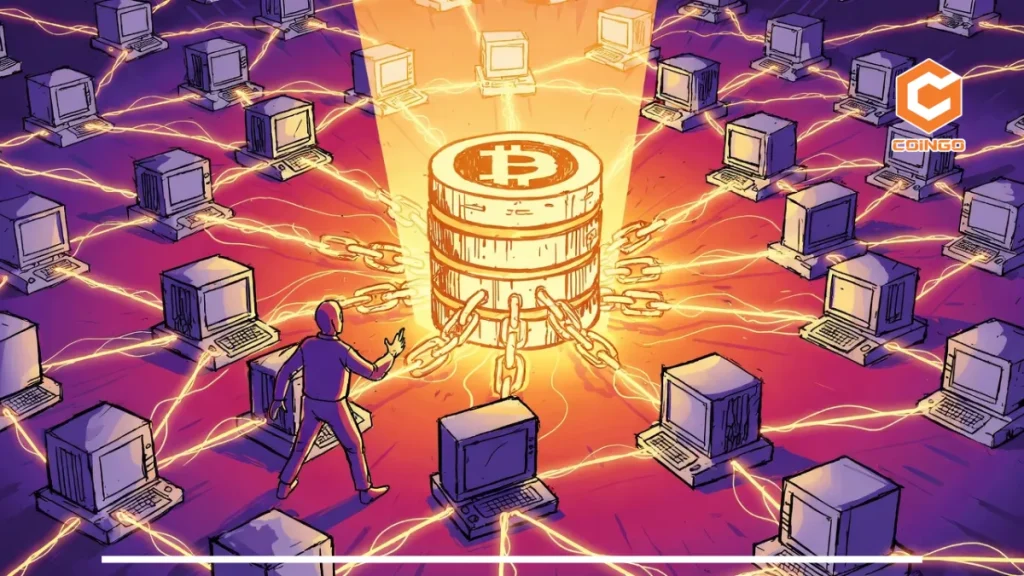
A blockchain is a shared digital record that thousands of computers around the world maintain at the same time. Every transaction added to it is checked, copied across all those computers, and locked in place using cryptography. Once a record is added, it cannot be edited or deleted without rewriting the entire chain after it. That is the whole point. Most other databases work because one company keeps them honest. Blockchains work because no single company has to.
If that sounds abstract, the simplest mental model is a public ledger. Imagine a notebook that records every payment ever made, where every page is written in permanent ink, every word is checked against thousands of identical copies, and the rules of writing in the notebook are agreed in advance and enforced by code. That is what a blockchain does. The technology behind Bitcoin, Ethereum, and almost every cryptocurrency in 2026 is built on this same foundation.
- How a Blockchain Works, Step by Step
- What Makes a Blockchain Different From a Regular Database
- The Three Core Components Behind Every Blockchain
- Public vs Private Blockchains
- What Blockchains Are Actually Used For
- Common Misconceptions About Blockchains
- What Blockchains Cannot Do Well
- How to Start Interacting With a Blockchain
- The Bottom Line
How a Blockchain Works, Step by Step
The mechanics behind a blockchain are surprisingly straightforward once you walk through what happens when someone makes a transaction.
- Someone sends a transaction. Alice wants to send 1 BTC to Bob. She broadcasts this request to the Bitcoin network using her wallet software.
- The network receives it. Thousands of computers (called nodes) hear about the transaction. They check whether Alice actually has 1 BTC, whether her digital signature is valid, and whether the transaction follows the rules.
- It gets bundled into a block. Valid transactions are grouped together into a block — typically a few thousand transactions per block on Bitcoin, or a few hundred on Ethereum.
- The block gets confirmed. Specialized network participants (miners on Bitcoin, validators on Ethereum) compete or are selected to confirm the block. They expend computing power or staked capital to prove the block is legitimate.
- The block is added permanently. Once confirmed, the block is added to the chain and broadcast to every node. Each new block links to the one before it through a cryptographic hash, making earlier blocks effectively impossible to alter without redoing all the work that came after.
This entire process takes about 10 minutes on Bitcoin, 12 seconds on Ethereum, and under a second on newer chains. The trade-offs between speed and decentralization are one of the most active design debates in crypto today.
What Makes a Blockchain Different From a Regular Database
Most databases in use today — your bank’s records, social media posts, online order history — are controlled by one company. That company can edit, delete, or hide entries at any time. They might require a court order to do so, but the technical capability is always there. Blockchains were designed specifically to remove that capability.
Three properties define a real blockchain:
- Decentralization: No single party owns or controls the database. Thousands of independent computers hold identical copies.
- Immutability: Once recorded, transactions cannot be changed without overwhelming a majority of the network — which is mathematically and economically prohibitive for major chains.
- Transparency: Every transaction is visible to anyone. Wallet addresses are pseudonymous — they do not show your name — but every move is permanently public.
The trade-off is that blockchains are slower and more expensive than centralized databases for most operations. They are not designed to compete with Visa on speed. They are designed to do something Visa structurally cannot — operate without a central referee.
The Three Core Components Behind Every Blockchain
1. Cryptographic Hashing
A hash function takes any input and produces a fixed-length string that uniquely represents it. The same input always produces the same hash, but even a one-character change in the input produces a completely different hash. Each block in a blockchain contains the hash of the previous block. If anyone tries to change a transaction in an old block, its hash changes — which breaks every block after it. That is why blockchains are tamper-evident.
2. Public-Private Key Cryptography
Every wallet has two linked keys: a public address that anyone can see and use to send you funds, and a private key that only you control. Transactions are signed with the private key, and the network verifies the signature using the public key. A crypto wallet is essentially a tool for managing these keys. The phrase “not your keys, not your coins” comes from this — if someone else holds your private key, they control your funds, no matter what platform claims otherwise.
3. Consensus Mechanisms
Thousands of independent computers need to agree on which transactions are valid and what order they happened in. Consensus mechanisms are how they reach that agreement without trusting each other. The two dominant models are Proof of Work (used by Bitcoin), where miners compete to solve cryptographic puzzles using computing power, and Proof of Stake (used by Ethereum, Solana, Cardano, and most newer chains), where validators are selected to confirm blocks based on how much of the native token they have locked up. Staking is how Proof of Stake networks let users participate in consensus and earn rewards.
Public vs Private Blockchains
Not every blockchain is open to everyone. The space splits into two main categories.
Public blockchains are open and permissionless. Anyone with an internet connection can read the data, send transactions, or run a node to help verify the network. Bitcoin and Ethereum are the largest examples. Their security comes from sheer scale — Bitcoin alone is verified by tens of thousands of independent nodes around the world.
Private or permissioned blockchains restrict who can read or write to them. They are commonly used by companies and governments for internal record-keeping, supply chain tracking, or interbank settlements. They get some benefits of blockchain technology — tamper-evident logs, shared records across departments — but they sacrifice the censorship resistance that makes public chains valuable. Most of what people mean when they say “blockchain” in 2026 refers to public chains.
What Blockchains Are Actually Used For
The original use case was simple: send money across the internet without a bank. Bitcoin still does this better than almost any alternative for transfers above a certain size. But the technology has expanded into a much wider set of applications, most of which were not envisioned in the original 2008 Bitcoin whitepaper.
Decentralized Finance — DeFi — uses programmable blockchains like Ethereum to recreate financial services without intermediaries. Lending, borrowing, trading, and earning interest all happen through smart contracts that execute automatically when conditions are met. The largest protocols hold billions of dollars in user deposits and operate without any central company controlling the funds.
Stablecoins use blockchains to issue digital tokens pegged to traditional currencies, mostly the US dollar. The total market for these has crossed $320 billion. They are increasingly used for cross-border payments, treasury operations, and as the default unit of account inside crypto markets.
Other use cases include digital identity, supply chain verification, gaming economies, governance and voting systems, and tokenized real-world assets like real estate or carbon credits. Most altcoins exist because their creators believed they could build a better blockchain for one specific use case than Ethereum could.
Common Misconceptions About Blockchains
“Blockchains are anonymous.” Mostly false. Public chains are pseudonymous — your real name is not attached to your wallet by default — but every transaction is permanently public. Specialized firms can often link wallet activity to real identities, especially when funds touch regulated exchanges.
“Blockchains are unhackable.” The blockchain layer itself is extremely difficult to attack. But the applications built on top of it — exchanges, DeFi protocols, bridges — are hacked regularly. Most crypto losses in 2026 come from these layers, not from the underlying chains.
“Blockchains will replace banks.” Probably not in the way most people imagine. The more realistic outcome is that some banking functions get rebuilt on blockchain rails — settlements, cross-border payments, certain forms of credit — while others stay centralized for regulatory and consumer protection reasons. The two systems are converging more than one is replacing the other.
“All blockchains are wasteful.” This was a fair criticism of early Proof of Work systems. Modern Proof of Stake chains use roughly 99% less energy per transaction than Bitcoin. The energy debate has shifted significantly since Ethereum moved off Proof of Work in 2022.
What Blockchains Cannot Do Well
Honest assessment matters here. Blockchains are not magic. They are bad at several things, and pretending otherwise leads to bad investment decisions.
They are slow compared to centralized databases. Visa processes around 65,000 transactions per second. Bitcoin handles about 7. Ethereum handles 15-30 on its base layer, though Layer-2 networks scale this much higher. They are expensive when networks are congested. They cannot recover from user errors — sending funds to the wrong address is permanent. They cannot easily store large amounts of data on-chain because storage is expensive. And they introduce new attack surfaces, particularly around smart contract vulnerabilities and quantum computing threats that are becoming more concrete.
The quantum threat is no longer purely theoretical. Dogecoin executed its first post-quantum transaction earlier this month, and major chains are actively researching how to migrate their cryptography before quantum computers can break current signature schemes. This is one of the most important open problems in blockchain design today.
How to Start Interacting With a Blockchain
If you have read this far, you probably want to actually use one. The basic path is straightforward.
- Set up a wallet. MetaMask, Rabby, or Phantom are common starting points for Ethereum and Solana respectively. They store your private keys and let you send transactions.
- Buy a small amount of crypto. Use a regulated exchange to convert fiat into ETH, BTC, or another major asset. Start small. Treat the first purchase as tuition.
- Send a transaction. Move a small amount from the exchange to your wallet. Then send a tiny portion to another wallet you control. Watching the transaction confirm on a block explorer is the moment most of this clicks.
- Explore a dApp. Try a decentralized exchange like Uniswap, an NFT marketplace, or a basic lending protocol. Use small amounts. The point at this stage is learning, not earning.
The Bottom Line
Blockchains solved a problem most people did not realize they had — how to coordinate value and information across the internet without trusting any single intermediary. The technology is messy, slow in places, expensive in others, and still evolving. But the core idea has held up across seventeen years of attacks, hype cycles, and skepticism. The infrastructure that started with Bitcoin in 2009 now underpins a multi-trillion-dollar global market.
Whether blockchains end up reshaping money, governance, identity, or none of those things at scale is still being decided. What is clear is that anyone trying to understand the next two decades of digital infrastructure needs to understand this layer. The mechanics are not as complicated as the marketing makes them sound. A shared database that no one can quietly rewrite. That is it. Everything else is implementation detail.
This article is for educational purposes only and does not constitute investment advice. Always do your own research before purchasing or interacting with any cryptocurrency.