
Ethereum is a decentralized, open-source blockchain platform that enables developers to build and deploy applications without relying on centralized servers or gatekeepers. Launched in 2015 by Vitalik Buterin and a group of co-founders, it introduced a concept that Bitcoin never set out to provide: a programmable blockchain. Where Bitcoin is designed to do one thing exceptionally well — store and transfer value — Ethereum is designed to run code. That distinction changes everything.
The platform’s native cryptocurrency, Ether (ETH), is used to pay for computational work on the network. But ETH is only the fuel. The engine is Ethereum itself — a global, permissionless computer that anyone can use, build on, or connect to, without asking for permission from anyone.
The Ethereum stack: from the base blockchain up to users, with ETH fueling every layer
Bitcoin vs. Ethereum: Different Problems, Different Answers
The most common confusion for newcomers is the relationship between Bitcoin and Ethereum. Both are blockchains, both decentralized — but they were built for fundamentally different purposes.
Bitcoin was designed as digital gold: a fixed-supply, censorship-resistant store of value. Ethereum was designed as a platform — closer to a decentralized operating system than a currency. Buterin published the Ethereum white paper in 2013 after concluding that Bitcoin’s scripting language was too limited to support the kinds of applications he envisioned. His argument was simple: rather than building a new blockchain for every new use case, you could build a single programmable one and let developers do the rest.
| Feature | Bitcoin (BTC) | Ethereum (ETH) |
|---|---|---|
| Primary purpose | Store of value, payments | Programmable platform |
| Native asset | BTC | ETH (Ether) |
| Smart contracts | Very limited | Core feature |
| Consensus | Proof-of-work | Proof-of-stake (2022) |
| Supply cap | 21 million (hard cap) | No hard cap |
| DeFi / NFT / DApps | No | Yes — full ecosystem |
| Block time | ~10 minutes | ~12 seconds |
| EVM compatible | No | Yes — industry standard |
Bitcoin vs. Ethereum: key differences at a glance
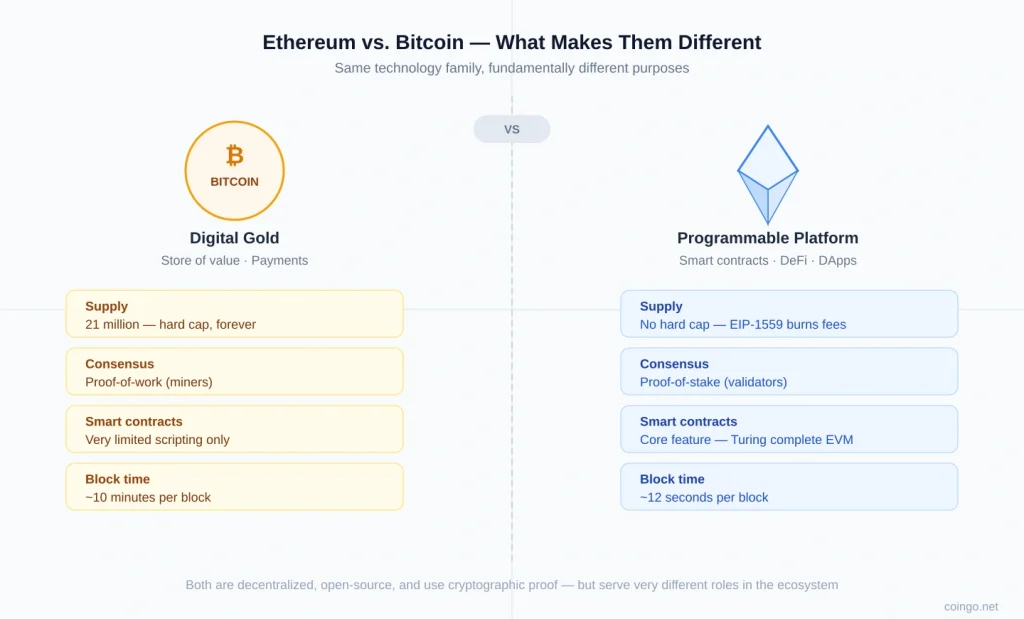
Bitcoin vs Ethereum: same technology family, fundamentally different purposes
Smart Contracts: The Core Innovation
The feature that separates Ethereum from every blockchain that came before it is the smart contract. A smart contract is a piece of code stored on the blockchain that executes automatically when predefined conditions are met — without any human intervention and without any possibility of interference from a third party.
The classic analogy is a vending machine — an idea coined by computer scientist Nick Szabo in 1994, a full two decades before Ethereum existed. You insert the correct amount, press a button, and the machine dispenses the product. There is no cashier, no negotiation, no counterparty risk. The rules are embedded in the mechanism itself. Smart contracts work exactly the same way, but for financial agreements, governance votes, digital ownership records, and any other interaction that traditionally required a trusted intermediary to enforce.
“Smart contracts are a type of Ethereum account. They have a balance and can be the target of transactions. However, they’re not controlled by a user — instead they are deployed to the network and run as programmed.”
— Ethereum Foundation
Smart contracts are written in a programming language called Solidity and deployed to the Ethereum network, where they live permanently on the blockchain. Once deployed, they cannot be altered — which is both their greatest strength (tamper-proof execution) and a known risk (bugs in the code are also permanent). Every interaction is visible to anyone who checks the blockchain: there are no hidden algorithms, no proprietary logic, no black boxes.
Smart contracts vs. traditional intermediaries — how Ethereum removes the middleman
The Ethereum Virtual Machine
Underneath every smart contract is the Ethereum Virtual Machine (EVM) — the runtime environment that processes and executes contract code across every node on the network simultaneously. When a smart contract is triggered, the EVM runs its instructions on thousands of computers at once, and all of them must reach the same result. This is what makes Ethereum trustless: no single entity controls the execution.
The EVM also defines Ethereum’s compatibility standard. Any blockchain that runs the same EVM specification can execute Ethereum smart contracts. This is why dozens of competing networks — from Polygon to BNB Chain to Avalanche — explicitly describe themselves as EVM-compatible. Ethereum set the standard the rest of the industry converged around, which means the developer tools, the code, and the skills are all portable across the ecosystem.
What Ethereum Is Actually Used For
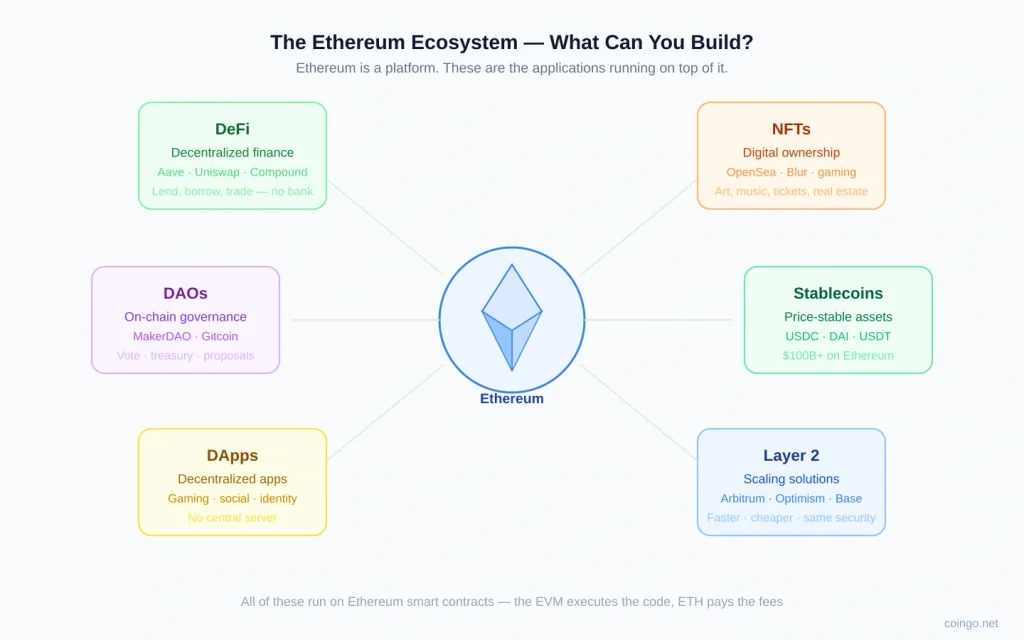
The programmability that smart contracts enable has produced an entire ecosystem of applications. Decentralized finance, or DeFi, represents the most financially significant category. Protocols like Aave and Compound allow users to lend and borrow assets directly from smart contracts, earning or paying interest without a bank involved. Uniswap and other decentralized exchanges allow token swaps directly from a wallet, without an order book or custodian.
Non-fungible tokens gave Ethereum its mainstream moment. By 2021, NFT sales on Ethereum-based marketplaces were generating billions in monthly volume. The underlying mechanism — a smart contract recording ownership of a unique digital asset — was entirely Ethereum’s. By 2026, NFT infrastructure has matured well beyond speculative art: sports rights, music royalties, event tickets, and real estate deeds are being tokenized on the same rails.
Decentralized Autonomous Organizations (DAOs) use smart contracts to enable governance without a central authority. Members vote on proposals, and outcomes are executed automatically by the contract. Ethereum currently hosts the largest developer ecosystem in blockchain, with more active developers and more DeFi value locked in its applications than any competing chain.
| Use case | What it enables | Examples in 2026 |
|---|---|---|
| DeFi | Decentralized lending, borrowing, trading without banks | Aave, Uniswap, Compound, Lido |
| NFTs | Unique digital ownership — art, music, gaming | OpenSea, Blur, gaming items |
| DAOs | Decentralized governance and on-chain voting | MakerDAO, Gitcoin, Nouns |
| DApps | Apps without centralized servers | Gaming, social, identity, supply chain |
| Stablecoins | Price-stable assets running on Ethereum | USDC, DAI, USDT |
| RWA tokenization | Real-world assets brought on-chain | Treasury bonds, real estate, commodities |
| Layer 2 scaling | Faster, cheaper transactions anchored to Ethereum | Arbitrum, Optimism, Base, Polygon |
Major use cases built on the Ethereum platform as of 2026
Bitcoin vs Ethereum: same technology family, fundamentally different purposes
Ether (ETH): The Network’s Native Fuel
Every operation on Ethereum — from a simple token transfer to a complex DeFi interaction — consumes computational resources. Those resources are paid for in Ether (ETH), denominated in units called gas. Gas is a fee that compensates validators who maintain the network, calibrated to the complexity of the operation.
Beyond paying for transactions, ETH plays a second structural role: it is the asset that validators must stake as collateral to participate in Ethereum’s proof-of-stake consensus mechanism, introduced in the Merge upgrade of September 2022. Validators who behave honestly earn staking rewards; those who attempt to cheat the network risk having a portion of their staked ETH destroyed — a mechanism called slashing. As of 2026, staking ETH yields roughly 3.5–4.5% APR. ETH also benefits from EIP-1559, which burns a portion of gas fees with every transaction, creating deflationary pressure on supply.
“If Bitcoin is digital gold, Ethereum is digital infrastructure. BTC stores value. ETH powers everything built on top of it.”
Ethereum in 2026: Where Things Stand
Ethereum enters 2026 at a genuine inflection point. The network has successfully transitioned to proof-of-stake, reducing energy consumption by over 99%. Layer-2 networks — Arbitrum, Optimism, Base, and others — have made transaction fees a fraction of what they were at peak congestion, opening Ethereum’s programmability to users who were previously priced out.
The Ethereum Foundation’s active work on post-quantum cryptography — formalized in early 2026 with the launch of the Post-Quantum Ethereum initiative at pq.ethereum.org — signals that the network’s developers are thinking on a decades-long timeline. And the continued expansion of real-world asset tokenization, with institutions including BlackRock and Franklin Templeton deploying Ethereum-based products, suggests that the vision Buterin outlined in 2013 is no longer theoretical.
None of this means the challenges are resolved. ETH has underperformed Bitcoin in recent market cycles. Questions about Ethereum’s identity — store of value, yield-bearing asset, internet infrastructure layer — remain contested. Competition from faster, cheaper chains is real.
What is not contested is Ethereum’s position as the most battle-tested programmable blockchain in existence, with the deepest developer ecosystem, the highest total value locked across its applications, and a decade of security track record. For anyone trying to understand where decentralized technology is going, Ethereum remains the clearest place to start.
This article is for educational purposes only and does not constitute financial or investment advice.