


The largest crypto derivatives settlement of Q1 2026 lands on Friday — and the mechanics of max pain could drag BTC toward a level that also happens to be its most important resistance.
Add an SEC ruling on 91 ETF applications the same day, and this might be the most consequential 24 hours crypto markets have seen in months.
Friday, March 27 is shaping up to be an unusually loaded day for crypto markets. At 08:00 UTC, Deribit — the world’s largest crypto options exchange — will settle $14.16 billion worth of Bitcoin and Ethereum options contracts, the single biggest quarterly expiry of 2026. At roughly the same time, the SEC is expected to deliver rulings on 91 pending crypto ETF applications covering assets including XRP, Solana, Litecoin, and Dogecoin. Two catalysts. One morning.
Bitcoin is trading near $71,000 heading into expiry. The number traders and market makers are circling is $75,000 — the max pain level for the March 27 settlement, and coincidentally, the same resistance zone that has rejected every BTC rally attempt since February.
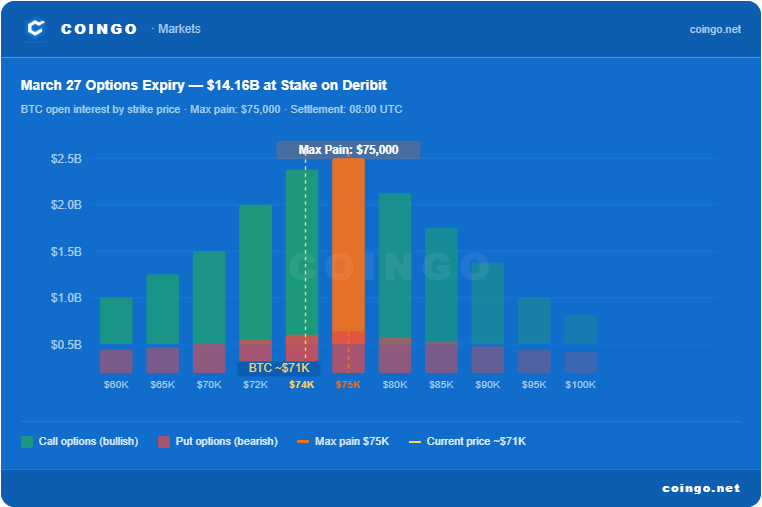
How Max Pain Works — and Why It Matters This Time
Max pain refers to the strike price at which the largest number of open options contracts expire worthless — the level that inflicts the maximum financial damage on options buyers while benefiting the sellers, who are typically large institutions and market makers. According to Deribit’s Chief Commercial Officer Jean-David Péquignot, the current positioning makes $75,000 a genuine gravitational pull.
“With Bitcoin currently trading near $71k, the $75k Max Pain price represents a gravitational pull. Historically, this encourages delta-hedging by market makers that can drive prices toward the strike where the most options expire worthless.”
— Jean-David Péquignot, Chief Commercial Officer, Deribit
The mechanics behind this are not theoretical. Market makers who sell options continuously hedge their exposure by buying or selling the underlying asset. As expiry approaches and options near the max pain strike become most relevant, this hedging activity intensifies — and the cumulative effect tends to pull spot price toward that level. The effect is strongest for large quarterly expiries, where open interest is thick enough to create real price gravity.
CoinDesk’s research shows BTC settles within 5% of max pain roughly 60–65% of the time on quarterly expirations. The signal is weaker for weekly and monthly expiries, but for Friday’s event — the biggest settlement of Q1 — the pull is more meaningful than usual.
The Numbers Behind Friday’s Expiry
| Asset | Notional Value | Put/Call Ratio | Max Pain |
|---|---|---|---|
| Bitcoin (BTC) | $10.2 billion | 0.85 call-heavy | $75,000 |
| Ethereum (ETH) | $3.3 billion | 0.78 call-heavy | ~$2,100 |
| Total | $14.16 billion | — | Q1 record |
March 27, 2026 Deribit expiry breakdown
March 27, 2026 Deribit expiry breakdown · Source: Deribit, CoinDesk, March 25–26 2026
Bitcoin’s $10.2 billion in expiring contracts accounts for roughly 40% of total open interest on Deribit. The put/call ratio of 0.85 — slightly more calls than puts — suggests positioning leans cautiously bullish, but not with the kind of conviction that would make a directional move inevitable. Implied volatility has compressed over the past week as traders adopt a wait-and-see posture ahead of settlement, a pattern typical of pre-expiry periods.
The SEC Variable — and Why It Changes Everything
What makes Friday unusual is the second catalyst running in parallel. The SEC is expected to rule on 91 crypto ETF applications on March 27, covering spot products for XRP, Solana, Litecoin, and Dogecoin. If approvals come through, the directional impact would almost certainly override the max pain gravity entirely — potentially triggering a rally that breaks $75,000 on volume and carries BTC toward the $80,000 level that acted as support in November before breaking down in January.
A broad rejection, conversely, would add downside pressure on top of whatever positioning unwind follows settlement. In that scenario, the $68,000 area — which has provided intermittent support through March — would come back into focus quickly.
| Scenario | Price Path | Outcome |
|---|---|---|
| BTC holds $71K–$75K | Max pain gravity pulls up | Controlled |
| BTC breaks above $75K | Short squeeze triggered | Rally $80K |
| BTC drops below $68K | Put buyers profit | Selloff risk |
Post-expiry scenario matrix
Post-expiry scenario matrix based on current positioning and price levels
What Traders Are Watching
Institutional traders appear to be selling calls at higher strikes heading into Friday, signaling measured optimism without aggressive upside bets. The options market’s overall structure — calls outnumbering puts but not by a commanding margin — reflects a market that is neither convinced a breakout is imminent nor positioned for a sharp leg lower.
The most consistent pattern from past quarterly expiries is not the direction of the initial move — it is the timing of the post-expiry move. Volatility typically compresses into settlement and releases in the 3–7 days that follow. Traders who have attempted to front-run expiry direction have historically fared worse than those who waited for both Friday catalysts to resolve before entering positions.
“Quarterly expiries typically produce compressed volatility into settlement and an explosive directional move in the days after. Friday is a coin flip. The week after is where the position is.”
With BTC sitting roughly $4,000 below max pain at current prices, there is mechanical room for upside between now and 08:00 UTC Friday. Whether that move materializes depends on whether spot demand is genuine or if the options market is simply pulling price toward a level that will be abandoned the moment settlement passes.
For a market that has spent the better part of six weeks unable to hold gains above $74,000, Friday is the clearest near-term test of whether the buyers who have been quietly accumulating in the $60,000–$72,000 range are finally ready to take control — or whether the next leg happens in the other direction.