
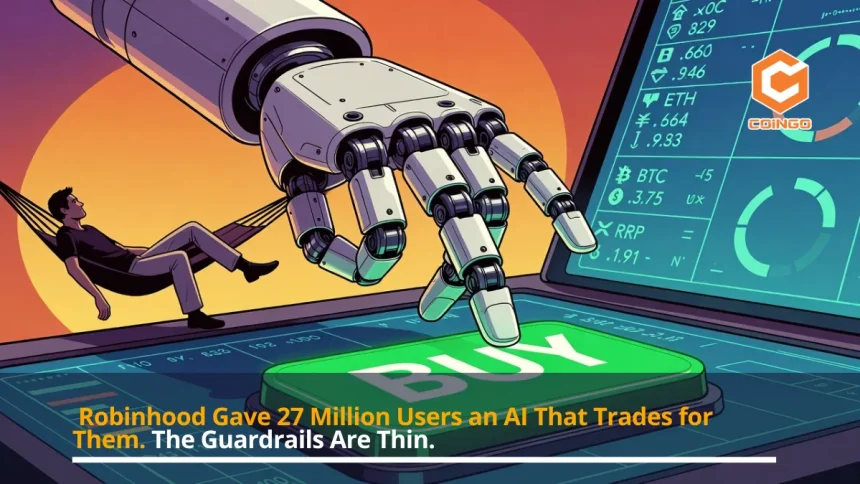
Robinhood just gave every one of its 27 million customers the ability to hand their trading accounts to an AI agent. Not a recommendation engine. Not a chatbot that suggests stocks. An autonomous agent that can monitor markets, build portfolios, execute trades, and spend money through a virtual credit card. All without the user being present.
The company announced two products on Wednesday: Agentic Trading and the Agentic Credit Card. Both are live now for U.S. stock trading. Crypto and options support is coming.
What the AI Agent Actually Does
Users connect a third-party AI agent to their Robinhood account through an API. The agent gets permission to act within parameters the user defines. Want an AI to build and maintain an AI-focused stock portfolio? Tell it. Want it to buy oversold stocks when RSI drops below 30? Set the rule. The agent monitors, decides, and executes. You do not have to be looking at your phone.
The Agentic Credit Card extends the same logic to spending. An AI agent gets a virtual card with a spending limit. It can track product prices, wait for discounts, and complete purchases when conditions are met. Robinhood is pitching this as “shopping automation.” It is also giving an AI access to a credit line.
The Guardrails Robinhood Describes
Robinhood says the system includes four safety layers. First, agentic trading runs in a separate account with limited funds, isolated from the main portfolio. Second, spending controls cap what the AI can charge. Third, users get real-time notifications for every trade and purchase. Fourth, there is an instant shutoff that revokes agent access immediately.
That sounds reasonable until you think about what is missing. There is no mention of position size limits relative to account value. No maximum number of trades per day. No circuit breaker if the agent generates losses past a threshold. The guardrails protect against unauthorized access. They do not protect against bad strategy.
Hedge Fund Tools for Retail Accounts
Robinhood is explicit about the positioning: this brings “hedge fund-style automation” to everyday investors. That framing is deliberate and revealing. Hedge funds use algorithmic trading within institutional risk management frameworks. They have compliance teams, drawdown limits, portfolio-level risk controls, and counterparty agreements that define what the algorithms can and cannot do.
A 22-year-old connecting a third-party AI to a Robinhood account with $5,000 has none of that. The algorithm is the same concept. The infrastructure around it is not.
The AI Agent Economy Is Already Here
Robinhood is not the first to give AI agents financial autonomy. Amazon gave AI agents their own crypto wallets earlier this year, letting them transact autonomously for supply chain payments. Coinbase built an app store where the customers are AI agents. The infrastructure for machines to move money is being built across every major platform simultaneously.
What Robinhood adds is scale. Coinbase’s agent tools target developers. Amazon’s target enterprise clients. Robinhood is targeting 27 million retail users who already have brokerage accounts funded and ready to trade. That is the largest single deployment of autonomous financial agents in history.
Crypto Is Next
Robinhood confirmed that crypto trading and options will be added to the agentic platform. No timeline was given, but the architecture is already in place. When it ships, AI agents will be able to buy and sell Bitcoin, Ethereum, and other assets listed on Robinhood without human intervention.
The crypto version raises additional questions. Stock markets have circuit breakers and trading halts. Crypto does not. A misbehaving AI agent trading stocks at 3 AM gets stopped by market close. A misbehaving AI agent trading Bitcoin at 3 AM keeps going. AI infrastructure providers are still figuring out pricing and access controls for autonomous agents. Robinhood is building the consumer-facing layer before those controls are mature.
HOOD stock rose on the announcement. Wall Street sees the product as a user engagement play that could boost trading volume and revenue per user. That is probably correct in the short term. The longer-term question is what happens when millions of AI agents, built by different developers with different risk tolerances, all react to the same market event at the same time. Flash crashes caused by human-built algorithms already happen. AI-driven security and risk management is still catching up to AI-driven execution. Robinhood just made execution available to everyone. The risk management part is left as an exercise for the user.