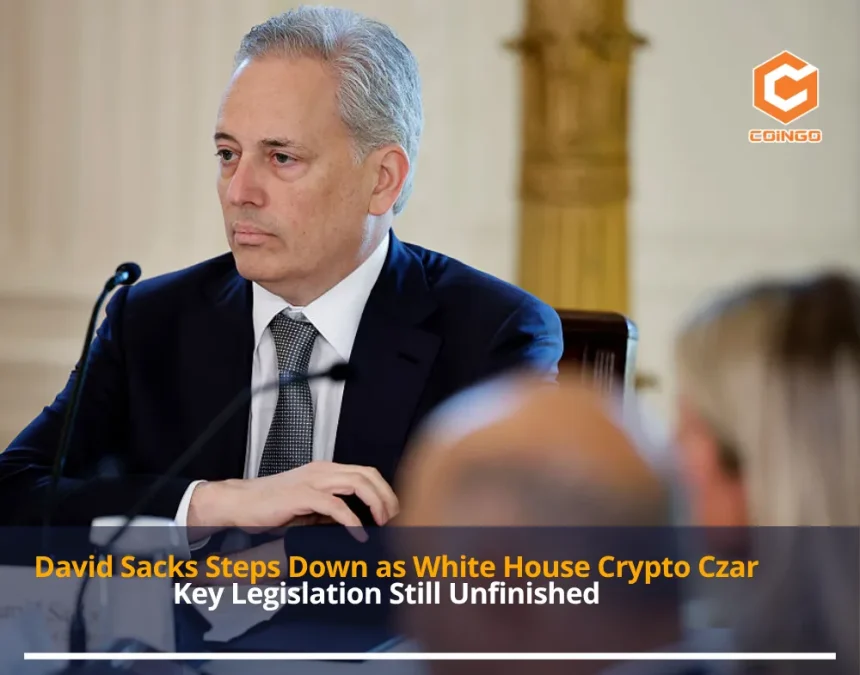
David Sacks has stepped down as the White House’s AI and crypto czar after reaching the 130-day limit for special government employees. In an interview with Bloomberg on Thursday, Sacks confirmed his departure and announced he will serve as co-chair of the President’s Council of Advisors on Science and Technology (PCAST) alongside senior White House technology adviser Michael Kratsios. The council’s 13-member roster includes Jensen Huang (Nvidia), Mark Zuckerberg (Meta), Marc Andreessen, and Fred Ehrsam — Coinbase co-founder and the sole crypto-native representative on the panel.
“Moving forward as co-chair of PCAST, I can now make recommendations on not just AI but an expanded range of technology topics.”
— David Sacks, via Bloomberg
What He Built — and What He Didn’t
During his tenure, Sacks was the administration’s most prominent voice on digital asset policy. He drove the passage of the GENIUS Act — the stablecoin-focused legislation that marked the industry’s first major legislative win under Trump — and championed the creation of a U.S. strategic Bitcoin reserve seeded with government-seized BTC. The reserve framework later evolved into the ARMA legislation, which accelerated the timeline. He also pushed to split crypto market oversight between the SEC and the CFTC through the Clarity Act.
But the biggest deliverables remain unfinished. The Clarity Act passed the House with bipartisan support but has stalled in the Senate Banking Committee over disagreements on stablecoin rewards. An early proposal for a permanent White House crypto council never materialized. The strategic Bitcoin reserve has yet to be fully operationalized.
The Industry’s Question: Who’s Next?
Sacks’ new role on PCAST is wider in scope and less operationally focused on crypto. The practical question for the industry is who now carries this legislation inside the White House. Senator Bernie Moreno has already flagged the urgency.
“If the bill doesn’t reach the Senate floor by May, it risks going dark until after the midterms.”
— Senator Bernie Moreno
Peter Van Valkenburgh, executive director of Coin Center, framed the stakes even more directly: relying on short-term friendly discretion instead of durable law would be a strategic mistake the industry may not recover from. The window for reform, he warned, does not stay open indefinitely.
Sacks will continue advising on AI, quantum computing, and semiconductor policy through PCAST. His influence on crypto — once the most direct line from Silicon Valley into the White House — is now one step further removed from the decision center.