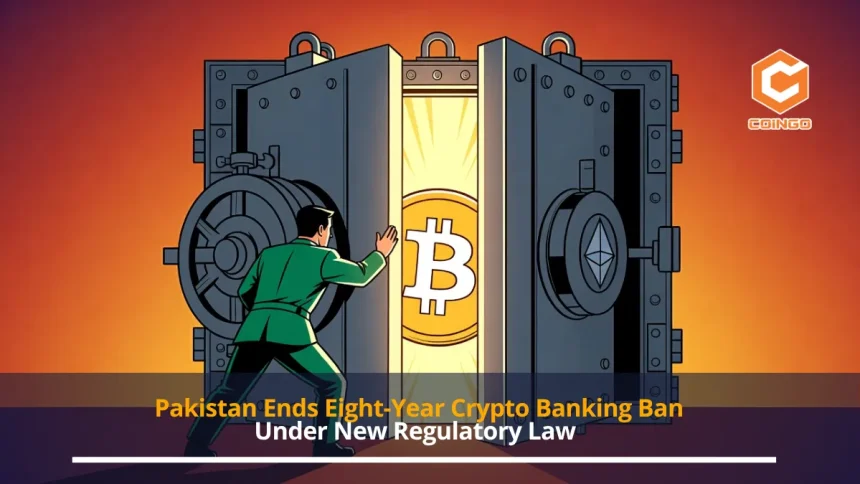
The State Bank of Pakistan (SBP) has formally lifted its 2018 ban on crypto-related banking services, replacing it with a regulated framework under the newly enacted Virtual Assets Act 2026. Licensed virtual asset service providers (VASPs) can now open bank accounts and access the formal financial system for the first time in eight years. The move formalizes a market that already ranks among the world’s largest by retail participation, with an estimated 40 million crypto users and annual trading volumes exceeding $300 billion.
Banks Can Service Crypto Firms but Cannot Hold or Trade Crypto
The SBP’s Circular Letter No. 10 of 2026, issued on April 14, replaces the 2018 directive that banned all banking involvement with virtual currencies. Under the new rules, banks and financial institutions can open accounts for VASPs that hold a valid license or No Objection Certificate from the Pakistan Virtual Asset Regulatory Authority (PVARA).
The framework draws a clear line: banks can provide banking services to licensed crypto firms, but they cannot invest in, trade, or hold virtual assets using their own funds or customer deposits. This limits the banking sector’s role to infrastructure provider rather than market participant, insulating the traditional financial system from direct crypto price exposure.
Client Money Accounts and Strict AML Requirements
Banks must open separate Client Money Accounts (CMAs) for each VASP to settle authorized transactions. These accounts must be denominated in Pakistani Rupees, non-remunerative, and strictly segregated from the VASP’s own operational funds. Cash deposits and withdrawals are prohibited, and CMA funds cannot be used as collateral or to extend credit.
Before onboarding any VASP, banks must obtain and independently verify the firm’s PVARA license. Enhanced due diligence requirements include understanding each VASP’s business model, customer base, onboarding processes, and geographic footprint. Banks must also update their risk profiling models to capture VASP-specific risks and continuously monitor all transactions, reporting suspicious activity to Pakistan’s Financial Monitoring Unit.
Pakistan Crypto Banking Framework at a Glance
| Component | Detail |
|---|---|
| Legal Basis | Virtual Assets Act 2026 |
| Regulator | PVARA (Pakistan Virtual Asset Regulatory Authority) |
| Effective Date | April 14, 2026 (immediate) |
| Banks Can | Open accounts for licensed VASPs |
| Banks Cannot | Trade, invest in, or hold crypto assets |
| Settlement Accounts | PKR-denominated Client Money Accounts |
| Estimated Crypto Users | ~40 million (17% of population) |
| Annual Trading Volume | $300B+ |
The 2018 Ban Drove Activity Underground
The original 2018 ban, which prohibited all banking involvement with virtual currencies, did not eliminate crypto activity. Peer-to-peer trading surged by over 700% in the years following the ban, according to the Federation of Pakistan Chambers of Commerce and Industry. Users simply routed around the formal banking system, creating a large informal market that operated without AML controls or consumer protections.
The new framework attempts to bring that activity back into the regulated system. By requiring PVARA licensing as a prerequisite for banking access, Pakistan creates a filter that separates legitimate operators from unlicensed ones while giving compliant firms the banking infrastructure they need to operate.
Tokenized Bonds, Bitcoin Mining, and a National Stablecoin
The banking reform is part of a broader digital finance strategy. In December, the Pakistani government signed a memorandum of understanding with Binance to explore tokenizing up to $2 billion in bonds, treasury bills, and commodity reserves. PVARA Chairman Bilal Bin Saqib has also outlined plans to accelerate crypto adoption through Bitcoin mining initiatives and the development of a national stablecoin.
Major global exchanges including HTX received preliminary No Objection Certificates from PVARA in December 2025. While none are authorized to operate commercially yet, the new banking rules give them a clear path to formal market entry.
A 40-Million-User Market Goes Formal
Pakistan’s decision to replace an outright ban with a structured licensing and banking framework reflects a pragmatic recognition that prohibition failed. With 17% of the population already involved in crypto trading and hundreds of billions in annual volume flowing through informal channels, the government chose to regulate what it could not stop.
The restriction on banks’ direct crypto exposure keeps the traditional financial system shielded, while the VASP licensing regime and CMA requirements create a controlled on-ramp. Whether this brings the bulk of Pakistan’s informal crypto market into compliance will depend on how quickly PVARA processes licenses and how accessible the banking framework proves in practice.