What Happened
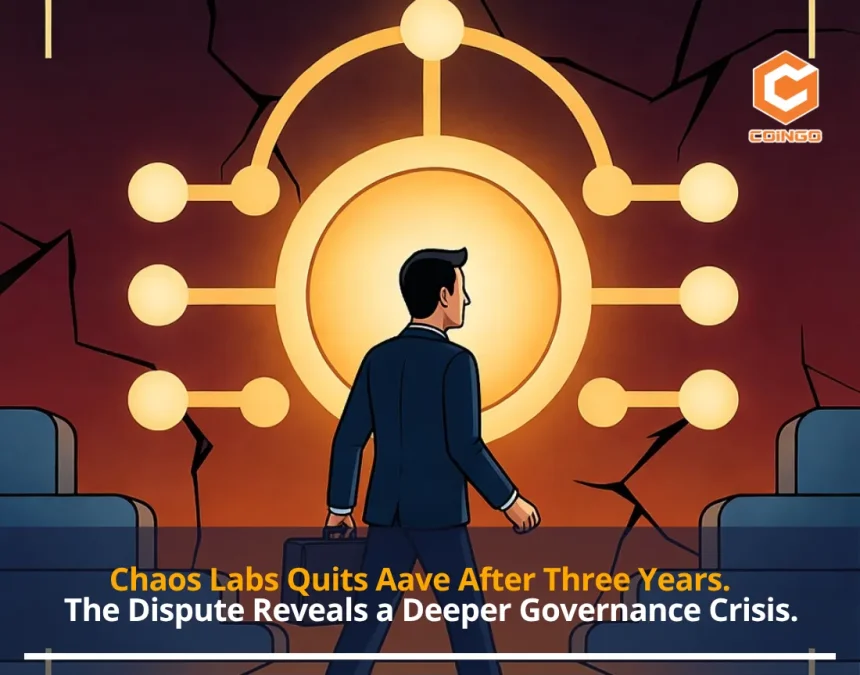
On April 7, 2026, Chaos Labs publicly announced it was ending its engagement with the Aave ecosystem, with founder Omer Goldberg posting the decision on X. The firm had served as Aave’s principal risk service provider since November 2022, a period during which the protocol’s total value locked grew fivefold from roughly $5 billion to $26 billion.
Goldberg was explicit that the departure was not made in haste. Budget negotiations had lasted months. Aave Labs offered a $5 million annual contract to retain the firm. Chaos Labs declined. The stated reason: not money, but a fundamental misalignment in how risk should be managed.
At the time the news broke, the AAVE governance token was trading at approximately $90, down roughly 4% over 24 hours. Some sources reported intraday dips of up to -11% immediately following the announcement before partial recovery. The $100 level remains a key resistance zone; on higher time frames, AAVE’s 50-week EMA has crossed below the 200-week EMA, forming a death cross overhead.
Two Versions of the Same Departure
The full picture of why Chaos Labs left involves two partly divergent accounts — one from Chaos, one from Aave.
Chaos Labs’ account: Goldberg pointed to the operational burden of Aave’s planned migration to V4 as the core issue. The new architecture requires simultaneously managing both the existing V3 markets and the incoming V4 infrastructure, which he described as doubling the workload rather than halving it. He noted that some Aave contributors had already departed, increasing Chaos Labs’ share of the load. The deeper issue was legal exposure: no regulatory framework, no safe harbor, and no settled legal precedent exists to define what a DeFi risk manager owes when a protocol fails.
“If things work, the work is invisible. If things break, the blame is not. There is no regulatory framework, no safe harbor, and no settled law that answers the question of what a risk manager owes when a protocol fails.” — Omer Goldberg, Chaos Labs founder
Aave Labs’ account: CEO Stani Kulechov described a different dynamic. According to Kulechov, Chaos Labs pitched a proposal to become the sole risk provider, which would have required removing the other risk partner, LlamaRisk, and replacing Chainlink’s price oracles with Chaos-built alternatives. Aave was unwilling to abandon its two-layer economic risk model or its relationship with Chainlink, which Kulechov said users were more comfortable with at scale. He also stated that Chaos Labs had already been exploring winding down its risk consultancy services independently of the Aave relationship.
Table 1 — Major Aave Contributors Who Have Exited (2025-2026)
| Contributor | Role | Stated Reason for Exit |
|---|---|---|
| Aave Chan Initiative (ACI) | Governance / DAO coordination | Disputes over Aave Labs’ budget requests and voting power transparency |
| BGD Labs | Aave V3 core development | “Asymmetric organizational scenario” and Aave Labs’ centralization efforts |
| Chaos Labs | Primary risk service provider (2022–2026) | V4 workload, undefined legal liability, alleged demand to become sole provider |
The Oracle Incident and the Legal Gray Zone
Chaos Labs’ departure cannot be fully understood without the context of a specific incident that preceded it. In March 2026, a misconfigured Chaos Labs oracle on Aave triggered approximately $26.9 million in erroneous liquidations involving staked Ether collateral. The CAPO risk agent reported an inaccurately low price ratio, pushing multiple accounts below their health-factor thresholds. At least 34 high-leverage positions were forcibly closed before parameters were corrected. Wrapped staked Ether was undervalued by approximately 2.85% during the window.
Chaos Labs and Aave both stated that no bad debt was incurred and affected users would be reimbursed. But the episode crystallized the structural problem Goldberg flagged in his departure statement: risk managers are making protocol-wide decisions that move tens of millions of dollars, with no legal framework defining their liability if something goes permanently wrong. The March incident was recoverable. A more severe failure might not be.
This is the legal gray zone Goldberg described as central to the decision to leave even a $5 million engagement: responsibility without a defined framework for accountability.
Why the V4 Transition Doubles the Workload
A significant part of Chaos Labs’ technical objection centers on the nature of Aave’s upcoming V4 migration. The new architecture introduces a Hub-and-Spoke model: a central liquidity layer serving multiple satellite markets with improved capital efficiency and risk isolation. The first governance vote on V4 passed unanimously on March 24, 2026, signaling community support for the direction.
The problem, as Goldberg framed it, is timing. Historical precedent suggests these protocol migrations take months or years to complete fully. During the transition, both V3 and V4 must run simultaneously — each with its own risk parameters, oracle feeds, and market configurations. A risk manager does not see its workload reduced by migration in progress. It effectively manages two full protocol versions at once, with all the complexity that entails.
Goldberg’s comment — “Until V4 fully absorbs V3’s markets and liquidity, both systems need to be operated and managed simultaneously. The workload during the transition doesn’t halve. It doubles.” — captures the economic logic of walking away: the compensation structure was built for one system, not two.
A Pattern: Three Exits, One Common Complaint
Framing Chaos Labs’ departure as an isolated commercial dispute misses the pattern. This is the third major contributor exit in recent months, and all three point toward the same structural tension inside Aave’s DAO.
The Aave Chan Initiative — the protocol’s most influential governance community — cited disputes over Aave Labs’ budget requests and voting power. BGD Labs, which built the Aave V3 codebase, cited an “asymmetric organizational scenario” and Aave Labs’ centralization tendencies. Chaos Labs now adds a third data point: a dispute over who controls risk infrastructure and whether external partners are being asked to absorb liability without corresponding authority or compensation.
All three complaints converge on the question of how much control Aave Labs — which manages branding, communications, and holds significant voting influence — exercises within a system formally governed by decentralized community vote. In a true DAO, decisions flow through Aave Improvement Proposals and community consensus. In practice, the concentration of operational and reputational influence inside Aave Labs creates a structural asymmetry that multiple core contributors have now publicly described as untenable.
What Happens Next for Aave
Aave Labs has moved quickly to contain the narrative. Kulechov confirmed that the protocol’s smart contracts, asset listings, and network integrations are unaffected by Chaos Labs’ exit. LlamaRisk — the second risk provider in Aave’s two-layer model — has publicly stated it will continue providing uninterrupted risk coverage and is coordinating with the DAO on the transition.
LlamaRisk’s confirmation matters for short-term stability, but the longer-term question is different. Chaos Labs spent three years building the pricing models, risk parameter calibrations, and oracle infrastructure that Aave’s markets relied on. That institutional knowledge does not transfer automatically. Whether LlamaRisk can absorb Chaos Labs’ full scope of responsibilities, or whether Aave will need to onboard a new risk provider, has not yet been formally addressed.
For the AAVE token, the market’s reading of this situation will depend on how credibly Aave can demonstrate continuity through the V4 transition. The protocol has crossed $1 trillion in cumulative lending volume and maintains TVL in the tens of billions. Its fundamentals remain strong. But the departure of three core contributor teams in rapid succession — governance, core development, and primary risk management — raises a legitimate question about whether Aave’s incentive and governance structures can retain the talent its scale demands. That question is unlikely to be resolved quickly.