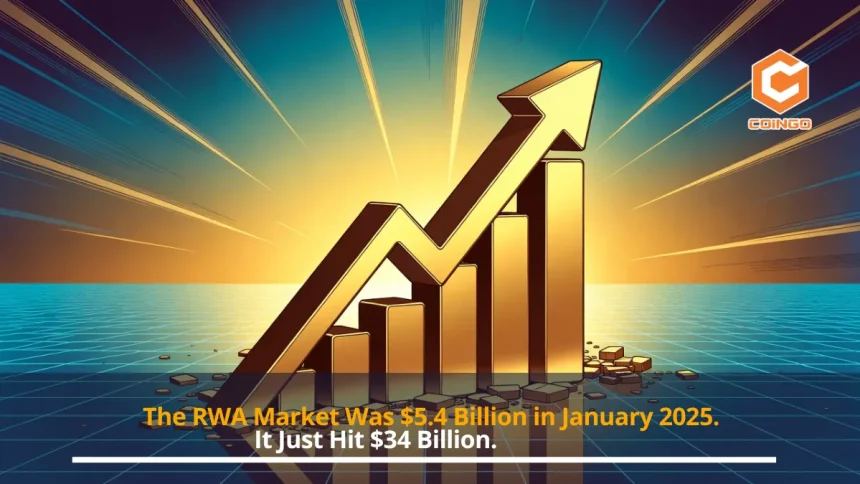
The on-chain market for tokenized real-world assets crossed $34 billion this week. That number was $5.4 billion in January 2025. It was below $3 billion in mid-2024. Roughly the size of an elite university endowment, according to rwa.xyz. Except this endowment settles 24/7, trades without brokers, and runs on smart contracts.
No fanfare. No launch event. Just a number that quietly tripled while the rest of crypto argued about memecoins.
Treasuries Are Half the Market
U.S. Treasury-linked products account for roughly $16 billion of the $34 billion total. Commodities sit near $6 billion. Asset-backed credit exceeds $3 billion. Tokenized equities are approaching $1 billion with a $2.94 billion monthly transfer volume, an 86% jump in 30 days.
The dominance of Treasuries makes sense. They are the safest asset class in the world, they offer predictable yield, and they settle instantly on-chain instead of T+1 through traditional rails. Ondo settled tokenized Treasuries with JPMorgan and Mastercard in under five seconds earlier this year. That single demo did more for institutional adoption than a hundred whitepapers.
Ethereum Owns 60%. The Rest Is Fragmented.
Ethereum carries approximately 60% of all tokenized RWA value. Tokenized U.S. Treasuries on Ethereum alone hit $8 billion in market cap earlier this month. BlackRock’s BUIDL fund, built on Securitize and running on Ethereum, crossed $2.5 billion in assets under management. It is the single largest tokenized Treasury product in existence.
Behind Ethereum, Provenance Blockchain holds roughly 27%, mostly from Figure Lending and mortgage-related issuance. BNB Chain, XRP Ledger, and Solana each sit near 6%. Solana’s RWA market grew 43% to $2.01 billion in Q1. Franklin Templeton extended its FOBXX government money market fund to Stellar and Polygon. The chain wars are playing out in tokenization, not just DeFi.
The Names Behind the Money
This is not retail-driven growth. The names deploying capital into tokenized assets read like a Wall Street conference attendee list. BlackRock. JPMorgan. Franklin Templeton. DAMAC, which partnered with MANTRA on a $1 billion real estate tokenization project. LG put $6.8 billion in liquidity fund range on Ethereum via Calastone. Intesa Sanpaolo, Italy’s largest bank, raised its crypto-related asset exposure from $100 million to $235 million in a single quarter.
Ondo Finance owns 60% of the tokenized equity market with $557 million across 230 assets in eight categories. JPMorgan launched its first tokenized money market fund on Ethereum in December 2025 and filed a second one in May. These are not experiments. They are product launches.
$16 Trillion by 2030. Or $2 Trillion. Depends Who You Ask.
Boston Consulting Group and Standard Chartered published a forecast putting the tokenized asset market at $16 trillion by 2030. McKinsey’s estimate is $2 trillion. That is an eightfold disagreement between two of the most respected consulting firms in the world. It tells you that nobody actually knows how fast this market will grow. What they agree on is the direction.
The $34 billion figure today represents 815,297 total asset holders. That is a small fraction of the 256 million stablecoin holders tracked by rwa.xyz. The addressable audience exists. The products exist. The infrastructure exists. What does not exist yet is the distribution layer that connects tokenized assets to the average investor. Securitize is going public through a SPAC merger specifically to solve that gap.
The Part Nobody Talks About
Liquidity. An Arxiv study found that most RWA tokens exhibit low trading volumes, long holding periods, and limited investor participation. Tokenization has been more successful at digitizing already-liquid assets like Treasuries than at unlocking liquidity for inherently illiquid ones like real estate or fine art. Projects like Ondo and Canton have gained traction precisely because they tokenize assets that already have deep markets. The hard part is not putting real estate on a blockchain. It is finding a buyer on the other side.
The market tripled in 17 months. The next tripling, from $34 billion to $100 billion, depends on whether secondary markets develop enough depth to handle assets that are not U.S. government debt. That is a harder problem than minting tokens. And it is the problem that will determine whether RWA tokenization becomes the foundation of a new financial system or stays a very expensive proof of concept.