World Liberty Plans a Phased Unlock Vote, Not a Full Token Release
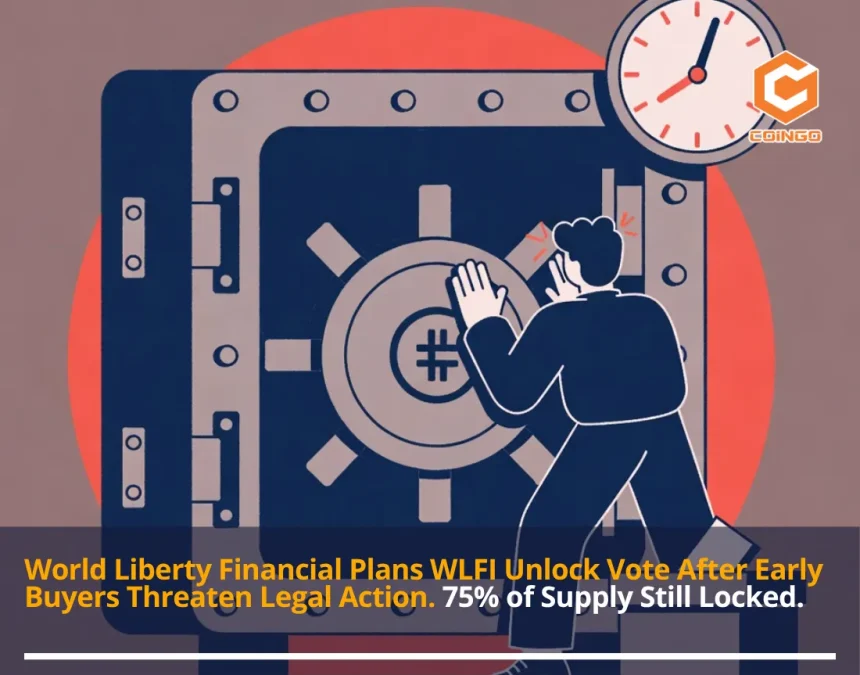
World Liberty Financial announced on April 10, 2026 that it intends to put forward a governance proposal next week that would establish a phased, long-term vesting schedule for WLFI tokens currently held by early retail purchasers. The proposal will first be opened for community input before proceeding to a formal governance vote.
Crucially, the project clarified that the vote will not cover a full or immediate unlock of all WLFI holdings. Instead, it outlines a structured release plan that distributes tokens in stages over time. The distinction matters because a significant portion of the early buyer community has been pushing for faster access — and some have already begun pursuing legal remedies.
WLFI tokens currently serve a limited function: they are governance tokens with no confirmed utility beyond voting rights. Transferability has remained restricted since the token sale, with any unlock requiring a governance-approved vote. According to data from Tokenomist, approximately 24.67% of WLFI’s 100 billion token supply has been released to date, while roughly 75.33% remains locked or pending future unlock decisions.
Trump’s World Liberty Financial Under Scrutiny Over Partner’s Links to Sanctioned Network
Early Buyers Are Locked Out 18 Months After a $550 Million Sale
World Liberty Financial’s public token sale began around mid-October 2024, raising at least $550 million across two funding rounds. The project’s original sale materials stated clearly that WLFI tokens would be non-transferable and could remain locked indefinitely, with any future unlock subject to a governance vote no earlier than 12 months after the sale — with no guaranteed timeline beyond that threshold.
That 12-month minimum has now passed — the current proposal comes approximately 18 months after the initial sale. Despite this, the majority of early buyers’ holdings remain inaccessible. Some self-identified presale buyers have publicly complained that most of their tokens are still locked even as portions of the broader token supply have become transferable to other categories of holders.
At least one self-identified buyer stated on X that they had filed legal notices and were pursuing claims in both the United States and the Netherlands against World Liberty Financial and its backers. Cointelegraph was unable to independently verify whether any formal lawsuit had been filed. World Liberty Financial did not respond to a request for comment by the time of publication.
The legal pressure has since moved past social media. The largest WLFI investor has now formally sued the Trump family’s crypto project, citing the same lockup terms and governance opacity that smaller buyers have been complaining about for months. The case shifts the dispute from individual X grievances to a courtroom argument over what the original sale materials promised and what the project has actually delivered. The phased unlock proposal lands directly into that legal context.
A previous governance vote on March 16, 2026 had already introduced a six-month lock-up rule for certain transfers — representing one of the first formal changes to the project’s transferability framework. That vote was approved by token holders, though its passage has done little to address the frustration of early retail buyers who purchased during the public sale.
Treasury Borrowed $75 Million Using WLFI as Collateral
Adding to holder frustration is a separate concern around treasury activity. On-chain data from Etherscan shows that World Liberty Financial’s treasury borrowed approximately $75 million in stablecoins from the DeFi lending protocol Dolomite, using WLFI tokens as collateral. Community members have raised questions about how treasury funds are being deployed and what the borrowing activity means for the long-term tokenomics of a project whose retail participants cannot yet access liquidity.
The treasury borrowing is not inherently problematic — DeFi protocols routinely use governance tokens as collateral for operational capital. But the timing, combined with the extended retail lockup and the political profile of the project, has made the on-chain activity a point of active community scrutiny. The governance vote planned for next week will be watched closely not only for its outcome but for whether the community input process meaningfully shapes the final unlock structure before the formal vote proceeds.