Risk-On Rotation Hits Privacy Coins First
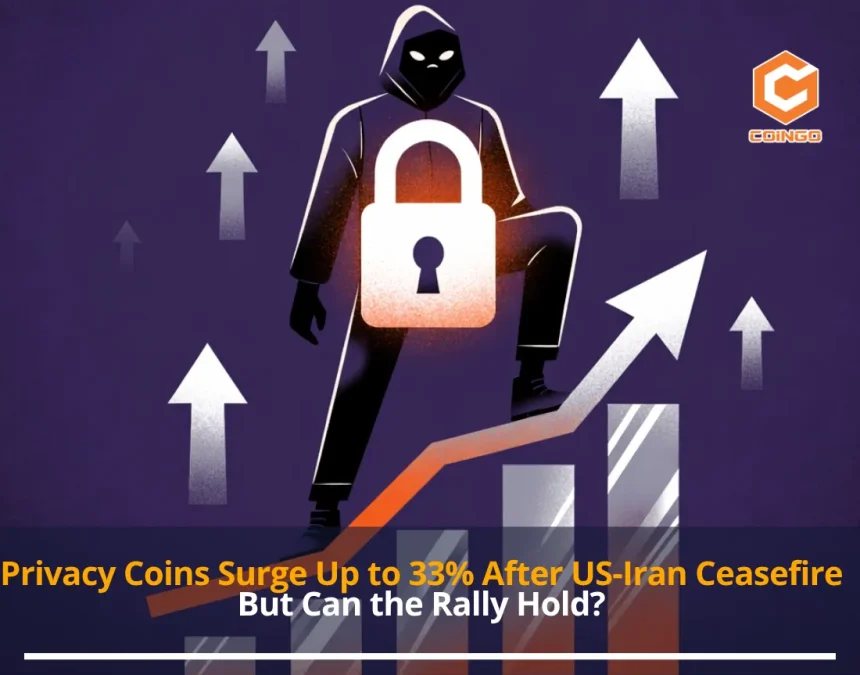
Privacy coins have staged a sharp breakout since April 4, 2026, with the move accelerating meaningfully after the April 8 US-Iran ceasefire announcement triggered a broad shift in market sentiment. When geopolitical risk eases suddenly, capital rotates quickly into the highest-beta assets that have been sleeping the longest — and in this cycle, that description fits privacy coins precisely.
DASH led the charge, jumping more than 33% in 24 hours to reach $42.84. The volume figure was particularly notable: turnover hit nearly 45% of DASH’s entire market cap in a single day — a reading that typically reflects a combination of short squeeze dynamics and genuine accumulation by conviction buyers entering new positions. Zcash (ZEC) pushed toward $382.24, while Decred (DCR) recovered to $22.96 after an extended downtrend. Monero (XMR) — the sector’s benchmark — surged to $344.99.
Monero’s On-Chain Signal Separates This Move From Pure Speculation
What distinguishes the current privacy coin rally from a pure sentiment trade is what is happening with actual usage. For XMR specifically, peer-to-peer transaction volumes are hitting yearly highs. That is not a technical artifact or a futures market artifact — it reflects real demand for Monero’s privacy features from actual users conducting actual transactions.
This matters for sustainability. A price move driven entirely by spot speculation and short squeezes tends to reverse quickly once the momentum fades. A move accompanied by rising on-chain usage has a demand-side component that can sustain elevated price levels even after the initial excitement cools. Monero’s P2P volume signal suggests at least part of the rally reflects genuine adoption rather than just risk appetite.
XMR has also absorbed exchange delisting pressure from multiple regulated platforms over the past year without meaningful long-term price damage. Each delisting was initially negative, but Monero’s decentralized trading ecosystem — operating through atomic swaps, P2P platforms, and Tor-accessible exchanges — has proven resilient. The delistings reduced retail accessibility but did not reduce actual network usage.
The Narrative Shift: From Anonymity to Business Privacy
The longer-term investment case for privacy coins is evolving beyond the original “anonymity” framing that made them controversial. The emerging argument — articulated by Grayscale Research and others — centers on operational confidentiality for businesses.
On public blockchains, every transaction, balance, and counterparty relationship is permanently visible on-chain. For individuals comfortable with that transparency, this is fine. For businesses managing payroll, supplier payments, treasury flows, and competitive financial information, permanent on-chain visibility is a structural liability. Privacy chains like Monero address this problem in a way that transparent public blockchains cannot.
This reframing positions privacy coins not as tools for hiding illicit activity but as enterprise-grade infrastructure for financial confidentiality — a significantly larger and more defensible addressable market. How far that narrative penetrates institutional thinking will be one of the key variables determining whether privacy coins sustain meaningful adoption beyond their current niche.
Regulatory Headwinds Remain the Primary Structural Risk
The rally’s sustainability faces one persistent structural challenge that no amount of narrative improvement resolves: regulatory pressure. Multiple regulated exchanges have delisted XMR and DASH under pressure from compliance requirements. The European Union’s MiCA framework and FATF travel rule implementation have made privacy coins increasingly difficult for licensed entities to handle.
The regulatory picture is not uniform, however. Some jurisdictions are tightening restrictions while others are beginning to treat privacy as a legitimate financial feature rather than a red flag. This creates a geographic bifurcation in the privacy coin market — accessible and growing in some regions, actively constrained in others.
If the current risk-on environment holds — meaning geopolitical tensions remain subdued, liquidity conditions continue to ease, and appetite for high-beta altcoin exposure persists — the privacy coin rally could extend further. The technical setup is constructive across multiple assets: breakouts from prolonged consolidation bases, expanding volume, and positive momentum. The fundamental usage signal from Monero adds credibility.
The counterargument is equally clear: privacy coins remain among the most regulatory-sensitive assets in the crypto market. A single enforcement action, a new exchange delisting wave, or a reversal in the macro environment that triggered the rally in the first place could reverse the move as quickly as it developed.