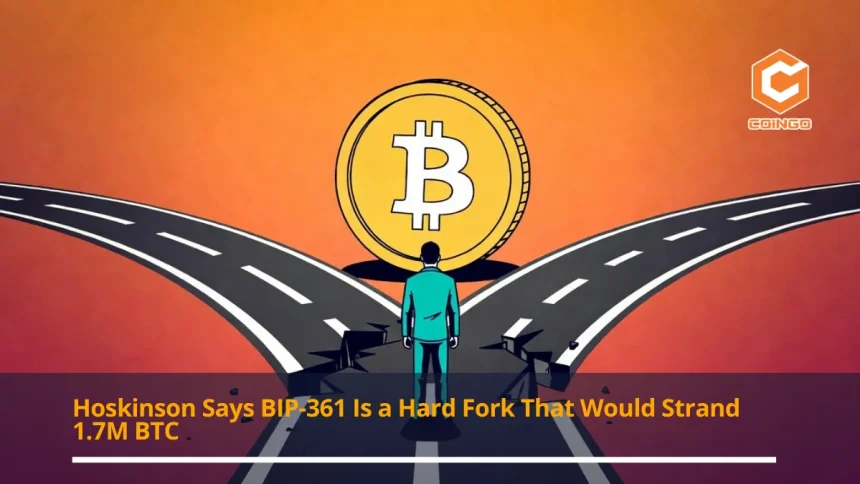
Cardano founder Charles Hoskinson has publicly challenged BIP-361, the Bitcoin quantum defense proposal authored by Jameson Lopp and five other developers. In a livestream this week, Hoskinson argued that the proposal mislabels itself as a soft fork when it functionally requires a hard fork, something Bitcoin has never executed. He also pointed out that approximately 1.7 million BTC in wallets predating modern seed phrase standards cannot be recovered through the proposed zero-knowledge proof system, effectively making those coins permanently unspendable.
34% of Bitcoin Supply Has Exposed Public Keys
Hoskinson cited on-chain data showing that as of March 1, 2026, more than 34% of all Bitcoin in circulation carries an exposed public key, representing roughly 8 million BTC. These coins sit in address formats where the public key is visible on the blockchain, making them theoretically vulnerable to anyone with a sufficiently powerful quantum computer capable of reverse-engineering the private key.
BIP-361 proposes freezing these vulnerable funds and requiring holders to migrate to post-quantum addresses. Hoskinson’s objection is not with the goal but with the execution. He argued that the changes required go far beyond what a soft fork can deliver and that calling it a soft fork misrepresents the scope of the upgrade to the community.
BIP-361 Proposes Freezing 5.6M Dormant BTC to Block Quantum Theft
Pre-2013 Wallets Cannot Use the ZK Recovery System
BIP-361 includes a zero-knowledge proof recovery mechanism that would allow holders of HD wallet seed phrases (based on BIP-32 and BIP-39 standards) to reclaim frozen funds. However, Hoskinson pointed out that these standards were not widely adopted until around 2013. Wallets created before that era, including those believed to belong to Satoshi Nakamoto (estimated at 1.1 million BTC), use older key generation methods that cannot produce a compatible ZK proof.
The result, according to Hoskinson, is that approximately 1.7 million BTC would be permanently stranded with no technical path to recovery, even for legitimate owners. He emphasized that he builds ZK proof systems professionally and sees no way to construct a valid proof for pre-BIP-32 key formats.
BIP-361 Vulnerability and Impact Breakdown
| Metric | Value |
|---|---|
| BTC With Exposed Public Keys | ~8M BTC (34% of supply) |
| Unrecoverable Pre-2013 BTC | ~1.7M BTC |
| Satoshi’s Estimated Holdings | ~1.1M BTC (within the 1.7M) |
| BIP-361 Classification | Soft fork (disputed by Hoskinson) |
| Hoskinson’s Claim | Requires a hard fork |
| Recovery Mechanism | ZK proof (BIP-32/39 seed only) |
Governance Gap Is the Root Problem
Hoskinson framed Bitcoin’s lack of on-chain governance as the structural reason no clean solution exists. He pointed to Cardano, Polkadot, and Tezos as examples of blockchains with formal governance mechanisms capable of handling protocol-level decisions through community votes. Without such a mechanism, he argued, Bitcoin faces a binary choice in the 2030s: let quantum attackers drain vulnerable addresses or push through a hard fork that makes 1.7 million BTC permanently unspendable.
He also raised the growing influence of institutional holders. BlackRock and Strategy (formerly MicroStrategy) have accumulated significant BTC positions. Hoskinson suggested these institutions, along with the US government as a reported strategic reserve holder, will eventually pressure developers to act regardless of ideological resistance from the community.
A Debate That Will Define Bitcoin’s Next Decade
Hoskinson’s critique adds a layer of technical specificity to the BIP-361 debate that had previously centered on philosophical objections about ownership and immutability. The claim that the proposal is structurally a hard fork, combined with the identification of 1.7 million BTC that cannot use the ZK recovery path, raises concrete engineering questions that BIP-361’s authors will need to address.
Whether Bitcoin’s development community accepts the hard fork framing or finds a technical workaround for pre-2013 wallets will shape the conversation for years. The quantum threat timeline remains contested, but the governance question Hoskinson raises is already live: who decides, and through what process, if millions of BTC must be frozen or abandoned to protect the network.