
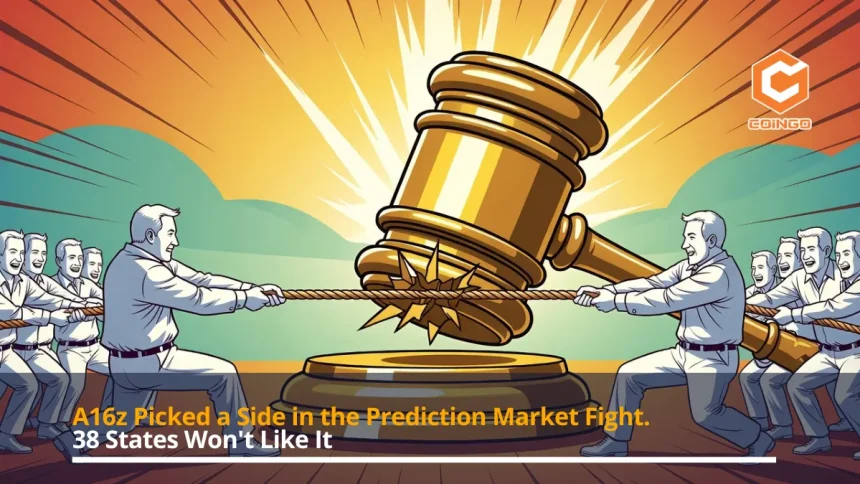
Andreessen Horowitz just picked a side in the biggest jurisdictional fight in crypto right now. The firm submitted an 18-page comment letter to the CFTC on May 2, backing the agency’s position that prediction markets are federally regulated derivatives, not state-level gambling products. The letter landed days after 38 state attorneys general filed a brief arguing the exact opposite in the same Massachusetts court where the CFTC filed its own brief on the same day.
The fight is not abstract. If states win, platforms like Kalshi and Polymarket would need to block users state by state, draining liquidity from markets that depend on broad participation to function. If the CFTC wins, prediction markets operate under a single federal framework nationwide. The stakes are a projected $1 trillion annual industry.
Same court, same day, opposite briefs
April 24 produced the sharpest visual of the split. The CFTC filed an amicus brief in Commonwealth of Massachusetts v. KalshiEx at the Massachusetts Supreme Judicial Court. The agency argued that the Commodity Exchange Act gives it sole authority over event contracts traded on designated contract markets. CFTC Chairman Michael Selig put it bluntly: any state that tries to seize authority over these markets will see the agency in court.
Hours later, 38 state attorneys general filed their own brief in the same case. Led by Nevada AG Aaron Ford and Ohio AG Dave Yost, the coalition argued that Dodd-Frank was designed to regulate financial products from the 2008 crisis, not to create a federal highway for unregulated sports betting. New York AG Letitia James said prediction markets cannot ignore state gambling laws designed to protect consumers.
The numbers the states cited are striking. From January to June 2025, Kalshi alone processed over $1 billion in 3.4 million sports wagers. Roughly 90% were tied to sports outcomes. The AGs argue that makes it a sportsbook, not a derivatives exchange.
A16z’s argument: block users by state and you kill the market
The a16z letter targets a specific mechanism. If exchanges must geo-block users based on state residency, they violate the CFTC’s own impartial access rules. The firm wrote that being forced to deny access would “severely circumscribe available liquidity” in affected markets. Thin order books mean wider spreads, worse pricing, and less accurate probability signals, which is the entire point of prediction markets.
The firm also pushed back on the gambling framing directly. A16z argued that the CFTC, not state legislatures, holds the authority to define what constitutes “gaming” under federal commodities law. The agency has decades of oversight history over event contracts. Letting 50 states independently decide what counts as gambling would fragment the market beyond repair.
There is an interesting blockchain angle too. A16z argued that on-chain prediction markets are actually easier to regulate than traditional platforms because every transaction is auditable on a public ledger. The transparency argument cuts against the states’ consumer protection concerns.
The CFTC is already suing five states
This is not a policy debate anymore. The CFTC has filed lawsuits against Illinois, Arizona, Connecticut, New York, and Wisconsin in the past month alone. It secured a temporary restraining order against Arizona’s enforcement actions. It filed amicus briefs in both the Ninth Circuit and the Massachusetts SJC. Chairman Selig wrote a Wall Street Journal op-ed calling state enforcement a “power grab.”
The states are not backing down either. A 41-AG coalition filed a formal comment with the CFTC urging the agency to confirm it has no jurisdiction over sports-related contracts. Maryland’s governor issued an executive order banning state employees from trading on prediction markets. The coalition has grown from 3 states in April 2025 to 41 states coordinating through a common interest group with over 60 attorneys.
The congressional pressure on prediction market integrity adds another layer. The Senate voted unanimously to ban senators and staff from trading on platforms like Kalshi and Polymarket. Kalshi said it already blocks members of Congress and called the vote “a great step to increase trust.”
The legal precedent that keeps coming up
Both sides keep referencing the same case. In 2024, Judge Jia Cobb ruled in Kalshi’s favor in the D.C. District Court, finding that event contracts do not constitute terrorism, assassination, or war under the CEA, and that the Act specifically preempts state law when it comes to derivative markets. The states argue that ruling was narrow and wrong. The CFTC treats it as binding precedent.
Meanwhile, Hyperliquid just launched prediction markets on its perps engine, Gemini secured a DCO license, and March volume hit $25.7 billion. The industry is scaling fast while the legal framework underneath it is being litigated in real time. Four of the CFTC’s five commissioner seats are currently vacant, which means any formal rulemaking will take longer than normal. The market is not waiting.