Richard Widmann, Google Cloud’s global head of Web3 strategy, said it plainly at Consensus Miami on Thursday: an AI agent cannot get a bank account. Not because it’s difficult. Because it’s impossible. The technology and the regulations both block it. Crypto, he said, is “a fantastic machine readable interface for payments.”
That one sentence reframes a debate that’s been building for months. If AI agents are going to buy things, book things, and settle invoices on behalf of humans, they need financial rails designed for software, not people. Google and PayPal think stablecoins and open protocols are the answer.
Google Donated Its Payments Protocol. 120 Partners Signed On.
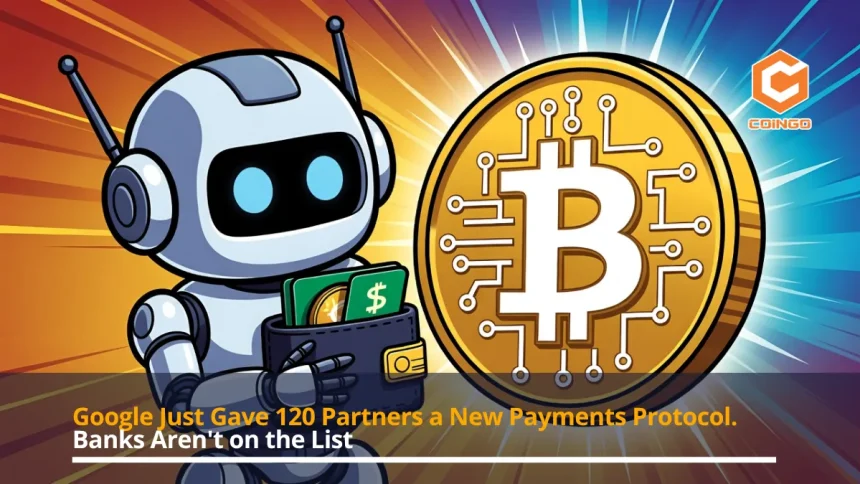
Google has launched the Agentic Payments Protocol, called AP2, and donated it to the FIDO Alliance. The protocol now has over 120 partners, including PayPal, Mastercard, American Express, Coinbase, Revolut, and Etsy. Widmann compared the move to the x402 internet-native payment standard given to the Linux Foundation.
The latest version, AP2 v0.2, introduces “Human Not Present” payments. That means an agent can execute a pre-authorized purchase when the user isn’t actively involved. Think concert tickets bought the second they go on sale. Or API fees settled in the background while you sleep.
Alongside AP2, Google and Mastercard co-developed a standard called Verifiable Intent. It creates a tamper-proof log of what a user authorized an agent to do. Both standards now sit under FIDO Alliance governance.
PayPal: 95% of Merchants Already See Agent Traffic
May Zabaneh, PayPal’s SVP and general manager of crypto, framed agents as the next channel after the company’s evolution from offline to online to mobile. PYUSD, PayPal’s stablecoin, is “a very natural programmable layer for payments,” she said.
Here’s the number that matters: a recent PayPal survey found that 95% of merchants already see AI agent traffic on their sites. But only 20% have machine-readable catalogs. That gap is where the opportunity lives. Zabaneh compared it to the early days of e-commerce, when stores had physical inventory but no website. Now they have websites but no agent-readable product feeds.
On liability, she was direct: if an agent makes a bad purchase, who pays? “That’s definitely something we have to think through as an industry,” she said. No answer yet. Just the question.
The Custody Problem: Agents Shouldn’t Hold Full Keys
Google has extended its Cloud KMS platform to cryptocurrency custody. Widmann argued that an agent should hold only one of two or three key shards, never the full private key. “It cannot simply unilaterally move funds or take action,” he said.
This matters. Amazon Web Services launched its AgentCore Payments service on May 7, giving AI agents instant access to pay for APIs and services. Coinbase built an app store where the customers are AI agents. Trust Wallet and Mesh are rebuilding crypto wallets specifically for autonomous software. The infrastructure race is accelerating.
ARK Invest Puts the Number at $8 Trillion by 2030
ARK Invest’s Big Ideas 2026 report projects that AI agents could facilitate $8 trillion in online consumer spending by 2030. The share of digital spending handled by agents would rise from about 2% in 2025 to nearly 25% by the end of the decade.
McKinsey puts a similar figure at $5 trillion. Either way, the scale dwarfs the current stablecoin market, which recently crossed $321 billion. If even a fraction of agent-driven commerce flows through crypto rails, the demand for stablecoins could multiply several times over.
The Standards War Is Already On
Two protocols are competing to become the default payment rail for agents. Google’s AP2, now under FIDO Alliance governance. And Coinbase’s x402, an HTTP-native protocol donated to the Linux Foundation. Visa and Mastercard have both launched agent-focused payment frameworks separately, with Mastercard completing Europe’s first live AI-agent bank payment.
What’s unusual is how fast the crypto industry moved here. Coinbase, Amazon, and Google all launched agent payment infrastructure within weeks of each other. CZ said at the same conference that BNB Chain should position itself as “the money for agents.”
Widmann was asked what keeps him up at night. His answer: “How do you onboard agents into all of the existing capital markets and infrastructure plumbing that powers payments and trading today.”
Zabaneh’s answer was shorter. Trust. The protocols exist. The partners are signed up. The question is whether consumers will let a piece of software spend their money. Based on surveys, only about 30% currently feel comfortable letting an AI agent make purchases over $50. That number will have to move before $8 trillion becomes real.