The word altcoin is short for alternative coin — and it refers to every cryptocurrency that is not Bitcoin. That sounds like a simple definition, but it covers an enormous range of assets. From Ethereum, a programmable blockchain platform worth hundreds of billions of dollars, to obscure meme coins launched last week with no development team and no roadmap, everything that is not BTC falls under the altcoin umbrella.
Bitcoin was the first cryptocurrency, launched in January 2009 by the pseudonymous Satoshi Nakamoto. The first altcoin — Namecoin (NMC) — appeared just two years later in 2011, built on Bitcoin’s open-source code with a few modifications. Since then, the altcoin market has exploded. As of 2026, CoinGecko tracks over 18,000 cryptocurrencies. The global crypto market capitalization stands at approximately $2.4 trillion, with Bitcoin claiming around 58% dominance and the remaining 42% distributed across thousands of altcoins.
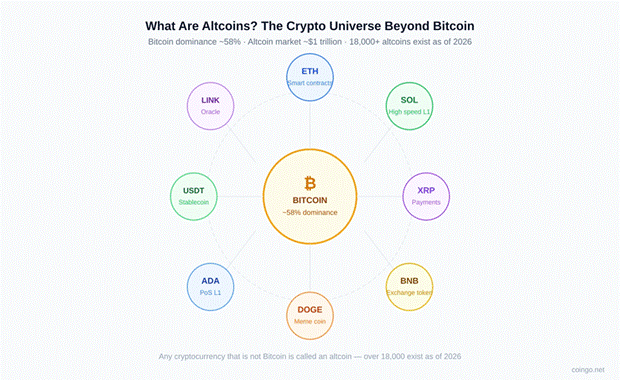
The altcoin universe: major cryptocurrencies orbiting Bitcoin, each with a distinct role
Why Do Altcoins Exist?
The honest answer is: for many different reasons, not all of them equally legitimate.
The legitimate reasons are significant. Bitcoin was a breakthrough, but it was designed for one specific purpose — peer-to-peer digital cash — and its architecture reflects that. It has no native smart contract capability, limited transaction throughput, and high fees during periods of congestion. Ethereum was created precisely to address the first limitation. Litecoin addressed the second. XRP addressed the third. Each of these early altcoins had a coherent technical rationale.
The less legitimate reasons also matter. Because creating a new cryptocurrency requires relatively little capital, and because retail interest in crypto creates demand for tokens with compelling stories, thousands of projects have launched without genuine utility. The ICO boom of 2017, the DeFi yield-farming craze of 2020, and the meme coin supercycle of 2021 all produced enormous numbers of projects that existed primarily to enrich their creators. Many collapsed to near-zero within months. Understanding this history is essential context for evaluating any altcoin.
“Altcoins are diverging from Bitcoin as BTC increasingly trades like a macro asset, while altcoins are judged on real usage, ecosystem growth and regulatory positioning.”
— Cryptocom Market Analyst, January 2026
Types of Altcoins
The altcoin market is not a single category. It is a collection of distinct asset classes, each with its own mechanics, use cases, and risk profile. Understanding the taxonomy is the foundation of understanding the market.
| Type | Examples | Purpose |
|---|---|---|
| Smart contract platforms | ETH, SOL, ADA | Run code, DApps, DeFi |
| Stablecoins | USDT, USDC, DAI | Price-stable, pegged to $1 |
| DeFi tokens | UNI, AAVE, MKR | Governance and protocol utility |
| Layer 2 tokens | MATIC, ARB, OP | Scale Bitcoin/Ethereum — faster, cheaper |
| Utility tokens | LINK, FIL, GRT | Access specific services — oracles, storage, data |
| Meme coins | DOGE, SHIB, PEPE | Community driven, high risk |
Major altcoin categories and their examples as of 2026
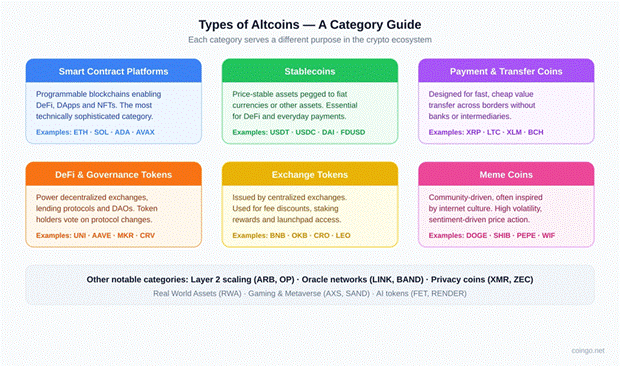
Altcoin categories: from smart contract platforms and stablecoins to meme coins and DeFi tokens
Smart Contract Platforms: The Most Important Category
If you understand only one altcoin category, it should be smart contract platforms. These are blockchains that, like Ethereum, can run arbitrary code — enabling DeFi protocols, NFT markets, games, identity systems, and any other application a developer can imagine.
Ethereum remains the dominant platform, with the largest developer ecosystem and the highest total value locked in its applications. But competition is fierce. Solana has established itself as the leading high-performance alternative, processing transactions in milliseconds at near-zero cost. Avalanche, Cardano, and Polkadot each offer distinct architectural approaches. The emergence of Ethereum-compatible (EVM) chains means that developers can often deploy the same code across multiple networks, and users can bridge assets between them.
This category has produced the most enduring value in crypto outside of Bitcoin. Ethereum has been running in production since 2015. Solana processed billions of transactions. These are not experimental projects — they are live infrastructure supporting real financial activity.
Stablecoins: The Infrastructure Layer
Stablecoins are altcoins whose value is pegged to an external asset — typically the US dollar, though some track gold or other currencies. They solve one of crypto’s fundamental problems: how do you stay in the ecosystem without exposure to price volatility?
The stablecoin market has grown to over $279 billion in combined market capitalization as of 2026, making it the largest single altcoin category by value. Tether (USDT) and USD Coin (USDC) dominate by volume, with daily trading turnover that exceeds Bitcoin’s on many days. DAI, issued by the MakerDAO protocol, is the leading decentralized stablecoin — its value is maintained algorithmically through collateral rather than a centralized reserve.
Stablecoins are not investment assets in the traditional sense — they don’t appreciate. But they are indispensable infrastructure: every major DeFi protocol runs on them, and they are increasingly used for cross-border remittances, payments, and as a hedge during volatile markets.
Meme Coins: High Risk, High Noise
Meme coins deserve special attention because they attract the most retail interest while offering the least fundamental value. Dogecoin, the original meme coin launched as a joke in 2013, remains one of the top 10 cryptocurrencies by market cap over a decade later — sustained almost entirely by community sentiment and periodic celebrity attention. Shiba Inu, PEPE, and hundreds of others followed the same template.
The risk profile of meme coins is extreme. When sentiment is positive, they can produce extraordinary gains in short periods. When sentiment shifts, they collapse just as rapidly. The $TRUMP meme coin, launched ahead of the January 2025 inauguration, traded at $73 at its peak and had fallen over 95% to around $3 by February 2026. This pattern — explosive launch, sustained collapse — is the norm, not the exception.
Meme coins are not investments in any conventional sense. They are speculative instruments where timing and exit strategy matter more than any fundamental analysis.
Altcoin Season: When Altcoins Outperform Bitcoin
One of the most important concepts for understanding altcoin market dynamics is altcoin season. This refers to periods when altcoins collectively outperform Bitcoin, typically measured by tracking whether 75% of the top 50 cryptocurrencies have outperformed BTC over the prior 90 days.
Altcoin season tends to follow a predictable pattern. Bitcoin typically leads a bull cycle, appreciating significantly and pulling capital into the broader crypto market. Once BTC stabilizes at a higher level, some of that capital rotates into altcoins seeking larger percentage gains. This rotation can be dramatic: during peak altcoin seasons, mid-cap altcoins have posted gains of 1,000% or more within weeks, while Bitcoin moved only modestly.
The inverse is also true. In bear markets, altcoins tend to fall further and faster than Bitcoin. Their lower liquidity means that when investors exit, prices drop sharply. Bitcoin dominance — BTC’s share of total crypto market cap — typically rises during downturns as capital flees to the perceived safety of the most established asset. As of March 2026, Bitcoin dominance stands at approximately 58%.
Altcoins: Advantages and Risks
| Advantages | Risks |
|---|---|
| More room for growth than Bitcoin | Most altcoins lose value long-term |
| Solves specific real-world problems | Lower liquidity than Bitcoin |
| Faster and cheaper transactions | Harder to find on all exchanges |
| Wide variety of use cases | Many are scams or abandoned projects |
| Innovation in DeFi, NFTs, L2 | Extreme price volatility |
Key advantages and risks of altcoin investing
How to Evaluate an Altcoin
With over 18,000 cryptocurrencies in existence, the challenge is not finding altcoins — it is finding ones worth taking seriously. A basic evaluation framework helps.
What problem does it solve? Start here. Every credible altcoin should have a clear answer to this question. If the project’s documentation cannot articulate a specific problem being solved, that is a warning sign.
Who is the team? Investigate the founders and developers. Are they identifiable? Do they have a track record in blockchain development or relevant industries? Anonymous teams are not automatically disqualifying — Satoshi Nakamoto was anonymous — but they do increase risk.
What is the tokenomics? Understanding tokenomics — the supply, distribution, and inflation mechanics of a coin — is critical. A coin where insiders hold 80% of supply and face no lock-up period is structurally set up to dump on retail buyers.
Is there real usage? Check on-chain data. Are people actually using the network? Are transaction volumes real? Tools like DeFiLlama, Etherscan, and DuneAnalytics provide transparent on-chain metrics that no marketing document can hide.
What is the market cap vs. fully diluted value? A large gap between circulating market cap and fully diluted value (FDV) suggests a significant amount of supply is yet to enter the market. This creates future sell pressure that many investors overlook.
“Execution over hype is the new test in 2026. Regulation, adoption and sustainability increasingly determine which altcoins can outperform beyond speculative cycles.”
— Cryptocom Senior Market Analyst
The Altcoin Landscape in 2026
The altcoin market of 2026 is materially different from its earlier iterations. Regulatory clarity in major jurisdictions — including the passage of the Digital Asset Market Structure Act in the US and MiCA implementation in Europe — has filtered out many projects that relied on regulatory ambiguity to operate. The projects that remain are increasingly those with genuine utility and legal compliance frameworks.
Institutional participation has changed the dynamic for large-cap altcoins. Spot ETFs covering Ethereum, XRP, Solana, Litecoin, and Dogecoin are pending SEC decisions as of March 2026. If approved, these products would extend the same institutional access mechanism that transformed Bitcoin’s capital flows to a broader set of altcoins.
Real-world asset (RWA) tokenization has emerged as one of the most significant growth areas. BlackRock, Franklin Templeton, and major banks are tokenizing Treasury bonds, money market funds, and other traditional assets on Ethereum and competing chains. This represents the maturation of blockchain technology from a speculative asset class into financial infrastructure that institutions actively use.
For anyone trying to navigate this market, the lesson of 2026 is simple: the altcoins that survive and grow are those that are genuinely useful. The ones that do not survive are the ones that were never more than stories.
Sources: Cryptocom Market Updates (Jan 2026), bitcoincom, CoinGecko, CoinMarketCap, Caleb & Brown. This article is for educational purposes only and does not constitute financial or investment advice.