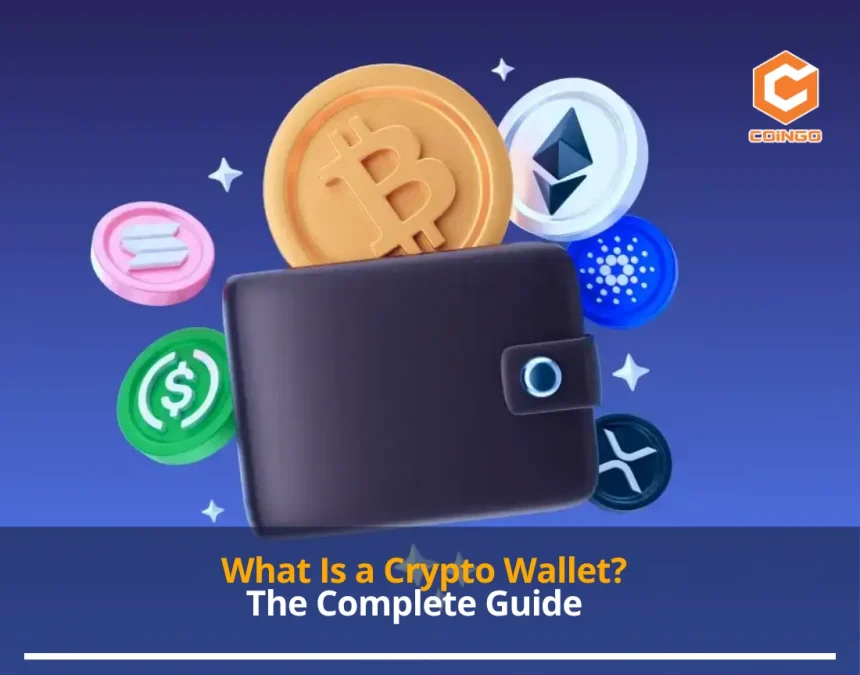
A crypto wallet is software — or a physical device — that stores the private keys needed to access and manage your cryptocurrency. The name is slightly misleading: your Bitcoin or Ethereum never actually sits inside the wallet. It lives on the blockchain. What the wallet holds is the cryptographic proof of ownership — the private key that authorizes you to move those funds. Lose the key, lose the funds.
As of early 2026, the global crypto wallet market is valued at $14.84 billion and growing at a 26.7% compound annual growth rate. Mobile wallets dominate usage, with 72% of users preferring mobile-first solutions. But the most important choice is not mobile vs. desktop — it is whether your wallet is hot or cold, and whether it is custodial or non-custodial.
Hot Wallets vs. Cold Wallets
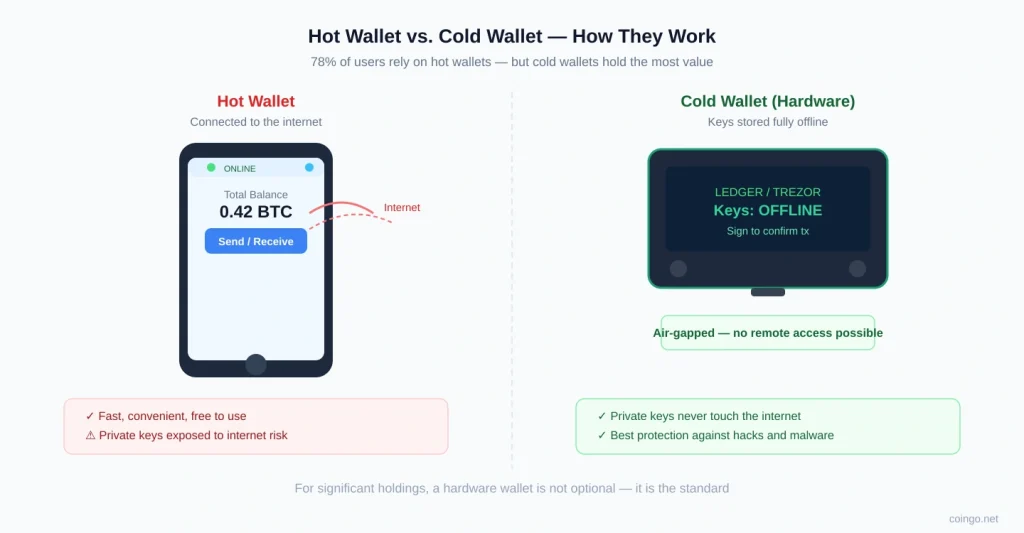
The most fundamental distinction in crypto storage is whether your wallet is connected to the internet. A hot wallet — any software wallet on a phone, computer, or browser extension — is always online. This makes it fast and convenient for transactions, but it also means the private key is potentially reachable by hackers, malware, and phishing attacks. Hot wallets account for 78% of all crypto wallets due to their accessibility.
A cold wallet — typically a hardware device like Ledger or Trezor — stores your private keys completely offline. The key never touches an internet-connected environment, making remote hacking virtually impossible. Hardware wallet sales grew 31% in 2025 as security awareness increased. Despite this growth, only about 2–3% of crypto holders use a hardware wallet as their primary storage — a gap that represents significant risk for the majority of users with meaningful holdings.
Custodial vs. Non-Custodial Wallets
The second critical distinction is custody: who actually holds your private keys? In a custodial wallet — typically an account on a centralized platform — the platform holds your keys on your behalf. You log in with an email and password, but the platform controls the underlying keys. This is convenient, but it introduces counterparty risk: if the platform freezes withdrawals, gets hacked, or fails, your funds can be inaccessible.
In a non-custodial wallet, you hold the keys directly. A seed phrase — typically 12 or 24 words — is generated when you create the wallet. This phrase is the master key to all your funds. Anyone with it can access your assets. Anyone without it — including you, if you lose it — cannot. As of 2025, 59% of crypto users now prefer non-custodial solutions, up significantly from prior years, reflecting growing awareness of self-custody principles.
“For anyone holding more than a few hundred dollars in cryptocurrency, or anyone who interacts with DeFi protocols regularly, a hardware wallet is not optional. It is the single most important security measure you can take.”
— Blocklr, Hardware Wallet Guide 2026
Types of Wallets Compared
Every wallet type involves a trade-off between convenience and security. The right choice depends on how much you hold, how actively you trade, and how much you interact with DeFi protocols.
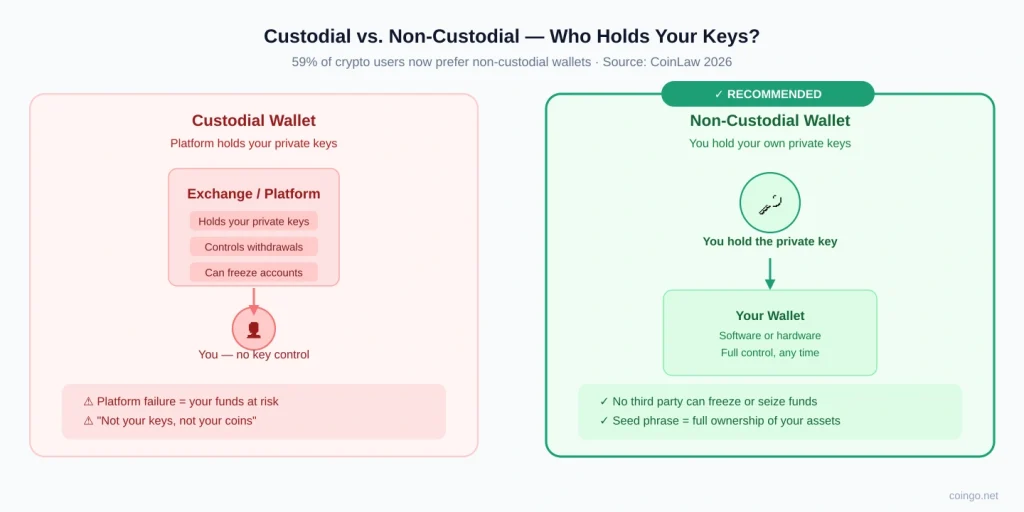
Custodial vs. non-custodial — who actually controls your crypto
| Feature | Software wallet | Hardware wallet | Exchange wallet |
|---|---|---|---|
| Key control | Self-custody | Self-custody | Platform holds |
| Security level | Medium | Highest | Varies |
| Internet connection | Required | Not required | Required |
| Cost | Free | $50–$300+ | Free |
| Setup time | ~5 minutes | ~15 minutes | ~2 min + KYC |
| Best for | Daily use, DeFi | Long-term storage | Active trading |
Table 1 — Wallet Types Comparison: features, security and best use cases
Your Seed Phrase: The One Thing That Matters Most
Whether you use a software wallet or a hardware device, every non-custodial wallet is secured by a seed phrase — a sequence of 12 or 24 randomly generated English words. This phrase mathematically derives every private key your wallet will ever use. It is not stored on any server. It cannot be recovered if lost. And anyone who obtains it has complete, irrevocable control over every asset in that wallet.
The standard advice is simple but non-negotiable: write your seed phrase on paper, never photograph it or store it digitally, and keep physical copies in multiple secure locations. Over 68% of hardware wallet users cite seed phrase management as the most significant usability friction — but there is no shortcut. It is the price of self-sovereignty.
“Your seed phrase is not a password. It is the mathematical master key to all your funds. Treat it accordingly.”
Security Risks and How to Avoid Them
Phishing attacks led to over $1.1 billion in wallet-related thefts globally in 2025. Browser extension wallets remain the most targeted attack vector, comprising 42% of known compromises. The risks are real, but most are preventable with basic discipline.
| Risk | How to protect yourself |
|---|---|
| Seed phrase loss | Write it on paper, store in multiple secure physical locations — never digitally |
| Phishing attacks | Always verify URLs, never enter your seed phrase on any website or app |
| Clipboard hijacking | Always double-check the first and last characters of any address before sending |
| Exchange collapse | Move significant holdings to a self-custody wallet — not your keys, not your coins |
| Malware | Use hardware wallets for large amounts — private keys never touch an internet-connected device |
| Physical coercion | Use multisig or split storage for large holdings — no single device or person can authorize a transfer |
Table 2 — Wallet Security Risks: key threats and how to protect yourself
The last row in that table is increasingly relevant. France is now averaging one crypto kidnapping every 2.5 days, with attackers targeting wallet holders directly to coerce private key disclosure. Software wallet on a phone, large balance visible on chain, single key controlling the funds. That setup is the worst-case profile for a physical attack. Multisig configurations and split-storage strategies exist precisely because the threat model has moved from remote hacking to in-person coercion.
Choosing the Right Wallet in 2026
For most users, the practical answer is to use both types. Keep a software wallet with a small balance for daily transactions, DeFi interactions, and active trading. Store the bulk of your holdings in a hardware wallet that never connects to the internet directly. This combination — now used by over 20% of crypto users — provides both the convenience of a hot wallet and the security of cold storage.
The wallet market is maturing rapidly. Biometric authentication is now standard in 84% of mobile wallets. Social recovery wallets, which allow trusted contacts to help restore access, grew 44% year-over-year in 2025. Hardware wallets now support an average of 150+ cryptocurrencies. The tools are better than they have ever been. The fundamentals, however, have not changed: the safest place for your private keys is a device that has never been — and will never be — connected to the internet.
A wallet only matters when you actually use it. Sending BTC for the first time has its own checklist, our transfer guide covers what to verify before broadcasting a transaction.
Sources: CoinLaw Crypto Wallet Adoption Statistics (2026), Mordor Intelligence Hardware Wallet Market Report, SQ Magazine Wallet Statistics, Blocklr Hardware Wallet Guide 2026, CoinGecko Hot Wallets 2026. This article is for educational purposes only and does not constitute financial or investment advice.