A multisig wallet requires more than one private key to approve a transaction, turning custody into a team decision rather than a solo responsibility. The design has existed since the early Bitcoin era, but adoption accelerated after years of high-profile single-key losses, phishing drains, and exchange failures pushed both retail and institutional holders toward shared-control setups. In 2026, multisig is the default for most serious treasuries and a growing share of personal long-term storage. This guide explains how multisig works, the main configurations, and the situations where the extra friction is worth it.
How a Multisig Wallet Actually Works
A standard crypto wallet uses a single private key to sign transactions. Whoever holds that key can move the funds. A multisig wallet splits that authority across several keys and sets a threshold for how many of them must sign before a transaction goes through.
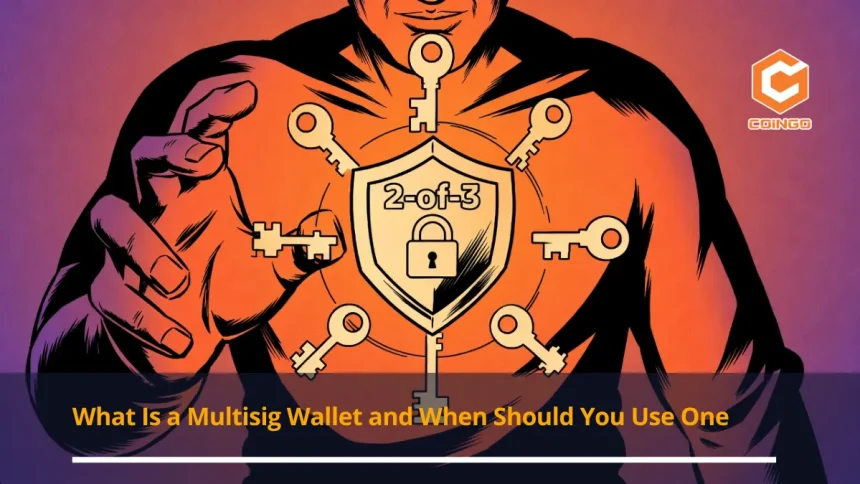
The configuration is written as M-of-N, where N is the total number of keys in the setup and M is the minimum number needed to approve a transaction. A 2-of-3 wallet has three keys and needs any two to sign. A 3-of-5 wallet has five keys and needs any three. The remaining keys can be lost, stolen, or unavailable without blocking access, as long as the threshold is met.
On Bitcoin, multisig is enforced at the script level using native standards like P2SH and P2WSH. On Ethereum and most EVM chains, multisig is implemented through smart contracts, with Safe (formerly Gnosis Safe) holding the dominant share of institutional deployments. Solana, TON, and other chains have their own program-based equivalents. The mechanics differ, but the underlying principle is the same: no single key can move the funds alone.
Why Single-Key Wallets Keep Failing Users
The case for multisig is built on the failure pattern of single-key custody. When one key controls everything, a single mistake ends the story. Phishing signatures, malware-infected devices, lost seed phrases, compromised hardware wallets, and coercion all produce the same outcome: total loss with no recovery path.
Coercion has stopped being a hypothetical. France is now averaging one crypto kidnapping every 2.5 days, with attackers physically targeting holders to force private key disclosure. A single-key wallet under physical threat is functionally a wallet with no security at all. The only defense that actually changes the calculation for an attacker is one where the target genuinely cannot complete the transaction alone, no matter what is held to their head.
The 2024 and 2025 waves of North Korea’s IT worker campaigns showed how effective targeted social engineering has become against developers and treasury operators. The Ethereum Foundation publicly exposing roughly 100 DPRK operatives embedded across 53 crypto projects made the scale of the problem undeniable. In most of those cases, a single compromised signing key was all that separated an attacker from a protocol treasury.
Multisig does not prevent phishing or malware. It changes what happens when one key is compromised. An attacker holding one out of three signers in a 2-of-3 setup still cannot move anything. The defender gets time to detect the breach, rotate the compromised key, and move funds to a fresh wallet. That margin is the actual product multisig sells.
Common Multisig Configurations and What They Are For
Not every multisig setup serves the same purpose. The right M-of-N depends on who holds the keys, how often the wallet needs to transact, and what threat model you are defending against.
| Setup | Best Use Case | Trade-off |
|---|---|---|
| Single-signature | Daily spending, small balances | Single point of failure |
| 2-of-3 multisig | Personal long-term holdings, small teams | Recovery depends on two keys surviving |
| 3-of-5 multisig | Company treasuries, DAOs, funds | More coordination required for every transaction |
| 4-of-7 multisig | Large treasuries, foundations, custodians | High operational complexity and slower execution |
Personal users usually settle on 2-of-3 because it balances recovery and security. One key lives on a hardware device at home, one on a second device stored elsewhere, and one with a trusted third party or service provider. Losing any single key does not lock you out, and no single compromise drains the wallet.
Organizations tend toward 3-of-5 or larger. Signing authority is distributed across executives, board members, or geographically separated operations staff. For regulated entities and public DAOs, the signer list itself is often disclosed on-chain, which adds a layer of social accountability on top of the cryptographic one.
When Multisig Is Worth the Friction
Multisig trades convenience for security. Every transaction requires coordination, multiple signatures, and often a delay while signers review the payload. For small, everyday wallets, that friction outweighs the benefit. For larger or longer-horizon holdings, the calculation flips.
The clearest cases for multisig in 2026:
- Long-term personal holdings above roughly one year of living expenses, where the cost of a single-key loss is genuinely disruptive.
- Company and DAO treasuries, where unilateral access by any single employee or contributor is a governance failure by default.
- Funds, custodians, and market makers managing client assets, where regulatory expectations increasingly require demonstrable shared control.
- High-value NFT collections and governance tokens, where a single signed transaction can transfer irreplaceable assets.
- Inheritance and estate planning, where keys can be distributed so that beneficiaries can recover funds without any one party having unilateral access while the owner is alive.
The cases where multisig does not make sense are just as important. A hot wallet used for daily DeFi interactions, small test balances, or a trading account where speed matters will usually perform worse under multisig. The delay between proposing and executing a transaction can cost more than the marginal security gain.
The Real Risks Multisig Does Not Solve
Multisig is not a complete answer. Several failure modes survive the switch from single-key custody, and some are created by it.
The first is signer collusion. If M signers agree to steal the funds, the wallet design will happily approve the transaction. This has played out publicly in multiple treasury disputes over the past two years, including the Justin Sun versus World Liberty Financial lawsuit, where control of shared wallets became the core legal question rather than a technical one.
The second is smart contract risk. EVM-based multisigs like Safe rely on contract code that has been heavily audited but is not immune to bugs or upgrade-path exploits. A vulnerability in the wallet contract itself affects every wallet deployed from it. Bitcoin script-based multisig avoids this category of risk but offers less flexibility.
The third is operational failure. A 2-of-3 setup where all three keys are stored in the same house, on the same laptop, or backed up to the same cloud account is not really a 2-of-3. Geographic and medium diversity is what makes the threshold meaningful. Losing two of three keys in a single fire or a single cloud breach collapses the security model entirely.
The fourth is signer availability. If signers cannot be reached when a transaction is urgent, the wallet is effectively frozen. Treasuries with signers in incompatible time zones or across hostile jurisdictions have discovered this the expensive way during market crashes and exploit response windows.
How to Set Up a Multisig Wallet Responsibly
The setup process varies by chain and tool, but the principles are consistent. For Bitcoin, tools like Sparrow, Nunchuk, and Specter are the mainstream options. For EVM chains, Safe remains the default. For Solana, Squads dominates institutional use.
Before creating the wallet, decide on the M-of-N, pick where each key will live, and document the recovery procedure. Hardware devices from different manufacturers reduce the blast radius of any single supply chain compromise. Keys held by different people reduce the risk of coercion against any one individual.
After creation, test the recovery flow with a small balance before moving significant funds. Run a full signing ceremony where each signer confirms they can produce a valid signature with their key. Send a small transaction, then a slightly larger one, and only then move the main balance. This process catches the configuration errors that account for most self-inflicted multisig losses.
Document the signer list, the threshold, the tooling used, and the recovery steps in a location that survives the loss of any single person involved. A multisig wallet that nobody but the original setup operator understands is a ticking failure.
Where Multisig Fits in a Broader Custody Strategy
Multisig is not the whole answer to self-custody. It sits alongside hardware wallets, passphrase-protected seed phrases, transaction simulation tools, and spending limits as part of a layered approach. A well-designed setup might use a single-key hot wallet for daily activity, a 2-of-3 multisig for medium-term holdings, and a 3-of-5 or cold multisig for long-term reserves.
The trend across 2025 and into 2026 has been toward hybrid setups: account abstraction on Ethereum now allows programmable multisig-style policies at the wallet level, including spending limits, session keys, and social recovery. These features do not replace threshold signing for high-value custody, but they narrow the gap between the convenience of single-key wallets and the safety of full multisig for mid-tier holdings.
For anyone holding amounts they cannot afford to lose, the question is no longer whether to use multisig but which configuration fits their situation. The tooling is mature, the patterns are well-established, and the cost of getting single-key custody wrong has never been higher.