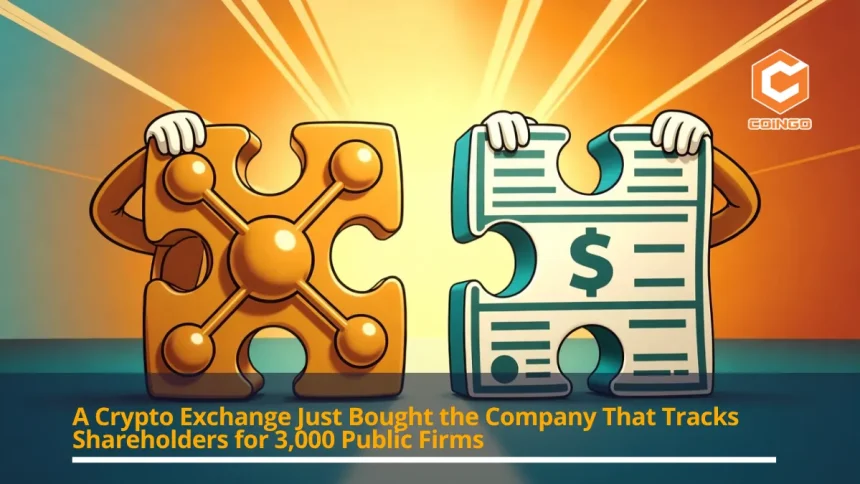
Bullish, the NYSE-listed crypto platform that also owns CoinDesk, agreed to acquire Equiniti for $4.2 billion on May 5. The transaction includes $1.85 billion in assumed debt and roughly $2.35 billion in Bullish stock priced at $38.48 per share. Equiniti is a regulated transfer agent serving nearly 3,000 public companies and over 20 million verified shareholders. It processes approximately $500 billion in annual payments.
This is the largest crypto-linked acquisition ever announced. Bigger than Coinbase buying Deribit for $2.9 billion. Bigger than Kraken’s $1.5 billion NinjaTrader deal. And it is not about buying another exchange. It is about buying the plumbing.
What a transfer agent does and why crypto wants one
Every publicly listed company needs a transfer agent. It is the entity that maintains the official record of who owns how many shares, processes dividend payments, handles corporate actions, and manages shareholder communications. Equiniti does this for blue-chip clients across the U.S. and UK, with SEC-registered and FCA-regulated operations.
Bullish’s thesis: tokenized securities need the same infrastructure. If you put a stock on a blockchain, someone still needs to track ownership, distribute dividends, and handle compliance. Right now that role does not exist in crypto. Equiniti fills the gap. Bullish CEO Tom Farley called tokenization “a once-in-a-generation shift” and said broad adoption requires three things: end-to-end tokenization services, a unified ledger, and issuer relationships at scale. “This combination delivers all three.”
The combined company: $1.3B revenue, $500M+ EBITDA
The numbers are not speculative. On a pro forma basis, the combined entity is expected to generate approximately $1.3 billion in adjusted revenue and over $500 million in adjusted EBITDA less capex for 2026. Bullish projects 6-8% annual revenue growth through 2029, with 20% growth specifically from tokenization and blockchain services. That last number is the one to watch. If tokenization revenue grows at 20% while the rest grows at 6%, the mix shifts fast.
Equiniti CEO Dan Kramer and the existing leadership team stay in place for day-to-day operations, regulatory obligations, and client relationships. Siris Capital, which bought Equiniti in 2021 and tripled its EBITDA during ownership, gets two board seats in the combined company. They also retain a call option to buy back “non-core” Equiniti business lines. Closing is expected January 2027, pending regulatory approvals.
DTCC, Goldman, and BlackRock are all moving on the same timeline
Bullish is not the only player making this bet. DTCC announced plans to launch tokenized securities with 50 major financial institutions by October. State Street and Galaxy just launched a tokenized cash fund on Solana. BlackRock’s BUIDL fund holds $2.6 billion in tokenized Treasuries and is fighting the OCC over a proposed 20% cap on tokenized reserves. Securitize just got FINRA approval to broaden its tokenized securities operations.
The pattern is clear. TradFi institutions are not experimenting with tokenization anymore. They are building the infrastructure to do it at scale. The CLARITY Act and GENIUS Act created the regulatory framework. Now the race is to own the pipes.
The CoinDesk angle nobody is talking about
Bullish bought CoinDesk in 2023. CoinDesk provides media, data, and research. Equiniti provides shareholder registry and corporate services. Bullish Exchange provides trading and liquidity. Stack all three and you get something that does not exist anywhere else: a vertically integrated platform that can issue a tokenized security, register shareholders, provide trading infrastructure, and distribute research about it, all under one roof.
Whether that vertical integration is a competitive advantage or a conflict of interest depends on who you ask. The platform will interoperate with existing infrastructure: DTCC, Euroclear, Clearstream, custodians, broker-dealers. It is designed to complement the traditional system, not replace it. At least for now.
$4.2 billion for a transfer agent. Two years ago that sentence would have made no sense. Today it might be the most important M&A deal in crypto’s history. Not because of the price tag. Because of what it says about where the money thinks blockchain infrastructure is actually going.