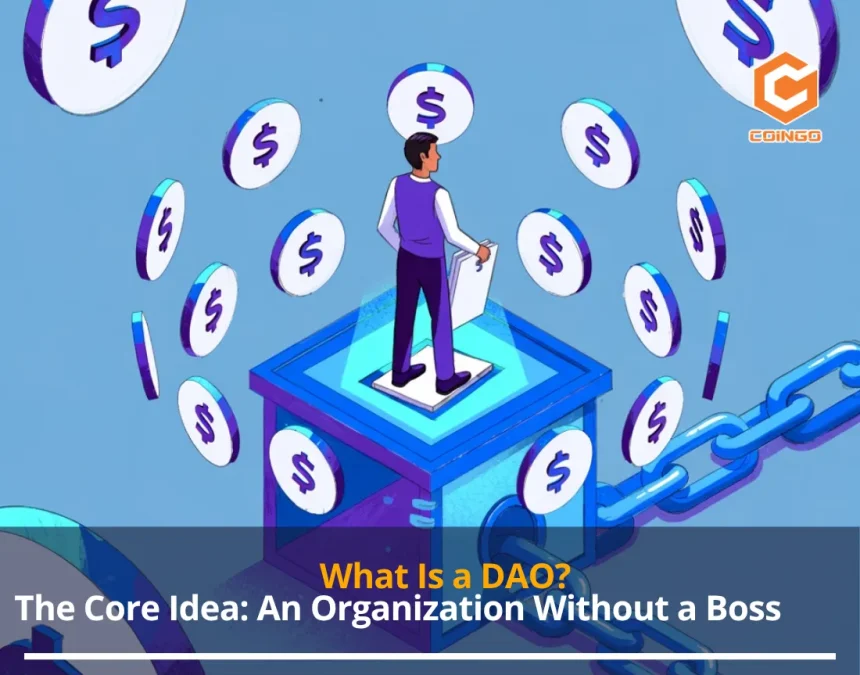
The Core Idea: An Organization Without a Boss
DAO stands for Decentralized Autonomous Organization. The name captures three distinct claims: that control is distributed rather than concentrated (decentralized), that core operations run automatically without human approval (autonomous), and that it constitutes a formal structure with rules, members, and a shared purpose (organization).
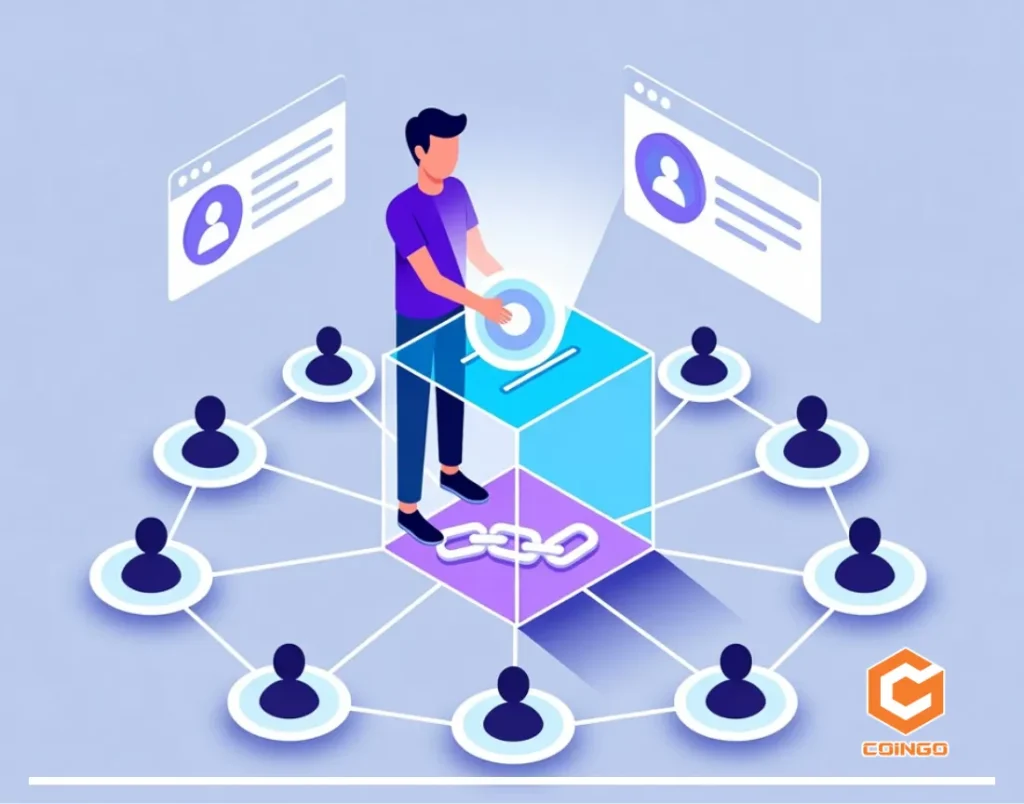
The simplest way to understand a DAO is to compare it to a traditional company. A company is a group of people following rules enforced by laws and courts. A DAO is a group of people following rules enforced by smart contracts on a blockchain. No CEO can override the contract. No board meeting is required to execute a vote. If the code says a proposal passes at 51% of votes, it passes — automatically, transparently, and without asking anyone’s permission.
- The Core Idea: An Organization Without a Boss
- How a DAO Is Built: Three Stages
- Governance Tokens: Votes, Rights, and Value
- The Treasury: How DAOs Control Capital
- Real-World Examples: What DAOs Actually Govern
- The Advantages DAOs Offer
- The Disadvantages DAOs Face
- The History That Shaped Everything: The DAO Hack of 2016
- What Comes Next: The State of DAOs in 2026
What makes this powerful is what it replaces: trust in individuals. In a traditional organization, you have to trust the people at the top to follow the rules. In a DAO, the rules are the top. Anyone can read the smart contract code. Anyone can verify the treasury balance. Anyone can see every vote that was cast and what it decided.
How a DAO Is Built: Three Stages
Building a DAO follows a structured sequence. The process is not instantaneous — moving from an idea to a fully autonomous organization typically takes months, sometimes years.
Stage 1: Writing the smart contracts. A core founding team writes the rules that will govern the DAO into smart contract code. This includes how proposals are created and voted on, what percentage of votes is required to pass different types of decisions, how the treasury is managed, who can participate, and how the rules themselves can be changed. This code is tested extensively before deployment because once it is live on a blockchain, it is extremely difficult to modify — and any bugs are public and potentially exploitable.
Stage 2: Acquiring funding and creating stakeholders. The DAO needs capital to operate and it needs people who have a stake in its success. This is typically done by minting governance tokens and distributing them — through sales, airdrops, contributor rewards, or liquidity mining. Token holders become the DAO’s voters. This stage is critical because a DAO without a distributed and engaged stakeholder base will be governed by a small group of large holders, which undermines the decentralization claim.
Stage 3: Deploying full autonomy. Once the community is established, the founding team deploys the remaining smart contracts that hand control to the token holders. From this point forward, the founders cannot unilaterally change the protocol, spend the treasury, or override a community vote. Every significant decision goes through the governance process — open to all token holders, recorded on-chain, and executed automatically when passed.
Governance Tokens: Votes, Rights, and Value
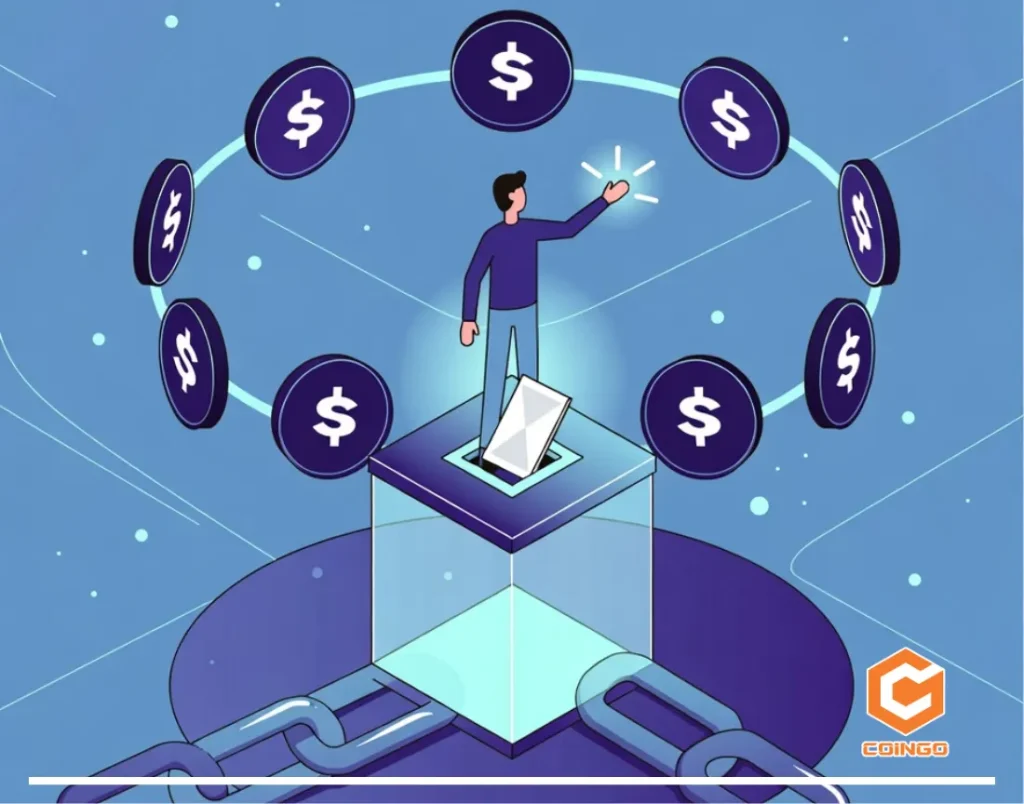
The governance token is the primary mechanism through which DAO members exercise control. Holding a governance token typically grants the right to submit proposals, vote on existing proposals, and delegate votes to others.
Most DAOs use a one-token-one-vote model, which means larger holders have proportionally more influence. This is a persistent source of criticism — in practice, a small group of early investors or insiders often hold enough tokens to pass or block any proposal they choose. Some DAOs have experimented with quadratic voting (where the cost of each additional vote increases, giving smaller holders more relative power) or conviction voting (where votes accumulate over time, rewarding sustained commitment).
Governance tokens frequently have a market price, which creates a second dimension to token ownership: they can be bought and sold by anyone. This means a determined actor can accumulate enough tokens on the open market to gain outsized governance influence — a phenomenon known as a governance attack. The most significant historical example was Beanstalk Protocol in 2022, where an attacker took out a flash loan, used it to acquire a supermajority of governance tokens, passed a malicious proposal, and drained $182 million from the treasury — all in a single transaction.
The Treasury: How DAOs Control Capital
Most significant DAOs maintain a multi-signature treasury — a shared wallet that requires approval from multiple designated signers before any funds can be moved. Treasury funds are typically held in a mix of the DAO’s native token, stablecoins, and other crypto assets.
The scale of DAO treasuries reached extraordinary levels during the 2021-2022 bull market. At peak, the combined treasury holdings of the top 10 DAOs exceeded $20 billion. By early 2026, that figure had contracted significantly — both from market prices falling and from spending on operations, grants, and development — but top protocols like Uniswap, Arbitrum, and Aave still hold hundreds of millions in their treasuries.
Treasury management has become one of the most contested areas of DAO governance. Key debates include: how much to diversify away from the native token (which is subject to price volatility), how much to allocate to contributors versus protocol development, whether to generate yield on idle assets, and how transparent spending should be. The answers differ widely across DAOs and reflect fundamental differences in governance philosophy.
Table 1 — Major Active DAOs by Treasury Size and Focus (April 2026)
| DAO | Focus | Treasury (est.) | Governance Token |
|---|---|---|---|
| Uniswap | DEX protocol | $3.5B+ | UNI |
| Arbitrum DAO | Layer 2 network | $2.5B+ | ARB |
| Aave | DeFi lending | $1.5B+ | AAVE |
| MakerDAO (Sky) | Stablecoin issuer | $1B+ | MKR/SKY |
| Compound | DeFi lending | $500M+ | COMP |
What Is DeFi? Decentralized Finance Explained
Real-World Examples: What DAOs Actually Govern
DAOs are not an abstract concept. They govern some of the most important infrastructure in decentralized finance and have made decisions worth hundreds of millions of dollars.
Uniswap DAO controls the fee switch on the world’s largest decentralized exchange. For years, the DAO debated whether to activate a fee mechanism that would route a portion of trading fees to token holders rather than liquidity providers. The debate involved competing economic models, legal concerns about securities classification, and genuine disagreement about the protocol’s long-term priorities. It took multiple proposals, years of discussion, and a significant governance overhaul before the fee switch was piloted in 2024.
MakerDAO — now rebranded as Sky — governs the DAI stablecoin, which at peak had billions in circulation backing DeFi across multiple chains. MakerDAO governance has had to respond in real time to market crises, including the March 2020 Black Thursday collapse where undercollateralized vaults required an emergency governance vote to recapitalize the protocol. Its treasury management evolution — including a major pivot to tokenized real-world asset collateral that now generates the majority of the protocol’s revenue — is the most sophisticated example of DAO treasury strategy in production.
Aave governance recently navigated the departure of three of its core contributor teams — ACI, BGD Labs, and Chaos Labs — in rapid succession, with each exit citing governance disputes with Aave Labs. The episode is a live case study in the tensions that arise when a DAO’s formal governance structure conflicts with the de facto influence of the entity that manages the brand and development roadmap.
Nouns DAO is a different model entirely: it auctions one NFT every day, with proceeds going to the treasury, and every NFT holder has one vote. As of 2026, Nouns DAO has accumulated a substantial treasury and funded an unusually diverse range of projects — from short films to public goods to physical installations — through a fully open grant process.
The Advantages DAOs Offer
Transparency that cannot be faked. Every proposal, vote, and treasury transaction is recorded on-chain and publicly readable. There is no back-room dealing that can remain hidden from the community — at least not through the formal governance system. Anyone with a wallet can verify what the DAO has decided and how funds have moved.
Permissionless global participation. A DAO can include contributors from any country without incorporation paperwork, banking relationships, or employment contracts in a shared jurisdiction. This enables genuinely global organizations to form and coordinate in ways that traditional legal structures make prohibitively complex.
Composability. Because DAO smart contracts are open source, a new project can fork a successful DAO’s governance framework, combine mechanisms from multiple existing systems, or build tools that interact directly with existing DAO contracts. Governance infrastructure is not built from scratch each time — it compounds.
Treasury security without trusted intermediaries. Multi-sig treasury management means no single individual can unilaterally access the funds. For organizations managing hundreds of millions in assets, this is a meaningful security improvement over the trust-based models that dominate traditional finance.
The Disadvantages DAOs Face
Governance attacks. If governance tokens can be bought on the open market, they can be acquired in large quantities by anyone with enough capital — including attackers. Flash loan exploits have enabled attackers to borrow enormous sums, acquire temporary governance supermajorities, pass malicious proposals, and drain treasuries within a single transaction. Defending against this requires careful parameter design and, often, time locks that delay proposal execution.
Voter apathy. Most DAOs struggle with low participation in governance votes. The majority of token holders do not vote on most proposals. This concentrates effective power in the hands of whales and active contributors, regardless of how the formal voting system is designed. Some DAOs have moved toward delegation systems — where passive holders assign their votes to active community members — but this recreates representative governance structures that the DAO model was supposed to replace.
Slow decision-making during crises. The original DAO hack in 2016 — where an attacker exploited a reentrancy bug and drained 3.6 million ETH — was known before it was fully exploited. The community was too slow to coordinate an emergency response. The same pattern has repeated across DeFi: governance processes designed for deliberate, multi-day voting are poorly suited to attacks that unfold in minutes. This is why most major protocols maintain some form of emergency multisig with the authority to pause or limit functionality without going through a full governance vote.
Legal uncertainty. DAOs exist in a legal gray zone in most jurisdictions. When things go wrong — whether a hack, a regulatory action, or a dispute between contributors — there is often no clear answer about who is liable, which court has jurisdiction, and what law applies. Some US states (Wyoming, Vermont, Marshall Islands) have passed DAO-specific legislation, but the frameworks are limited and largely untested. Most DAOs operate with significant unresolved legal exposure.
The plutocracy problem. Token-weighted voting means money equals power. In practice, early investors, founding teams, and institutional holders often control enough governance tokens to pass or block anything they choose. The promise of decentralization frequently masks a governance structure that is more concentrated than it appears.
Table 2 — DAO Governance Models Compared
| Model | How It Works | Key Tradeoff |
|---|---|---|
| Token-weighted voting | 1 token = 1 vote | Simple but plutocratic — large holders dominate |
| Quadratic voting | Cost of votes rises quadratically | More equitable but gameable via wallet splitting |
| Delegated voting | Passive holders assign votes to delegates | Improves participation but recreates representative structures |
| Conviction voting | Votes accumulate over time | Harder to game but slow for urgent decisions |
| NFT-based voting | One NFT = one vote | Equal voice per holder but barrier to entry via NFT cost |
The History That Shaped Everything: The DAO Hack of 2016
No account of DAOs is complete without the story of The DAO — the original, which became a cautionary tale that still shapes the industry.
In April 2016, a project called The DAO launched on Ethereum, raising $150 million in ETH through a token sale — the largest crowdfunding campaign in history at the time. It was designed as a decentralized venture fund: token holders would vote on which projects to fund with the treasury.
In June 2016, an attacker exploited a reentrancy vulnerability in the smart contract. The bug allowed the attacker to call the withdrawal function repeatedly before the contract updated the balance, effectively draining funds in a loop. Approximately 3.6 million ETH — about $60 million at the time — was siphoned into a child DAO.
The Ethereum community faced an unprecedented decision. The attacker had not technically broken any rules — they had followed the code exactly as written. But the code had a bug. After intense debate, the community voted to execute a hard fork of Ethereum — rolling back the blockchain to a point before the attack and redirecting the stolen funds. A minority of the community refused and continued the original chain, which became Ethereum Classic (ETC).
This episode established several principles that still govern how the industry thinks about DAOs. First: code is not law — communities will intervene when the stakes are high enough. Second: smart contract audits are not optional for protocols holding significant value. Third: decentralization does not protect against the human element of coordination failures.
What Comes Next: The State of DAOs in 2026
DAOs have matured significantly since 2016. The tooling is better — governance platforms, treasury management systems, and contributor payment infrastructure have all professionalized. The frameworks are more sophisticated — most major protocols now have structured delegation systems, emergency multisig overrides, and time-locked execution.
But the fundamental tensions have not been resolved. Voter apathy remains endemic. Governance attacks remain a live threat. The legal status of DAOs in most jurisdictions remains deeply uncertain. And the concentration of token ownership in early insiders continues to undermine the decentralization that DAOs promise.
The most interesting frontier is the question of what DAOs should govern. Early DAOs focused on DeFi protocol parameters — interest rates, collateral ratios, fee levels. The next wave is broader: DAOs governing layer 2 networks with billions in TVL, DAOs managing real-world asset portfolios, DAOs funding public goods research and open-source development. As the scope expands, the governance challenges scale with it.
A DAO is not a magic decentralization machine. It is a tool — one that distributes power according to how its rules are written and how its tokens are distributed. Understanding those rules, and who holds those tokens, is the actual measure of how decentralized any given DAO actually is.